

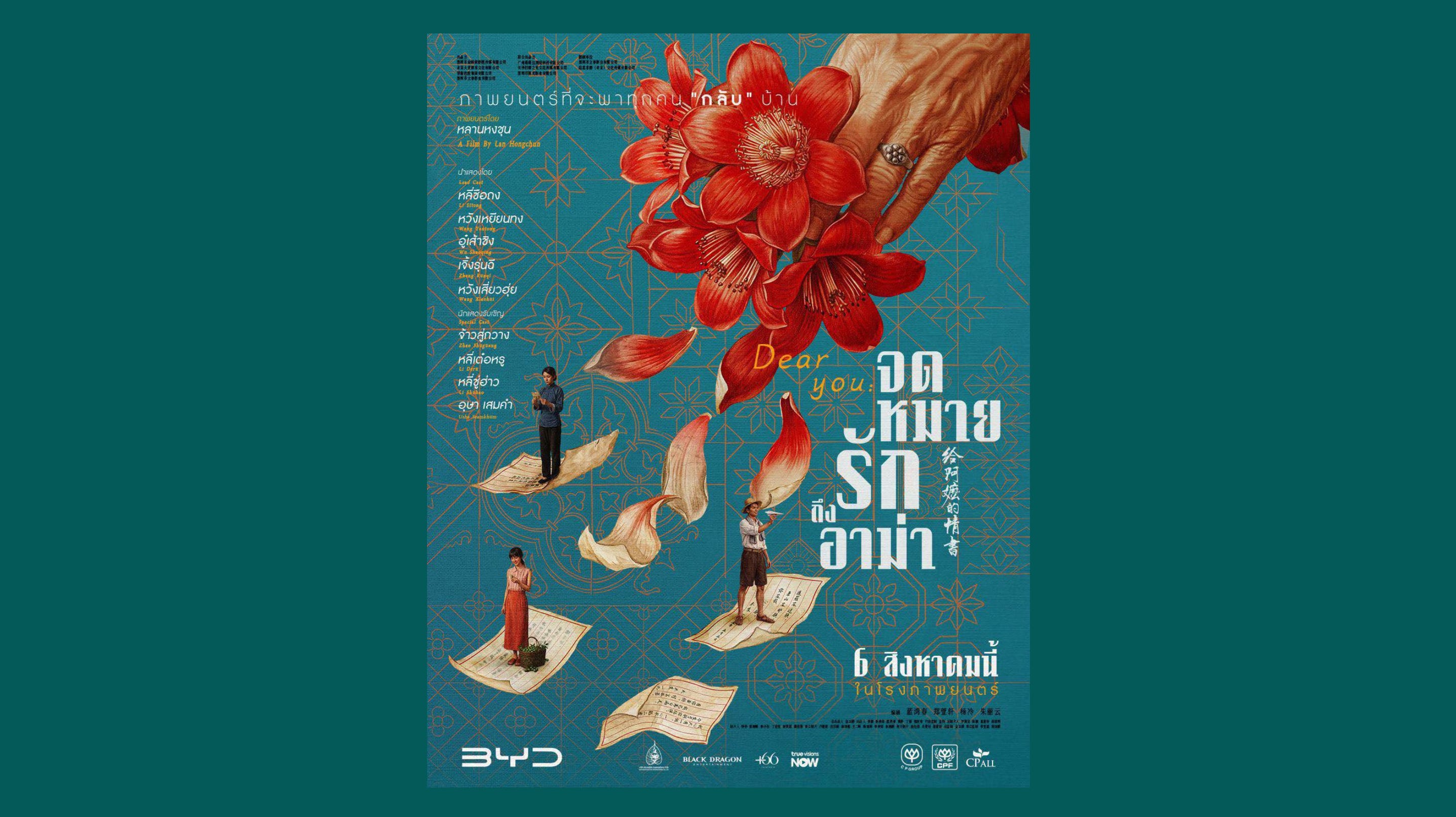
Something different today…a film recommendation!
Ask a Thai person of Chinese descent where their ancestors are from, and more often than not you will hear somewhere in the Teochew dialect-speaking Chaoshan region in Guangdong province. During the upheavals that overtook China from the late Qing Dynasty to the establishment of the People’s Republic, a wave of emigrants left Chaoshan to establish a new life in Southeast Asia, including Thailand. Today, over half of Thai-Chinese are Teochew in ancestral origin.
Despite the outsized influence of Teochew in Thailand, however, the dialect is relatively obscure in China. One estimate says that only about 14 million people in Chaoshan speak the language natively1 — in a country of 1.4 billion people. The city of Shantou, from where many Thais can trace their roots, is the poorest-performing of the three original special economic zones, with its dialect isolating it from the rest of the country. So it was a surprise when Dear You, a film made in Teochew, became one of China’s biggest hits this year. As CGTN said, for a Teochew film to experience this level of success was “unprecedented.” By June, it had become China’s second-biggest hit this year, grossing almost 2 billion yuan despite being made on a budget of just 14 million yuan and featuring a largely unknown cast of non-professional actors.
Dear You is reminiscent of the success of How to Make Millions Before Grandma Dies2 (which I wrote about here last year). But unlike the latter, which follows the story of later generations of Thai Chinese who have become firmly established in Bangkok, the former focuses on the struggles of first-generation Teochew immigrants who just freshly arrived from China.
The film is about Den Bhagseng, a Teochew immigrant in Siam who fled conscription during the Chinese Civil War to try to make a new life in Bangkok’s Chinatown, but uses letters to keep in touch with his wife Sogriu in China. Today Shantou and Bangkok are easily connected by flight; back then it was an arduous journey by sea. Not quite The Odyssey, perhaps, and certainly no cyclopes are waiting. But enough to make constant travel back and forth unfeasible. Viewers are thus introduced to the qiaopi, letters and remittances from overseas Chinese sent back to families left behind in China. At a time when Chinese immigrants often arrived in Siam with just, as the traditional saying goes, “a mat and a pillow,” they worked hard to send money back to their families in Chaoshan.
I think that Dear You is a film that feels special in Thailand because it feels like taking a time machine. You can read books about the exodus from China during its century of humiliation, of course — Jeffrey Sng and Pimpraphai Bisalputra’s A History of the Thai-Chinese was just recently translated into Thai — yet there is something different about seeing it played out on the big screen. It appears that this film is especially emotionally resonant to the older generation who still remembers their parents or grandparents sending qiaopi. For a younger generation of Thai-Chinese, this part of the family history is now largely forgotten, but at least in this film it has been brought back to life. And for many, it is the first time they may have watched a Teochew film (although even older people in Thailand who still understand some Teochew were unable to understand the Teochew spoken by the Chinese actors — Thais’ Teochew having been frozen in time while Teochew in Chaoshan evolved!)
But Dear You also poses interesting questions of identity. Outside of Thailand, the film has become politically charged. It sparked controversy in Singapore, where a decades-long government campaign to push aside Chinese dialects in favor of Mandarin led the limiting of screenings of the film in Teochew. This was not a popular decision. Singaporeans argued that the dialects had already been marginalized to the point where they pose little threat to the ability to acquire Mandarin; one professor told the BBC the uproar felt like “grieving a loss” of ancestral dialects.
It is a comment that makes me think of Thailand, where the of Chinese dialects has become far more complete that strangely enough limits this sense of loss. After all, you cannot lose what you never really had. I personally know of not even a single person in their 20s who can understand or speak Teochew with any fluency. No, that ability virtually declined significantly a generation previously, one long-term consequence of Field Marshal Plaek Phibunsongkram having closed down Chinese schools in the 1930s, and among my generation is essentially extinct. Today, anyone who wants to study the Chinese language today will do so in Mandarin — although of course, few of the ancestors of most Thai-Chinese spoke Mandarin.
A writer in Singapore’s Chinese-language newspaper Lianhe Zaobao had called the film a “United Front” film.3 (Predictably, this claim drew criticism from mainland Chinese papers). But Thailand probably has the most well-assimilated community of overseas Chinese anywhere in the world, all of its members having long ago prioritized the Thai identity and scarcely identifying as anything more than culturally Chinese in some sense. Ironically, then, the fact that Thailand’s nation-building project has been so successful in assimilating the Thai-Chinese means that Dear You can pose little danger. It is for Thais more a window to historical discovery than the catalyst for any awakening of a latent identity that threatens to overcome the primary national one.
If you are Thai-Chinese and are interested in the stories of ancestral origins that is quickly receding into an unreachable past, this film is worth a watch. And even if you are not, but have any curiosity in the roots of a significant segment of the Thailand’s citizenry, Dear You would be worth your time.
Dear You actually features an appearance by Usha Seamkhum, who plays the role of the grandmother in How to Make Millions Before Grandma Dies.
Without going too deeply into Communist Party terminology, the United Front Department in China manages, among other things, relations with overseas Chinese.
That was an interesting read and I was particularly interested in what you said here: “But unlike the latter, which follows the story of later generations of Thai Chinese who have become firmly established in Bangkok, the former focuses on the struggles of first-generation Teochew immigrants who just freshly arrived from China.”
I wrote a piece for the SCMP a few years back and I identified this group of immigrants that came from China like Dhanin Chearavanont, a descendant of Chinese immigrants and chairman of conglomerate the CP Group: “The pioneers were among an influx of Chinese immigrants, who famously came to Thailand with little more than the shirts on their backs – a plight Thais refer to as seaua peun, mawn bai, or ‘one rug and one pillow’.” https://www.scmp.com/lifestyle/food-drink/article/2113771/bangkok-street-food-vendors-removal-sparks-debate-about
As a descendant of Chinese origin yourself, I’m wondering how you feel about the recent anger among many Thais regarding the scams, the influx of new AI data centres and of course the usual corruption along with the pollution caused by Chinese companies? In my almost 3 decades of living in Thailand, there’s always been a bit of back-and-forth regarding the influence of China in Thailand but just recently it seems to have escalated enormously.
Any thoughts on this?
Thanks again. 🙏