
An Observer's Guide to Thai Politics
Getting started with watching Thai current affairs


New to Thai politics? Start here!
Getting into the role of a Thai political observer has a certain barrier to entry. Thai politics can feel like a very complicated business: ever-changing, a massive cast of characters, too many parties to count…the issues go on! If you want to understand politics in Thailand but find everything a bit overwhelming, this guide is the place to start.
Last updated: April 2026.
Thailand’s Governance in a Nutshell
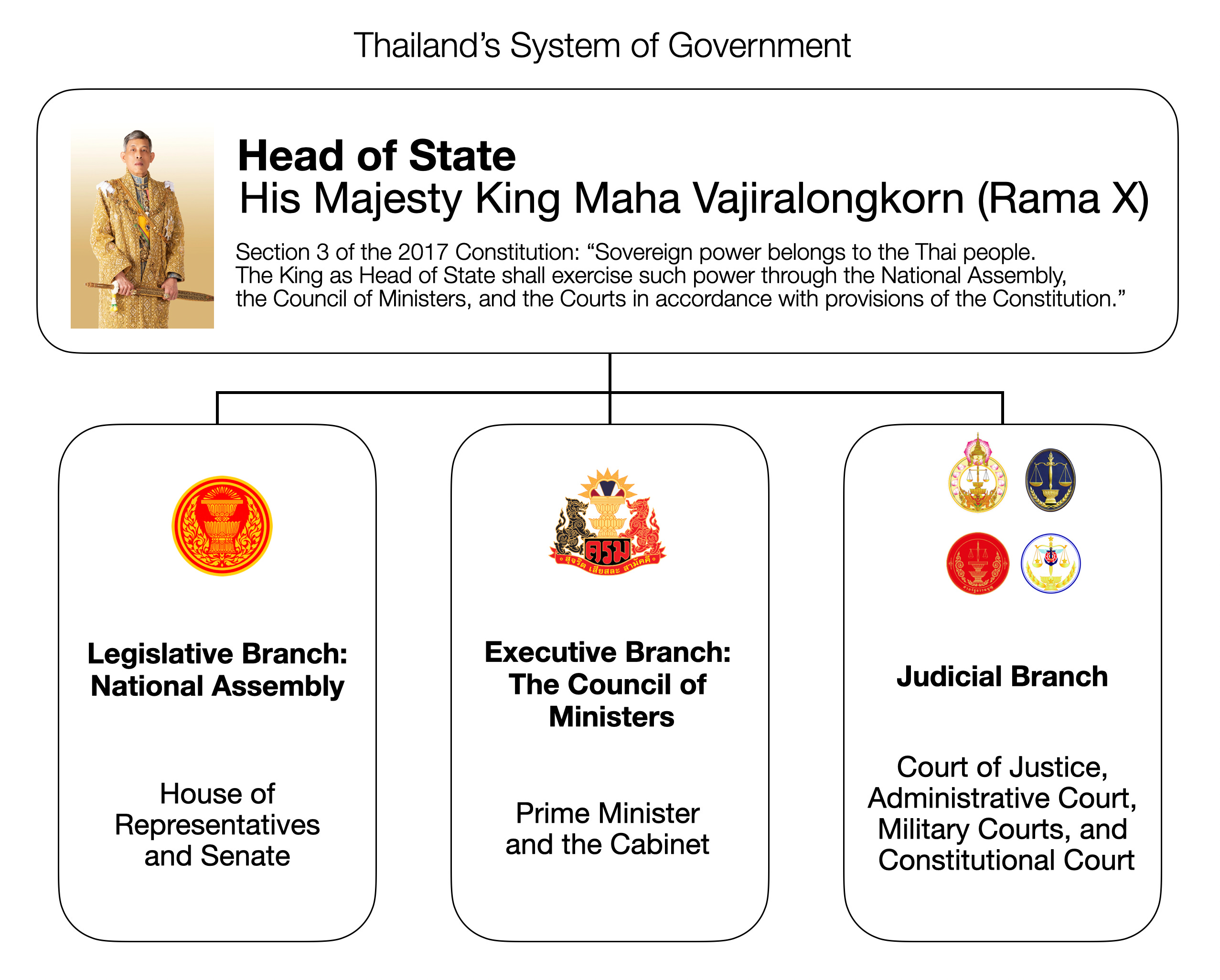
Thailand is a constitutional monarchy with a parliamentary democracy. Section 2 of the Constitution describes Thailand’s political system as “a democratic regime of government with the King as Head of State.”
The core pillar of the state is the Thai monarchy. In 1782, the reigning Chakri Dynasty was founded with the establishment of Bangkok as the national capital. The 1932 Revolution resulted in the transition from absolute to constitutional monarchy. Thailand’s kings have traditionally been viewed as semi-divine, and today the monarchy continues to be an important source of legitimacy. The previous monarch, King Bhumibol Adulyadej, was Thailand’s longest-serving king and steadily acquired moral authority over his reign of seventy years. King Bhumibol was succeeded in 2016 by his son, King Maha Vajiralongkorn. The institution is protected by a lèse majesté law1.
Power is exercised through the following major institutions of state:
Executive authority is vested in the Council of Ministers, which is headed by the Prime Minister. Since 1932, there has been 31 prime ministers. The incumbent is Paetongtarn Shinawatra, who assumed the post in 2024. Constitutionally, the Prime Minister can serve up to eight years in office (each parliamentary term lasts four years). The current prime minister is Anutin Charnvirakul.
Legislative authority is vested in the National Assembly, which consists of the House of Representatives (the lower house) and the Senate (the upper house). The House of Representatives has the authority to select a Prime Minister, to pass no-confidence motions, to make laws, and to scrutinize the work of government. The Senate, in addition to law-making powers, gets a say in the appointment of officials to the Constitutional Court and to other independent agencies. More on how parliament is elected and its powers below.
Judicial authority is vested in the Courts. There are four distinct courts: the Court of Justice, the Administrative Court, the Military Courts, and the Constitutional Court. Politically, the most influential is the Constitutional Court, which has jurisdiction over constitutional matters and whose ruling is binding over all state organs. The Administrative Court also has a prominent role as it adjudicates cases involving misuse of power and negligence.
However, the democratic system remains a work in progress in Thailand. Democracy has been repeatedly suspended by the military, with nine successful military coups occurring since the transition to constitutional monarchy in 1932. (In fact, Thailand has been called the most coup-prone country in the world). As a result, Thailand has often oscillated between periods of military rule and democratic politics.
Electoral System
The House of Representatives is composed of 500 members. 400 are elected through first-past-the-post in single-member districts. 100 are elected via the party list proportional representation system, where parties submit a national list of candidates. As such, during parliamentary elections voters will cast two ballots: one for the constituency Member of Parliament (MP) and one for the party-list. Before the elections, each political party can also submit up to three candidates for prime minister; the House of Representatives can only select a prime minister from this list of candidates submitted2. See the section on ‘Major Players and Parties’ for the current composition of the House of Representatives. Each parliamentary term lasts a maximum of four years, although the prime minister can dissolve the House of Representatives earlier than that.
The Senate is composed of 200 members. They are elected through self-selection process, where candidates from different professional groups vote amongst themselves. See here for how this complicated process works. The Senate is theoretically a non-partisan body, but as of May 2025 investigations are ongoing about whether or not a sizable majority of senators are under the sway of the Bhumjaithai Party3.
A Brief History of 21st Century Thai Politics
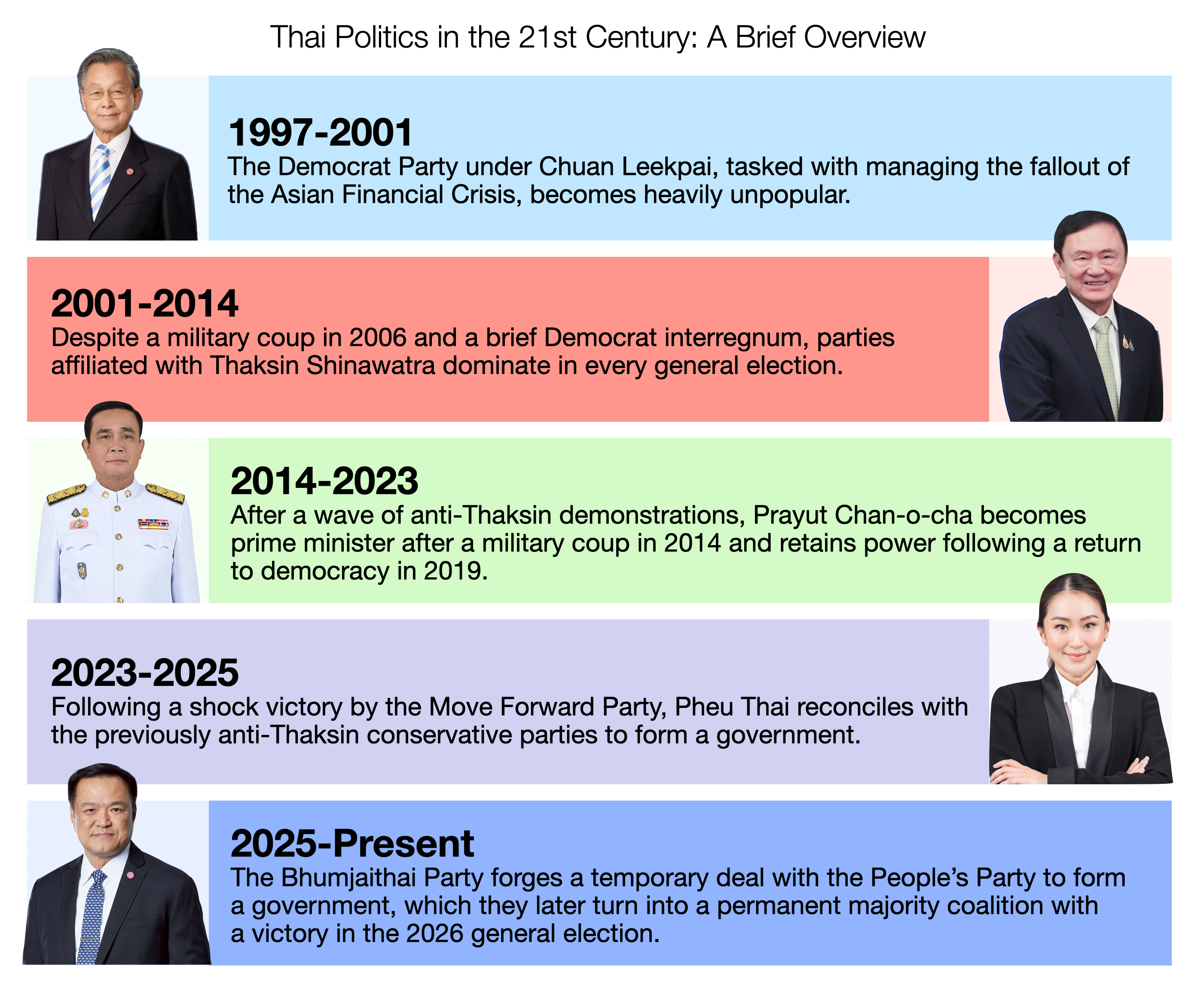
In the first twenty years of the 21st century, Thai politics revolved around political conflict between Thaksin Shinawatra and his network, against the conservative, military-aligned establishment. A new constitution introduced in 1997 was designed to create stronger governments; in the same year, Thailand became the center of the Asian Financial Crisis. The Democrat Party government that came to power was tasked with doling out the International Monetary Fund-prescribed "bitter medicine" of austerity, making it deeply unpopular.
Under this perfect storm of conditions, Thaksin swept to power in 2001. The billionaire Thaksin became highly popular with poorer, more rural communities by enacting redistributive policies such as universal healthcare and village subsidies, but establishment figures along with the middle and upper class increasingly disliked his populist style4 and illiberal politics5. A military coup was launched in 2006 that removed Thaksin from power and he fled to self-imposed exile abroad after being charged with corruption. Thaksin’s Thai Rak Thai Party was dissolved, but his allies regrouped as the Palang Prachachon Party and won the next set of elections.
Judicial intervention, however, dissolved Palang Prachachon as well and removed the Thaksinites from power once more, which allowed the anti-Thaksin Democrat Party under Abhisit Vejjajiva to assume power in 20086. This period became marked by constant political instability, as Thaksin’s supporters (the red shirts) and his opponents (the yellow shirts) held numerous demonstrations. In 2011, Thaksin’s sister Yingluck Shinawatra won an election and allowed his Pheu Thai Party (the current incarnation of Thaksin’s successor parties) to form a government.
Yet anti-Thaksin protestors once again took the streets, after a botched attempt by the Pheu Thai government to introduce an amnesty bill that would have cleared Thaksin’s charges, and the increasingly chaotic political situation led to another military coup in 2014. The army commander, General Prayut Chan-o-cha, assumed power and governed as Prime Minister for nine years (five with virtually absolute powers). His government drafted a new constitution in 20177 with a special temporary provision that allowed unelected senators appointed by the military regime to join the elected lower house in selecting the next prime minister8. This helped Prayut form another government after calling for elections in 2019, despite the Pheu Thai Party winning the most seats9.
During the Prayut era, a third camp emerged in politics: the progressives led by Thanathorn Juangroongrueangkit. His progressive Future Forward Party called for fuller democratization and de-militarization, but was dissolved by the courts in 2020. That became the spark for mass protests against the Prayut government and the military’s constitutional engineering, and later into demonstrations calling for reform of the Thai monarchy. Although the protests were ultimately unsuccessful, Future Forward’s successor party, the Move Forward Party, won an upset victory at the 2023 general election and pushed the Thaksinites to a second-place popular vote finish for the first time, while the fractured conservatives were relegated to a third force.
The results of the 2023 general election forced the conservative camp, which had previously been virulently anti-Thaksin, to forge a grand compromise with Pheu Thai. Pheu Thai has governed in coalition with several conservative parties since then. Thaksin returned to Thailand that same year and served out his prison sentence in the Police General hospital before receiving a royal pardon; although he has no official government role, he is highly active politically. The compromise allowed first Srettha Thavisin and later Thaksin’s daughter, Paetongtarn Shinawatra to become prime minister. The Move Forward Party was dissolved by the courts in 2024 over its campaigning for amendment of the lèse majesté law, and replaced by the successor People’s Party.
A controversial phone call between Paetongtarn and the Cambodian strongman Hun Sen in mid-2025 led to her eventual removal by the Constitutional Court. This led to the collapse of the 2023 grand compromise. Bhumjaithai forged a temporary deal with the People’s Party to form a minority government and remove Pheu Thai from power. In 2026, Prime Minister Anutin Charnvirakul led Bhumjaithai to an outright election victory and formed a new government. Amidst all this, Thaksin Shinawatra was returned to prison after a court found that he had not properly served his sentence.
Major Players and Parties
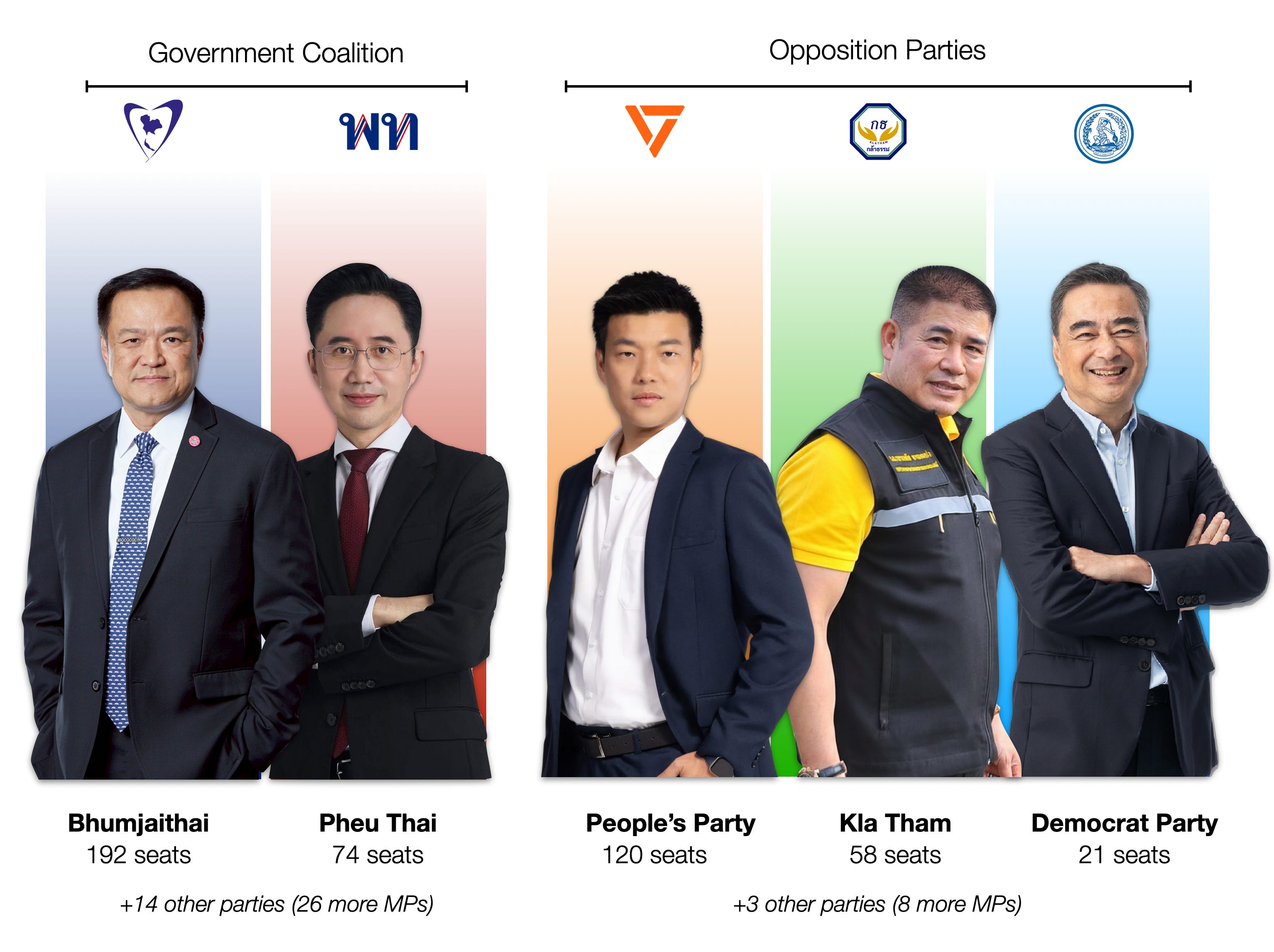
251 seats are needed for a majority. The government currently holds 293 seats.
The current major parties are:
Overall, Thai politics after 2023 can be characterized as being composed of three major camps:
Conservatives, a camp guided by a commitment to defending the constitutional status quo and traditional institutions such as the monarchy
Progressives, a camp that prioritizes constitutional revision and call for reforms to the military and the monarchy.
Thaksinites, a camp oriented around Thaksin Shinawatra
GOVERNMENT COALITION
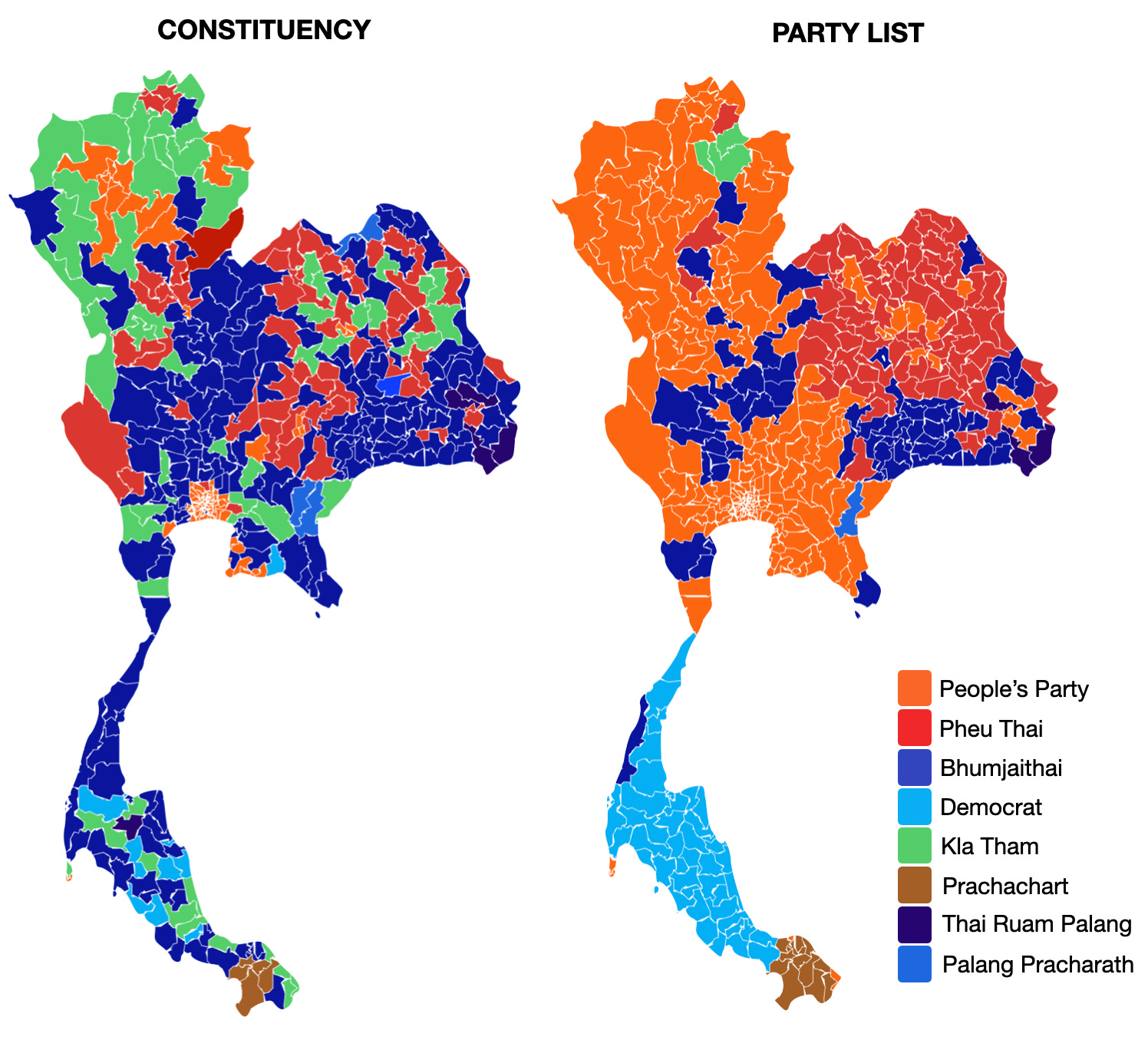
Bhumjaithai: Led by Prime Minister Anutin Charnvirakul. Previously a localist party with a stronghold in Buriram province, a steady acquisition of local MPs allowed the party to win local seats across the country in 2026. Although originally seen as ideologically flexible, Bhumjaithai has refashioned itself as a strongly conservative and royalist party. (192 seats) (Conservative)
Pheu Thai: Pheu Thai is the second biggest party in the coalition, with Thaksin’s nephew Deputy Prime Minister Yodchanan Wongsawat its most senior figure in government. Previously a dominant electoral force, Pheu Thai achieved its worst-ever election result in 2026. The party counts the north and the northeast as its strongholds. (74 seats) (Thaksinite)
OPPOSITION
People’s Party (Thai name: Prachachon): Led by Nattapong Rueangpanyawut, who also serves as Leader of the Opposition. Successor to the Future Forward and Move Forward parties, the PP continues to advocate for progressive social and economic policies, and the party has pledged to continue calling for constitutional reform. The party under-performed expectations and came in second in the 2026 general election. (120 seats) (Progressive)
Kla Tham: Led by Captain Thammanat Prompow. Kla Tham primarily focuses on shoring up its local constituency strength and is focused on agricultural policies. The party had previously been allied with Bhumjaithai but was unexpectedly relegated to the opposition after the general election. Kla Tham is particularly strong in northern Thailand. (58 seats) (Alignment unclear)
Democrat (Thai name: Prachathipat): Led by former prime minister Abhisit Vejjajiva. The oldest political party in Thailand and previously the bastion of anti-Thaksinism, the party’s electoral standing suffered as other conservative parties emerged. The return of Abhisit as party leader has revived the party and ensured that the party did well enough in 2026 to fight another day. Southern Thailand has been the party’s traditional stronghold. (21 seats) (Conservative)
The map below shows the results of the latest general election, held in 2026.
Local Politics
Thailand is composed of 77 provinces. Of these, one (Bangkok) is governed as a special administrative region, with the Governor of Bangkok being directly elected. The current Governor of Bangkok is Chadchart Sittipunt, an independent who previously ran for prime minister with Pheu Thai. Bangkok also votes for members of the Bangkok Metropolitan Assembly, which serves as the city council.
Other provinces are run via a parallel governance system, with appointed officials selected by the Ministry of the Interior and elected officials directly elected by the citizens of that province. Voters can select the Chairman and Councillors of the Provincial Administrative Organization (PAO), mayors (in urban communities), the Chairman and Councillors of the Provincial Subdistrict Organization (SAO) (in communities that are not governed as a municipality), and village chiefs. Traditionally, political parties have not been overtly involved in local elections, but this is changing.
Foreign Policy
A long-held tradition in Thai foreign policymaking is to be "a bamboo bending in the wind," and balance between multiple great powers, a tradition that continues today as it attempts to maintain good relations with both the United States and China. While Thailand is the oldest US treaty ally in Asia, relations with the US relations cooled in the aftermath of the 2014 military coup, and instead Thailand moved closer to China. Former prime minister Prayut Chan-o-cha referred to China as Thailand’s “number one partner” in an interview with TIME magazine. Thailand is a founding member of the Association of Southeast Asian Nations (ASEAN).
Further Reading
Deeper analysis on the dynamics of the 2023 Grand Compromise.
And of course, if you’re looking for the latest analysis on Thai current affairs, please consider subscribing to The Coffee Parliament!
Section 112 of the Criminal Code states: “Whoever, defames, insults or threatens the King, the Queen, the Heir-apparent or the Regent, shall be punished with imprisonment of three to fifteen years.”
However, only prime minister candidates from parties that have gained at least 25 seats are eligible for the post.
Per The Nation, 138 senators are suspected of “acting under the influence of a specific political party”
In Thailand, the word “populism” (prachaniyom) has usually been used to refer to policies viewed as redistributive; the term has connotations of being fiscally irresponsible.
Critics accused Thaksin of abuse of power, cronyism, corruption, and human rights violations.
The Democrats convinced smaller coalition parties that previously allied with Thaksin to switch sides, but there are allegations that the military helped broker this deal.
Constitution drafting has almost become a minor industry in Thailand, given how often it occurs. Military coups are usually followed by the drafting of a new constitution. Counting both interim and permanent constitutions, the 2017 Constitution is Thailand’s 19th since 1932.
This temporary provision has now expired and the Senate is now indirectly elected through a different method; see the section on the Electoral System.
Technically Prayut did successfully assemble a coalition with a lower house majority, but the presence of the 250 senators (which voted en masse for Prayut) was seen as an insurmountable challenge for the Pheu Thai-led opposition.