

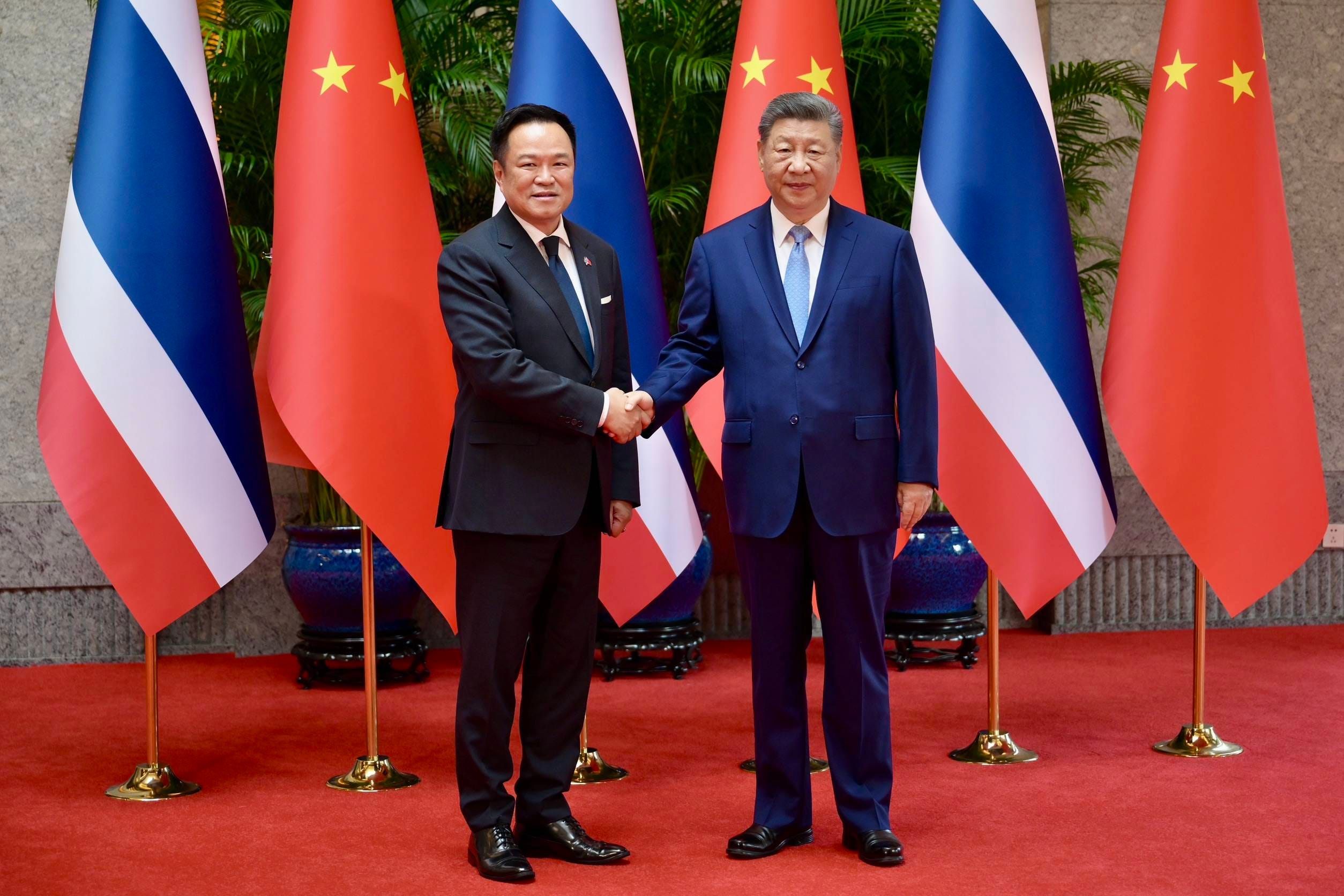
Prime Minister Anutin Charnvirakul made an official visit to China from July 16 to July 20. Although Anutin previously visited China when he accompanied His Majesty the King on his state visit last year, this was Anutin’s first official visit as prime minister.
I’ve summarized some of the interesting takeaways from this trip here.
AI takes center stage
Anutin attended China’s 2026 World AI Conference, where Xi urged that AI development “not be a solo performance by a single country, but a symphony of international cooperation.” As Brookings fellow Kyle Chan summarizes, China (which has championed open-source AI development) is contrasting America’s “closed system where power and profits flow back to American corporations” with China’s “open system where everyone, including the Global South, can participate and benefit.” In other words: “the US is Apple and China is Android.”
Interestingly, it doesn’t appear that Thailand actually provided a full endorsement of Xi’s vision on AI. For his part, Anutin gave a rather anodyne speech where he called for AI cooperation based on the principles of “Protection, Potential, and Prosperity.”1 Most interestingly, Thailand was not among the 29 countries that signed the agreement to create a World Artificial Intelligence Cooperation Organization as proposed by Xi. I am not still not sure how to square this; Anutin was clearly one of the guests of honor at China’s AI summit, but for some reason Beijing was willing to tolerate Thailand’s decision not yet to become a full-fledged member of the WAICO.
The Cambodian subtext
Cambodia did feature in the discussions between Anutin and Xi, however, with Xi offering to facilitate further talks between the two countries. Xi also proposed holding the next Mekong-Lancang Cooperation summit in China rather than Thailand if Cambodia is reluctant to attend talks held in Thailand. Most importantly for domestic Thai perceptions, Xi apparently assured Anutin that tanks and weaponry that China has sold to Cambodia cannot be used to harm Thailand, and that a new shipment of tanks has been delayed. The FC Anutin Facebook page wrote: “On security, China gave us their word that Cambodian tanks cannot be used against Thailand. This is satisfactory.”2 The Chinese defense minister is due to visit Thailand this week, so security discussions between the two countries are expected to continue.
I saw Thais online noting the fact that in the group photo at the summit, Anutin stood next to Xi, while Cambodian Prime Minister Hun Manet stood slightly further away. I would not automatically read too much into this, however, as there is always a lot of diplomatic protocol that goes into the arrangements of these family photos.
“Quality Chinese capital”
During the visit, Anutin also spent a lot of time visiting Chinese tech firms. The FC Anutin Facebook page posted on July 19:
Many people might view Prime Minister and Minister of Interior Anutin Charnvirakul’s official visit to Chengdu on July 18, 2026, as merely a roadshow to invite Chinese investors to Thailand.
However, looking deeper reveals that this is a crucial strategy aimed at transforming the structure of the Thai economy—shifting it from a “traditional manufacturing base” to a global “advanced technology industrial hub.”
On this trip, Mr. Anutin led the Thai economic team…in discussions with executives from leading Chinese tech companies. These included Xiaomi, ChangAn Automobile, Innolight Technology, and Eoptolink Technology, all of which are leaders in the electric vehicle (EV), AI, data center, and digital infrastructure industries.
What the Thai government is pursuing is not simply bringing in “Chinese capital,” but selectively attracting “high-quality Chinese capital.” This approach ensures that investments come accompanied by technology, research and development (R&D), innovation, knowledge transfer, and workforce development for the Thai people—as these elements form the core of competitiveness in the modern global economy.
The usage of the term “high quality Chinese capital” is important because it contrasts with a word that has been in common Thai parlance recently: “gray Chinese,” referring to businesses operating with ambiguous legality (or outright illegality). This term has become controversial, with the Chinese ambassador to Thailand recently arguing that most Chinese businesses operating in Thailand do observe the law. This makes it interesting that Anutin is using this moment to show that his government is prioritizing “quality investments.” It helps him accomplish both domestic goals (showing that he is focused on drawing in new investment that will help boost Thailand’s industrial growth) and foreign policy goals (signaling that Thais are focused not just on China’s illicit industries but also its high-tech firms).
“One Family”
In the official Chinese readout of the Anutin-Xi meeting, Xi stuck to many of the themes that he conveyed to former prime minister Paetongtarn Shinawatra when she visited last year, calling for an “acceleration of the construction of the Thai-China railway”3 and continuing to “vigorously combat cross-border crimes such as online gambling and telecom fraud.” It is a reminder that there are still areas of concern within the bilateral relationship. Xi did repeat his line that Chinese and Thai friendship has stretched unbroken for a thousand years and “becomes more resolute with the passing of time.”
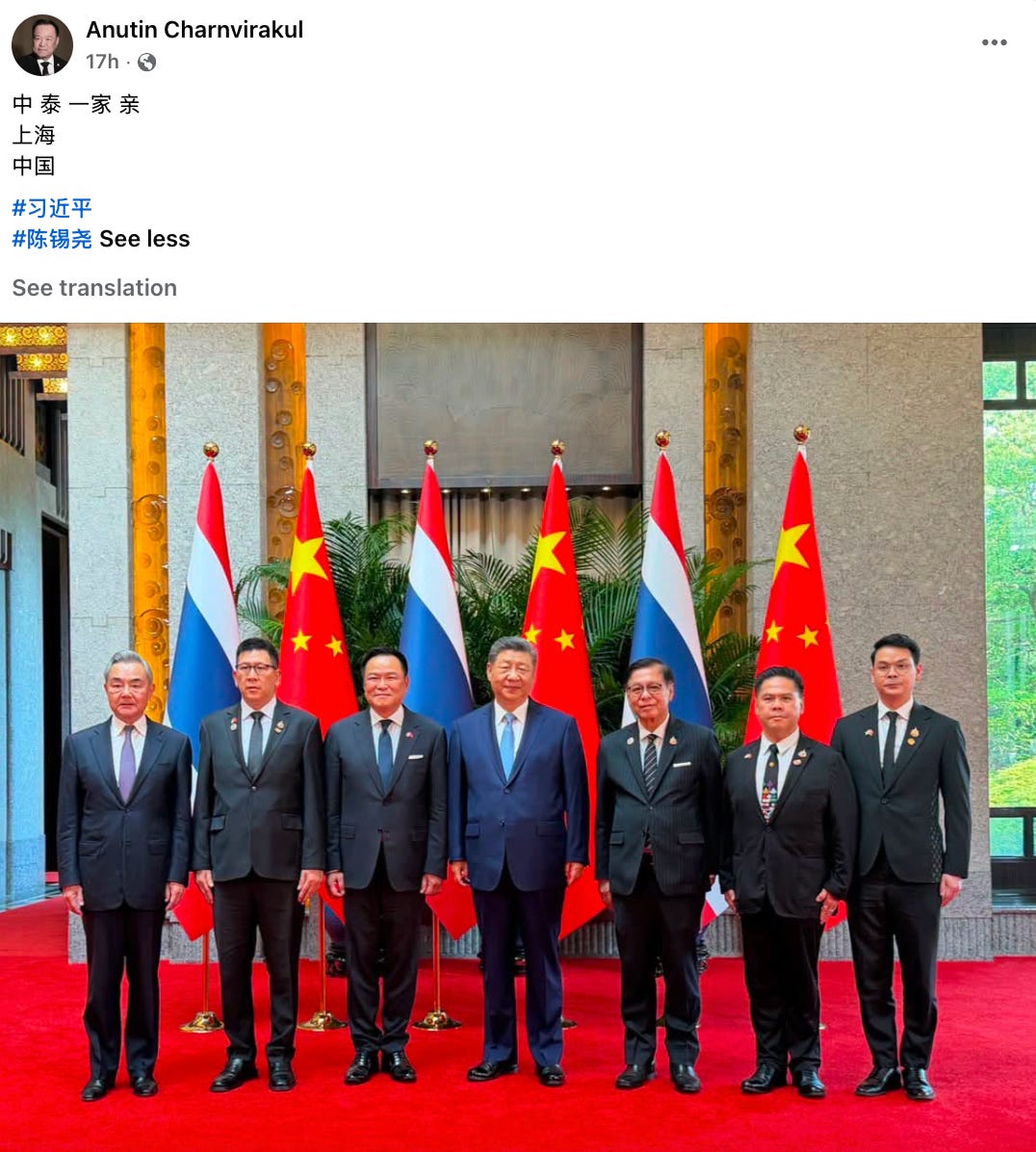
Anutin has been keen to emphasize the closeness of ties between the two countries. On his personal Facebook page, Anutin posted a photo of himself and multiple members of the cabinet with Xi Jinping and Foreign Minister Wang Yi, complete with the caption: “中泰一家亲” (China and Thailand are one family). He also added hashtags of Xi Jinping’s name and his own Chinese name, Chen Xiyao.4 (Anutin is a fluent Chinese speaker). Xi, in the readout, also used this phrase, as has become standard for Chinese leaders in discussions with Thai government officials.
All in all, a busy trip for the prime minister — one that will give us much food for thought about Thailand-China ties.
Part of the problem for Anutin may be the fact that the Bhumjaithai government’s AI efforts are still embryonic. The TH-AI passport scheme, for one, has been mired in controversy.
I have not seen Chinese sources mentioning this commitment, and we don’t know how China would enforce such a restriction.
This has been a big Xi priority since the Prayut era.
In official communications, however, the Chinese media refers to Anutin as Anuting, a direct transliteration of his Thai name.
Yeah, good article. Well written. My interest in this is where the Thai government lies with regard to their long-term strategy towards AI. At the moment they’re kind of sitting in the middle, having not been a signatory to the Chinese open and earth-facing system of AI governance, which leaves the Thais potentially to later opt for the American system.
That’s mostly under US government private sector licenses to Palantir, which is a closed system and really a surveillance network run by most of the American tech companies like Oracle, IBM, Apple, Starlink and so on and so on. It could become like Blockbuster versus Netflix in terms of which system prevails.
And should Thailand eventually opt for the Chinese model, how will that impact living in Thailand? Digital IDs? Social credit scores? Mass surveillance with cameras everywhere? The Digital IDs are already here btw. Interesting times ahead.