

Pheu Thai’s representative, Yodchanan Wongsawat, met with Prime Minister Anutin Charnvirakul today at Bhumjaithai’s headquarters, which was followed by a press conference where both leaders confirmed that Pheu Thai would support Bhumjaithai in forming a government.
The two parties have been in a state of competition since last year, with Thaksin Shinawatra’s demand to return the Ministry of Interior from Bhumjaithai during the last Pheu Thai government along with Paetongtarn Shinawatra’s voice call leak sparking Bhumjaithai’s exit from that coalition. Anutin said, however, that “whatever misunderstandings we had in the past is normal and should be erased,” pledging that the two parties should now “collaborate together without boundaries, working in the government together.”
We still don’t have a final seat count from this election, but the preliminary numbers put Bhumjaithai at 193 seats and Pheu Thai at 74 seats. Yesterday, Bhumjaithai also invited Palang Pracharath, Economic Party, New Party, and New Democracy Party (worth a combined ten seats) to support Anutin for prime minister. Today, three one-seat parties also announced their support for Anutin. This means that overall, the Bhumjaithai-led coalition now has 280 seats. Technically, this would be enough to form a government, as a majority line is only 250 seats. However, a senior Bhumjaithai figure earlier stated that they would be aiming for a stable government with at least 300 seats, so they will still need to invite at least one more coalition partner.
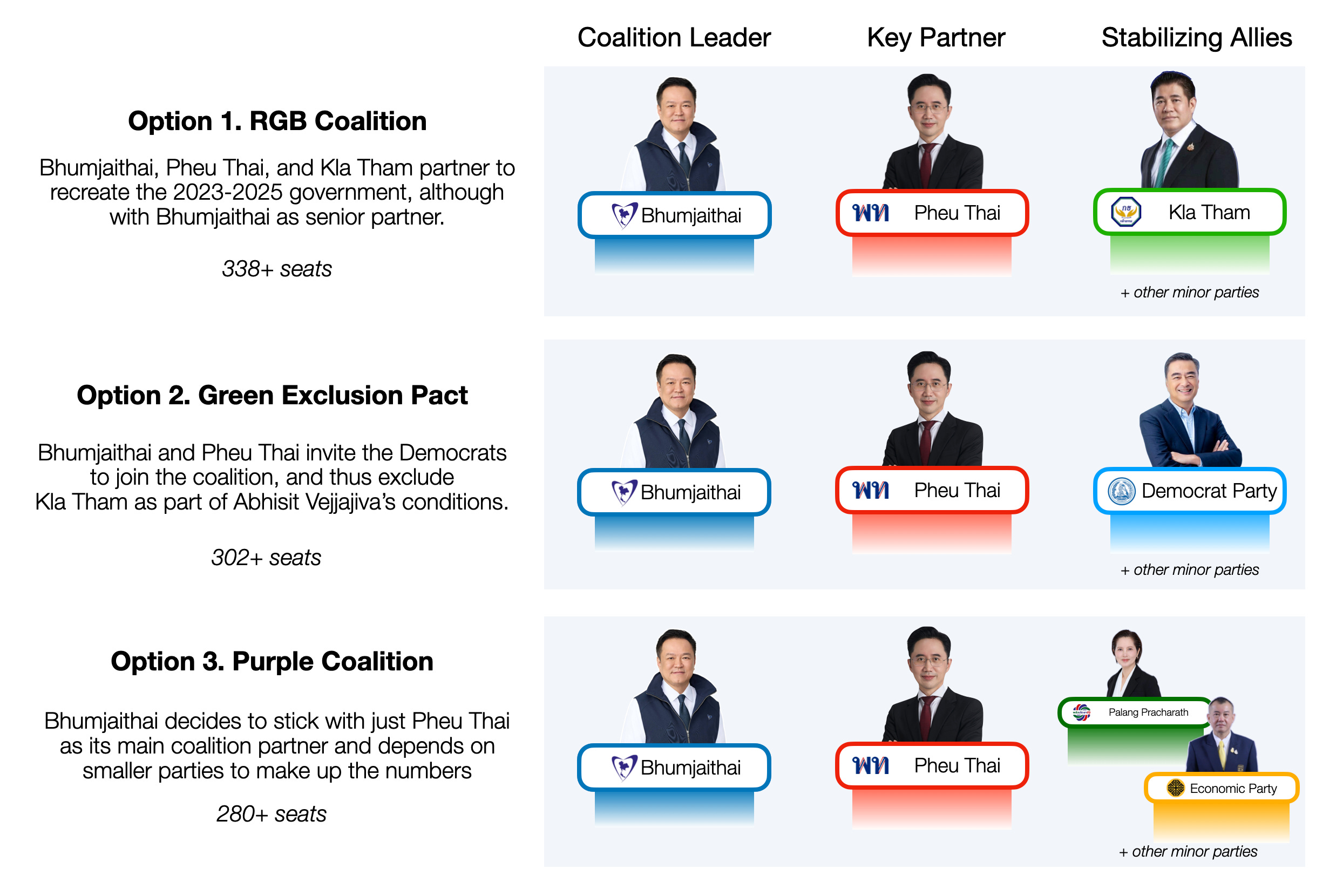
It looks likely that the next party to get an invitation will be Thammanat Promphao’s Kla Tham Party, as it is the next biggest party and Anutin has said that he will invite partners in descending order based on seat count. What we would get would thus be an “RGB Coalition” that is essentially a return to the pre-Paetongtarn voice call status quo, except with a switch in coalition leader.
Yet there are some interesting signs that there may be more friction in negotiations between the two parties than one might have initially imagined. For one, Anutin has stated that he wants a “national flag-colored” coalition. We are already two thirds of the way there (dark blue and red), but what is the white party?
Thammanat stated recently that he holds sway over 80 MPs, which is quite a few more than the 58 that Kla Tham was projected to have win. This must thus include MPs from small parties. Former Democrat MP Thepthai Senapong speculated that Bhumjaithai’s decision to invite new parties to join the coalition may have been intended as a signal that it is able to coordinate with these parties without Thammanat’s help.
Edit: Having thought about it further, the inclusion of the minor parties could be a major sign that Bhumjaithai may indeed be thinking about a coalition without Kla Tham. Why invite the minor parties if Pheu Thai and Kla Tham alone would already get Bhumjaithai way above the majority line?
One obstacle with including Kla Tham in the coalition would be that the coalition would contain around 338 MPs. If you excluded the small parties, that would be a coalition of 325 MPs. Given that the constitution mandates that there can be no more than 35 cabinet ministers, this would means that there would be a quota system of around 9 MPs to one cabinet position. This means that Bhumjaithai would be entitled to 21 cabinet roles, Pheu Thai to 8 and Kla Tham to 6. Would that be enough cabinet roles to satisfy the various faction leaders in these three parties?
Finally, there were rumors that Bhumjaithai and Kla Tham incurred bad blood during the campaign. But as I said in my last post, all of this friction so far looks more like Bhumjaithai trying to gain some advantage in its coalition talks with Kla Tham and demonstrating that it is not dependent on its current junior partner.
Let’s say Anutin is genuinely looking for an alternative, however. He does have options: Bhumjaithai could invite the Democrat Party (22 MPs) instead of Kla Tham. It would be a “green exclusion pact,” as the Democrats continue to insist that they would not join any coalition that includes Kla Tham. This would take the coalition to over a little 300 MPs.
That said, Democrat leader Abhisit Vejjajiva has said he has not received any invitation from Bhumjaithai and is not waiting around for a phone call. Even without Kla Tham, there is no guarantee that the Democrats will join the government. Abhisit was the face of the anti-Thaksin forces for close to a decade, so it remains to be seen whether or not Pheu Thai and Abhisit’s Democrats can truly bury the past. The party already appears to be gearing up for an active role in opposition
A final option would be to simply pause where they are and add in other minor parties. This “purple coalition” would be viable at 280+ seats, and it would make Bhumjaithai and Pheu Thai’s cabinet negotiations relatively straightforward. But it would mean that Anutin would be very vulnerable to Pheu Thai’s veto power as the party could pull out of the coalition and take the government towards collapse at whatever point it wishes, and it looks unlikely that the prime minister will want to begin his second term under such a vulnerability.
Anutin certainly has several options to weigh in the coming days.
A huge controversy has come about regarding barcodes on election ballots, which I won’t cover here today but is discussed in the Bangkok Post.
Would it actually be wise for Anuthin to strengthen Thammanat's outfit further by having him gain a higher profile by being in the government for four years? Sidelining him to the opposition for four years might serve BJT's further growth better. But there may be socio-political obligations that would not allow Kla Tham's exclusion.
It's easy to talk about a coalition that everyone knows came about as a result of fraudulent elections, and therefore has no legitimacy whatsoever.