

The FY2027 budget proposed by Prime Minister Anutin Charnvirakul has passed its first reading in parliament, with 288 MPs voting in favor and 119 voting against. Here are some of the highlights of the parliamentary debate on the budget.
Ekniti defends government budget 2027 budget
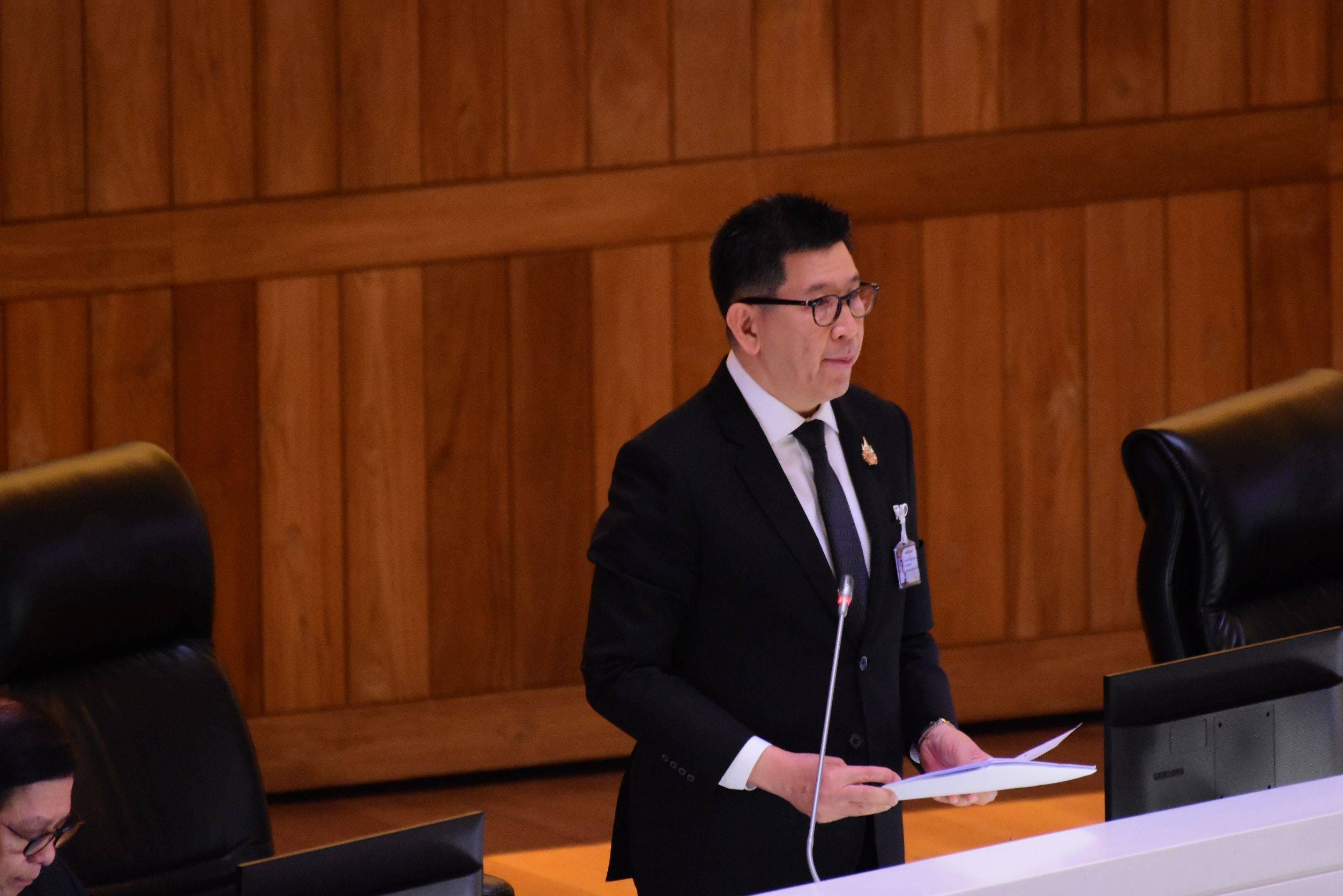
Anutin was accompanying His Majesty King Maha Vajiralongkorn on his visit to France, so Deputy Prime Minister and Finance Minister Ekniti Nitithanpraphas made the opening and closing speeches on the budget debate. His opening speech can be found here, and a summary of his closing speech can be found here.
Ekniti summarized the budget as follows:
The draft Annual Appropriations Bill for Fiscal Year 2027 sets a total budget cap of 3,788,000 million Baht, which can be categorized as follows:
Current expenditure: 2,786,367.1 million Baht (or 73.6%)
Treasury reserves compensation: 71,038.1 million Baht (or 1.9%)
Capital expenditure: 789,171.5 million Baht (or 20.8%)
Principal debt repayment: 151,520 million Baht (or 4.0%)
10.7% of the budget is allocated for national security, 9.2% for building competitiveness, 16.1% for developing human capital, 25.4% for creating opportunities and social equality, 3.6% for quality of life and the environment, and 17.9% for balancing and developing systems for government administration. 17.1% is placed in emergency reserves
In his speeches, the finance minister mounted a spirited defense of the budget that he has proposed. The goverment’s economic goal, Ekniti said, was to push Thailand into one of the top twenty most competitive countries globally in four years, return GDP growth to 3% annually, and push for Thailand to become a high-income country within 12 years.1 Ekniti noted that last year, the budget deficit amounted to 4.4% of GDP, and the Bhumjaithai government will reduce this deficit to 3.9% of GDP in order to rebuild fiscal credibility. By 2029, the government hopes to reduce this deficit to under 3%.
Ekniti also noted that although it appears that the budget for government investment had decreased by 70 billion baht, the government has in fact simply shifted its method of mobilizing capital through alternative tools, such as state enterprise investment budgets, and Board of Investment incentives and deregulation to attract investment. Overall, Ekniti said: “For the FY 2027 budget, the government will move away from its old practice of under-budgeting or hiding current expenditures—tactics that forced them to draw from treasury reserves later on. Instead, they will bring these vulnerabilities out into the open so that the problems can be targeted and solved directly."
The opposition’s response
All of the major opposition parties roundly criticized the government’s proposed budget.
Leader of the opposition and People’s Party leader Nattaphong Rueangpanyawut slammed the budget as “a budget that comes from the taxes of all Thais, but will not help Thais and instead will help those who are the pillars of the dark blue government.” Meanwhile, deputy leader Sirikanya Tansakun said Thailand’s economic issues are akin to “an abscess that has burst” and without a change to how the government approaches budgeting, the budget deficit will not decrease and new projects will become impossible.
The Democrat Party zeroed in on how the proposed budget is a “budget where we cannot see a future.” Party leader Abhisit Vejjajiva argued that virtually the entire investment budget this year comes from deficit spending or loans, which means that the national income is taken up entirely by routine spending and debt repayments. The tax-to-GDP ratio stands at 14.6%, Abhisit said, which is the lowest in history. He thus called for comprehensive tax reform. Deputy leader Korn Chatikavanij echoed Abhisit’s call for tax reform and also pointed out that the government’s goal of taking Thailand to high-income status in 12 years and becoming an OECD member in 2028 is likely impossible, as that would require investing at least 30% of the budget, but Thailand is barely able to invest even 20%.
Multiple MPs zeroed in on the government’s AI budget. Sirikanya noted that “any project with AI in the name or is related to AI received a substantial budget increase,” with the overall AI-related budget doubling. However, there does not appear to be a government strategy on AI, as different agencies are making their own procurement orders. Democrat deputy leader Karndee Leopairote said that although 90% of the AI-related projects are supposedly marked for investment, detailed scrutiny revealed that portions of this budget is actually being spent on building classrooms and even “AI buildings.”
People’s Party deputy leader Veerayooth Kanchoochat criticized the government’s industrial policy, arguing that the government appears to have a “fear of missing out” and is addicted to glamour, seeking foreign investment without truly building internal industrial strength. Focusing on the automobile industry, Veerayooth noted that most of the budget is focused on subsidies for EV producers, with little remaining for infrastructure building, testing centers, and workforce skill development.
Kla Tham joined in criticism of the budget. Kla Tham MP Pakpoom Boonpramook, for example, said that the area-based budgets for provinces and provincial groups had been reduced by 83 percent, which does not look like a normal budget reduction but is instead an attempt to remake devolution of budgetary power.
The biggest fireworks during the debate came when Democrat MP Jury Numkaew (who represents Hat Yai city, which suffered from a major flood last year) said that the government was allocating insufficient funds to disaster prevention. This prompted an angry response from deputy interior minister Jeseth Thaiseth, who accused Jury of not reading the budget carefully enough and suggested that the Democrats appoint him to the budget committee so he would have an opportunity to study the budget further. He was particularly incensed that Jury had said that he needed to light incense to summon a minister to reply to his question. Abhisit came to the assistance of his fellow Democrat MP, suggesting that Jury continue lighting incense until someone could give a proper answer on why there were very little funds for flood prevention in Hat Yai.
What next?
The budget will still need to pass its second and third readings. In the meantime, the cabinet and the major political parties have appointed a 72-member special committee to scrutinize the proposed budget. Particularly noteworthy members include Veera Theerapat, a famous news host who joined previous budget committees under the People’s Party quota but this year has switched to the government quota, Chaiwat Sathawornwichit (the recently defeated People’s Party Bangkok governor candidate), and Watanya Bunnag or “Madam Dear” (previously a Democrat Party politician who faded away from politics after she was refused permission to run in the 2023 party leadership race).
The Democrats had no qualms joining this government. One of Anutin's mistakes will be not inviting them to join the coalition.
Sure, there will be some sad people who lose out on being ministers, but the government will have a much easier road.
It's not like the Dems are doing that good of a job of being the opposition. But having the PP as the lone opposition is much much easier.