

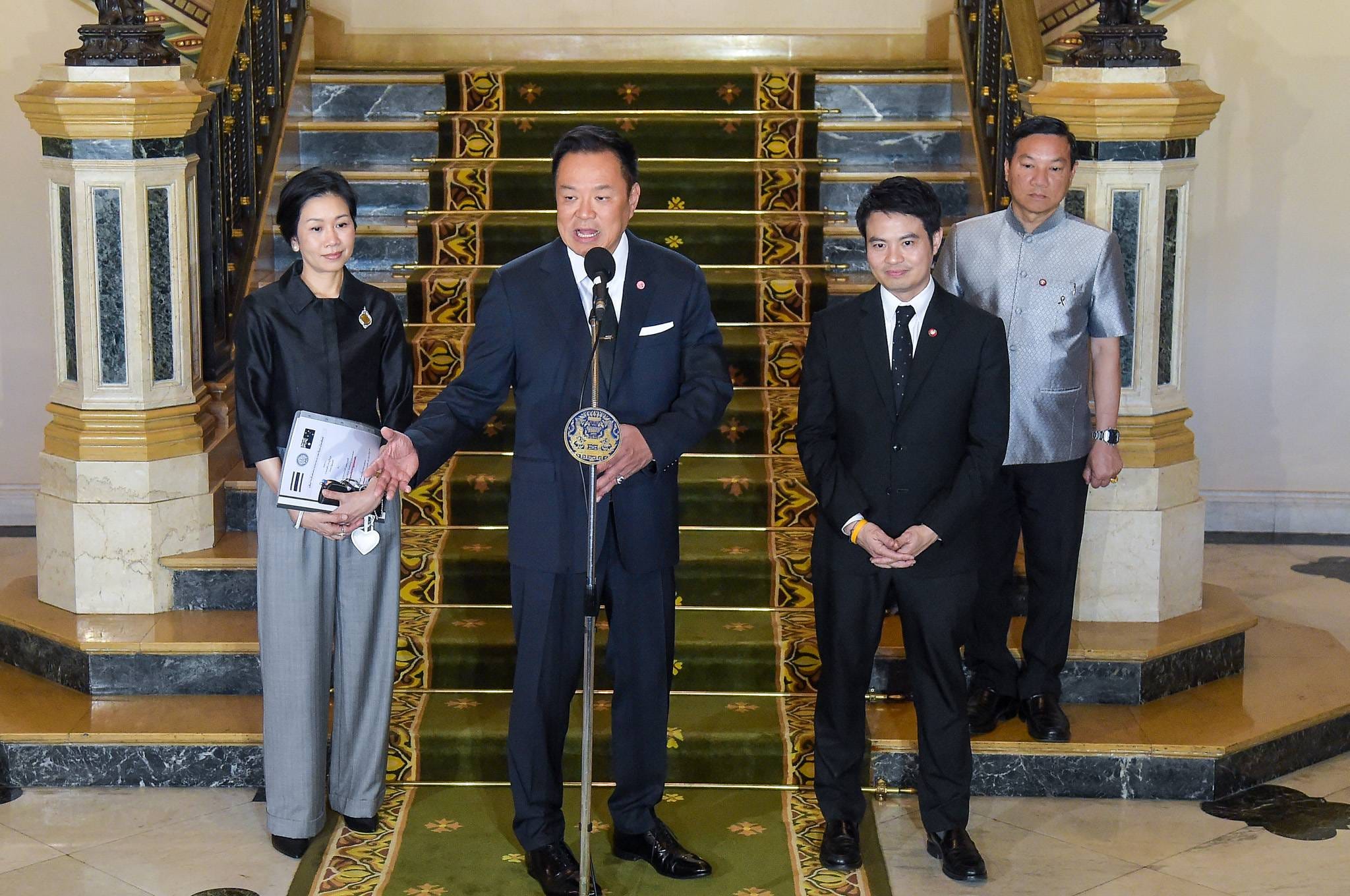
Prime Minister Anutin Charnvirakul’s second term so far has felt like one hundred days of quietude.
This state of affairs is not usual in Thai politics, especially under elected governments. For the first time this century, we have a pro-establishment government led by a political party that is clearly dominant in their own coalition. As far as we can tell, this government maintains friendly ties with other potential veto players in the political system, including the Senate and the military. The prime minister is neither beloved nor detested; in short, he is not the sort of polarizing figure who drives people to the streets in fury. If there was a government that seems likely to complete its term in office, this one would be it.
But are things genuinely as stable as it seems? There are some recent reports that the beneath the calm surface, the government is beginning to face increasing headwinds. In today’s newsletter, I want to take a look at some of the potential flashpoints facing the Anutin government.
Declining popularity
Bhumjaithai is fresh from an election victory, but new data suggests that public polling is already declining. The latest NIDA quarterly poll pointed to an almost 8% decline in the number of Anutin’s supporters, and 9% decline in the number of Bhumjaithai supporters. This is only one poll, but that is a pretty significant shift that Bhumjaithai will certainly flag as alarming.
As a NationWeekend analysis wrote, the Anutin government has faced several PR issues in its first three months, including controversy over its initial handling of the energy crisis, debate over its AI scheme, and perception of underperformance from some cabinet ministers. Another potential issue is the fact that the government contains many relatively inexperienced cabinet ministers (such as the “lookthep faction”)1. The cabinet’s most popular figure, commerce minister Supajee Suthumpun (who played a star role in the Bhumjaithai election campaign), has significantly cut back her media visibility, to the point where her Facebook page has had to explain that “Supajee has not disappeared, she is working.” Anutin recently threatened that ministers which “the world has forgotten about” (i.e. has no discernable accomplishments) will also be “forgotten by the prime minister” (i.e. reshuffled out of the cabinet). The prime minister also acknowledged that the government has not been effectively communicating its work to the people.
The saving grace is that the People’s Party has proved completely unable to capitalize on the government’s dipping popularity, with both leader of the opposition Natthaphong Rueangpanyawut and the party declining slightly as well in approval. It was instead Pheu Thai and the Democrat Party that made some modest gains. Given that it is still so early in the parliamentary term, a fall in just one poll will not be sufficient to trigger Bhumjaithai panic yet. As May Wong wrote in the Strait Times, “Regardless of the Anutin administration’s shortcomings, many voters may be willing to overlook them for now. Political stability may matter more than ambitious reform.” But if the decline in support continues, it will certainly be a data point that the government cannot ignore.
Bhumjaithai Infighting
Unlike in previous governments, there are also virtually no reports of intra-coalition infighting. The only player sizable enough to actually destabilize Bhumjaithai is Pheu Thai — with the coalition having 294 MPs, if Pheu Thai’s 74 MPs were to withdraw the government would be at immediate risk of falling. But Bhumjaithai is helped by a curious parliamentary dynamic: Kla Tham (with 58 MPs) remains in the opposition. Bhumjaithai recently sent Kla Tham a signal of friendship, and it is highly possible that should Pheu Thai turn into a rebellious actor, Anutin could turn to Kla Tham as a backup option. Hence why this coalition is stable.
But although infighting across parties within the coalition has been limited, we are seeing signs that all is not well inside Bhumjaithai itself. The biggest flashpoint appears to be tensions between the prime minister and his deputy prime minister and transport minister, Phiphat Ratchakitprakarn. In the middle of June, Phiphat was removed from his role overseeing the Eastern Economic Corridor, a move that appeared to be a surprise to Phiphat himself. (As Phiphat noted, he only found out about his removal when the order was read out at a cabinet meeting). This led to immediate speculation of a wider conflict between what has been dubed “two Ns and one P” — the Ns being Newin Chidchob and Anutin (nickname “Nhoo”) and the P being Phiphat. Phiphat, for his part, has denied these claims, arguing that Newin is not involved in the country’s administration.
The rapture between the prime minister and the deputy prime minister does not appear to be wide enough to threaten the government yet. It is worth noting, however, that Phiphat as leader of the party’s election campaign in the south was instrumental to producing the Bhumjaithai victory, and he is not someone that Anutin can easily afford to alienate. This flashpoint will be worth watching in the months to come.
Rumors of the prime minister’s replacement
The government so far has been in a legally sound spot — very important given Thailand’s recent history of judicial defenestrations of prime ministers. But the most immediate threat to the government is an upcoming Constitutional Court ruling on July 9 on the legality of its emergency borrowing decree. If the court issues a negative opinion, it is possible that there may have to be some ministerial resignations to take responsibility. I have seen some speculation that this could trigger a dissolution of parliament, but personally I doubt that things will go that far.
Recently, rumors began to float in the media that a backup has been prepared in the event that Anutin has to resign. The backup prime minister, reports stated, has a name starting with an “S.” On the surface that sounds obvious: Bhumjaithai’s second candidate for prime minister is Deputy Prime Minister and Foreign Minister Sihasak Phuangketkeow. But there are multiple “S” letters in Thai, and this particular “S” (ศ) is not how “Sihasak” (ส) is spelled. The only eligible candidate for prime minister whose name starts with the right “S” is People’s Party deputy leader Sirikanya Tansakun, who quickly denied that there are any deals being made for her to become prime minister. Bhumjaithai, for their part, have denied that there are any plans to replace Anutin with an outsider prime minister.
So what to make of these rumors? It is probably no coincidence that such a report would be floated at a moment when the Bhumjaithai government, as strong as it is, is suddenly facing some headwinds, in the form of declining popularity, party infighting, and a legal challenge. Still, talk of an imminent collapse of the government is probably premature. Making predictions is an easy way for a Thai political analyst to look foolish very quickly, but if you pushed me to say whether this government completes its term, I would still say at the moment the odds favor that scenario. Fundamentally, Anutin and his party still remain in as unassailable a position as we have seen in the past three decades of electoral politics. There are signs of trouble, but Thai governments have easily survived worse.
As I wrote in this overview of Anutin’s cabinet: “This is a faction of heirs to prominent local clans…Several received appointments in this cabinet, but some of the older generation in Bhumjaithai are reportedly dissatisfied with this grouping’s rise in influence. In addition to the large number of cabinet seats offered to the technocrats, this is another potential flashpoint for Bhumjaithai when reshuffles are placed on the horizon.”
There’s not an incumbent anywhere in the West who wouldn’t kill for Austin’s ratings. Neither loved nor hated is about as good as it ever gets these days the world over. No sign of any PP or Democrat resurgence at the recent gubernatorial. I doubt Austin’s losing any sleep.
The rapture between the rupture