

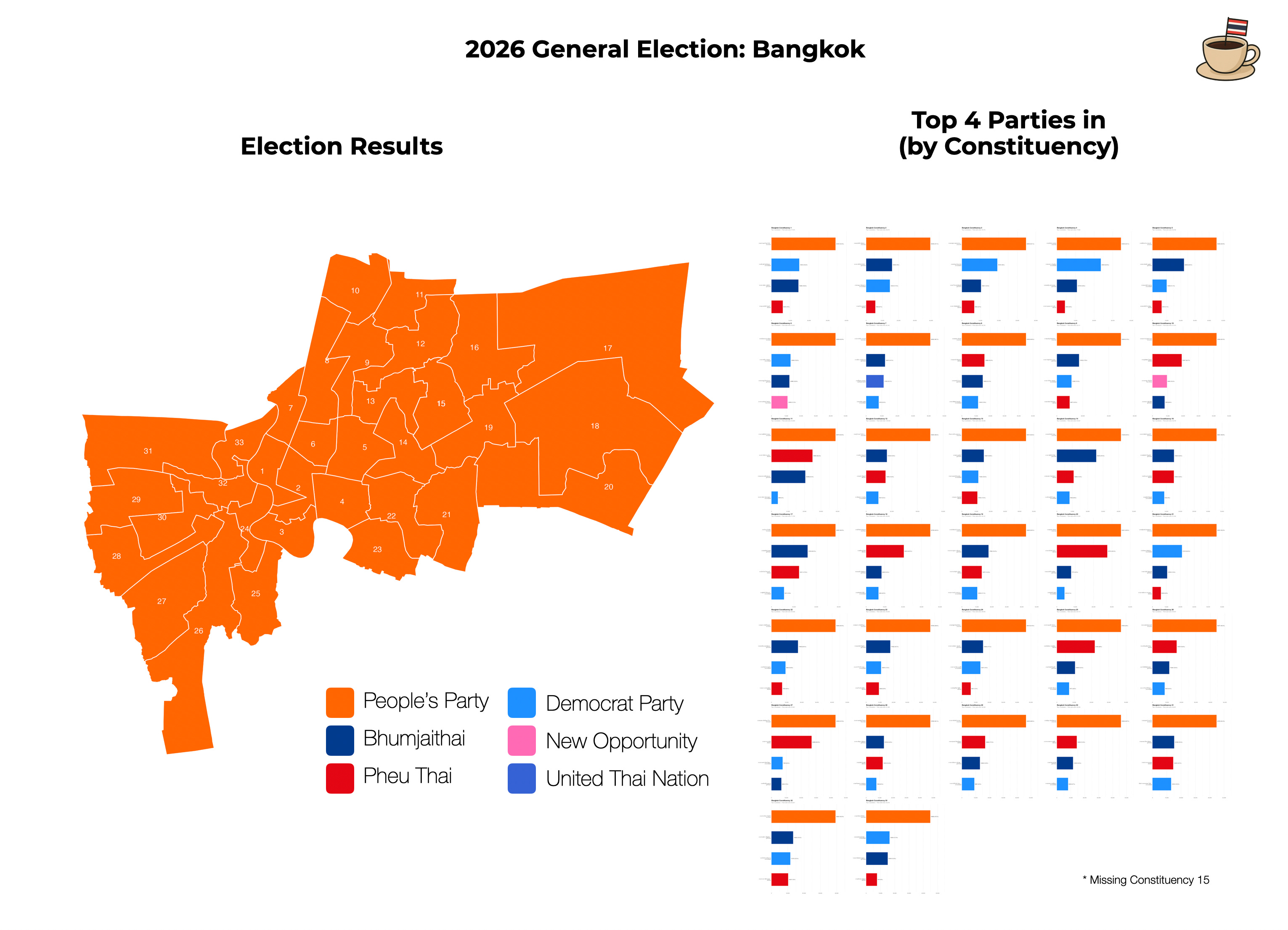
This is the first of several retrospective deep dives into the results of the 2026 general election, where I plan to look into interesting aspects of how certain regions behaved and how some parties performed. We’ll start off with an analysis of the results the nation’s capital: Bangkok.
You may ask why it is worth dissecting the results in Bangkok at all, when the People’s Party (PP) swept every single constituency. I think it deserves some attention because 1) it is an anomalous result that contradicts how the PP faltered in the constituencies across the rest of the country, and 2) Bangkok will be holding local elections later this year, and we may glean some useful predictions from these results.
Bangkok as swing province
Bangkok is a notoriously fickle-minded province, with the results often swinging wildly from election to election. This is because baan yai find it difficult to operate in highly urbanized environments, and so Bangkok candidates are often highly dependent on the party’s national popularity. Even well-regarded incumbents are easily tossed aside once their party falls out of favor.
Take a look at how Bangkok has voted in the past general elections held this century:
2001: Thaksin Shinawatra’s Thai Rak Thai Party swept 29 out of 37 Bangkok constituencies, with the Democrats winning the rest
2005: Thai Rak Thai won 32 out of 37 Bangkok constituencies
2007: The Democrat Party won 27 out of 36 Bangkok constituencies, with Pheu Thai winning the rest
2011: The Democrat Party won 23 out of 36 Bangkok constituencies, with Pheu Thai winning the rest
2019: Palang Pracharath won 12 out of 30 Bangkok constituencies, with Future Forward and Pheu Thai splitting the rest
2023: Move Forward won all but one of Bangkok’s 33 constituencies
2026: The People’s Party won all of Bangkok’s 33 constituencies
There are three observations worth highlighting. Firstly, Bangkok tends to vote in one direction (with exceptions in 2011 and 2019). Secondly, in the past 25 years, no political party has ever been able to sustain its popularity in Bangkok over more than two election cycles. A party can win the vast majority of the seats in one election and then be almost wiped out in the next. Third, winning all the seats in Bangkok is rare. You have to go all the way back to 1976, when the Democrats swept Bangkok, to find a precedent.
The PP still has no peer in Bangkok
The PP won an average of around 42,000 votes per constituency, followed by Bhumjaithai at around 14,000, Pheu Thai at around 12,000 and the Democrats at around 10,000 votes. (This excludes District 15, for which the Electoral Commission hasn’t uploaded final results at the time of writing). You could add up the tallies for the next three parties together and in some constituencies, that still wouldn’t be enough to beat the PP. Take, for example, District 8 in Bangkok. PT’s Surachart Thienthong had won a byelection as late as 2022 with a margin of almost ten thousand votes. In this election, you could add the BJT and Democrat tallies to PT’s and they still would be slightly behind the PP.
That will be enormously disappointing for the other political parties. PT had initially looked well-positioned to win back some seats in Bangkok’s outer ring, which the party had retained before 2023 even after the height of Thaksin’s popularity had receded in the capital. Yet, one PT candidate managed to sum up the party’s problems succinctly when he posted immediately after the election: “I’m out of energy. I can’t beat the krasae.” Even PT’s long-standing local candidates with a long track record of constituency service were unable to overcome the strength of the PP party brand in Bangkok.
The Democrats, former champions who have endured a Bangkok drought since 2011, will also be disappointed that they did not come closer to winning a seat, despite Abhisit Vejjajiva’s return to lead the party. Indeed, they were more often fourth than second. Before the election, some news agencies were reporting that the party was hopeful about ten constituencies in Bangkok, but even in these constituencies the results were nowhere near victory. Bhumjaithai is at its highest level of popularity in Bangkok ever — it won only around two percent of the Bangkok vote share in 2023 — but like the Democrats, this was not nearly enough for them to be competitive.
We saw some outstanding performances from certain parties in a number of constituencies, such as the son of United Thai Nation Party secretary general Chatchawal Khongudom coming third in District 7 (he has long been well-known in the area) but this goes to show that even longstanding local networks could not overcome the PP wave.
What this means
The PP’s Bangkok haul accounts for over a quarter of all the seats that the party has won in this general election. It is a double-edged sword: PP is now even more vulnerable to shifts in the national sentiment than previously. In dyeing Bangkok completely orange, it has also become the orange capital. The historical odds are already against it; as we noted earlier, in the past 25 years no party has swept Bangkok more than twice in a row. If the PP is unable to sustain its national popularity until the next general election, major losses in its Bangkok seats would be devastating to the party. “Luckily” for the PP, however, this will also be only the second time in the past 25 years where a party has swept Bangkok did not enter government. (The first time was 2023, when Move Forward failed to form a government). Its level of popularity in Bangkok may not prove difficult to sustain while it remains in opposition.
Of course, it’s far too early to consider what might happen in the next general election. Coming up far more quickly are the local elections. Governor Chatchart Sittipunt’s term will end later this year, and so Bangkok is due to hold an election both for Bangkok governor and for members of the Bangkok Metropolitan Council (BMC). Chatchart has yet to announce whether he will run for re-election.
Logic would typically dictate that the PP should be in a strong position to win both the governorship and sweep the BMC, given how stratospheric their general election performance was. But it’s worth remembering how deeply formidable Chatchart’s electoral performance was in 2022. He had won almost 53 percent of the vote; no other candidate received more than 10 percent of the vote. After four years, Chatchart is probably not as popular as he was in 2022, but he’d need to fall down a long way before anyone can come close to catching up. The field in 2026 is likely to be as fractured as in 2022, with the PP and the Democrats certain to field candidates, and a number of independents are also likely to jump in. (We don’t know if Bhumjaithai will contest this race). That would make a Chatchart victory even more probable, if he chooses to run.
Other parties may have more of a chance in the BMC elections; Pheu Thai had won the most seats in 2022, followed by Move Forward and the Democrats. Long-standing councillors have proved more impervious to national shifts than MPs, but we’ll see if the PP’s popularity bucks yet another trend.