

One year into Anutin Charnvirakul’s stint as Minister of Public Health, the COVID pandemic erupted and he was suddenly in charge of overseeing Thailand’s response to the biggest global health crisis in a century. Now, only a few weeks after he won a general election that will return him for a second term as prime minister, Anutin will now be in the unenviable position of overseeing Thailand’s response to a geopolitical crisis that have sent energy prices skyrocketing.
“The Iran war puts Asia in an energy panic,” blares The Economist’s headlines. “In 2025 Asia absorbed 87% of the crude and 86% of the liquefied natural gas (LNG) transiting via the Strait of Hormuz. Now the strait is blocked and Asia risks running out of fuel, fast.” As oil prices surge past $100 a barrel for the first time since 2022, Thailand is unfortunately one of those Asian economies that may find itself under significant pressure. 60 percent of Thailand’s crude oil and 25 percent of LNG are imported from the Middle East via the now-blockaded Strait of Hormuz. Multiple research agencies have noted that Thailand is one of Asia’s most vulnerable countries in the event of an energy crisis.
In his initial response to this unfolding energy shock, Prime Minister Anutin suspended fuel exports (except for petroleum to Laos and Myanmar)1. The government also acted quickly to assure consumers that energy prices will remain stable. On March 9th, Energy Minister Auttapol Rerkpiboon said that the Oil Fuel Fund was currently spending about 700 million baht a day to subsidize energy prices, and that this level of support can be maintained for at least another fifteen days.2 According to Auttapol, Thailand has enough supply of oil for 65 days “if imports were completely disrupted,” while “additional supplies secured from sources outside the Middle East would provide roughly another 30 days of coverage, bringing the total reserve estimate to about 95 days.” To help reach this goal, Anutin has also signed a directive requiring oil traders to increase their legal reserves from 1% to 3% of their annual trade volume.
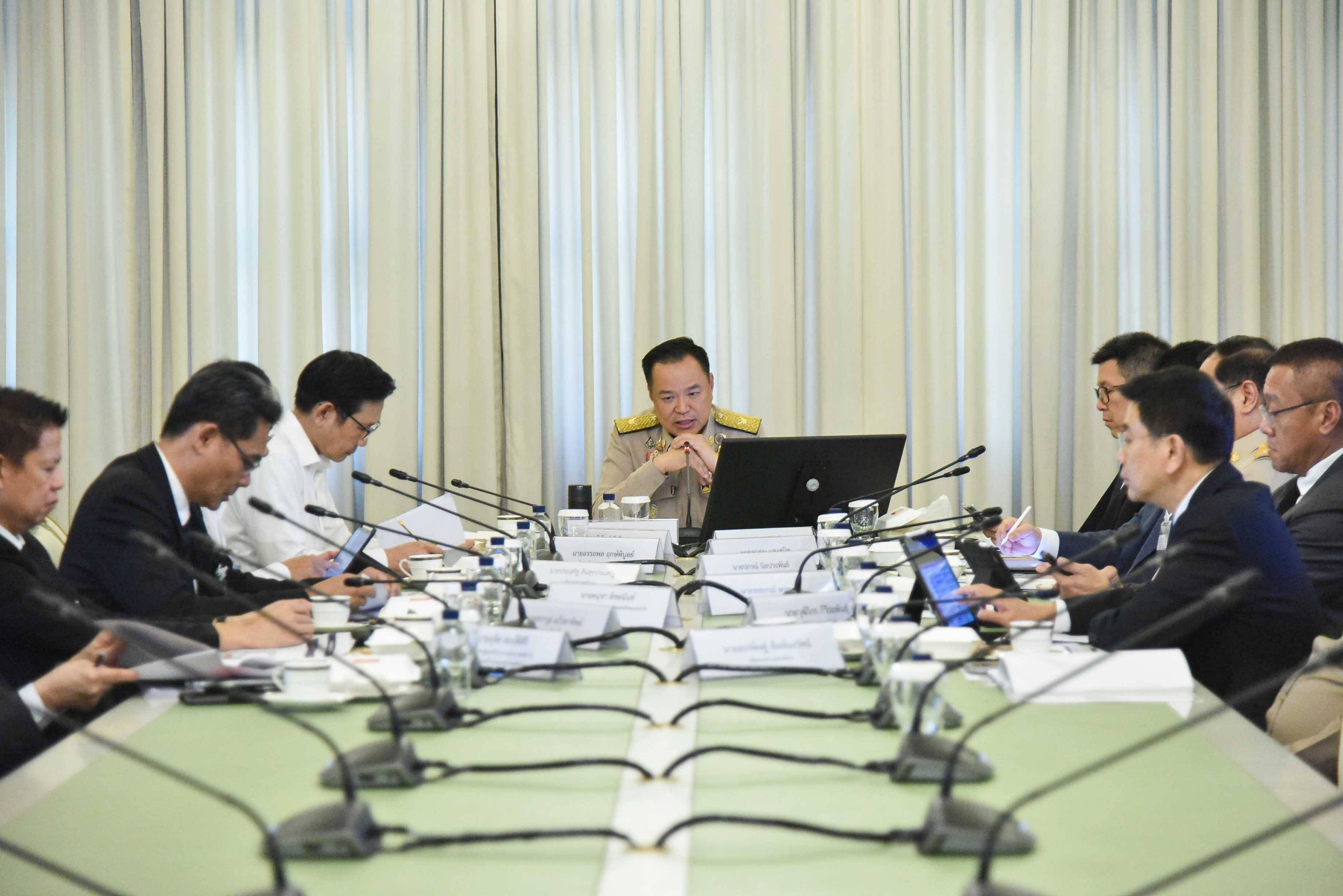
Yesterday, a high-level meeting resulted in the announcement of the following measures (posted here by the FC Anutin Facebook page):
Boosting biofuel usage by shifting biodiesel blend from B5 to B7 to reduce reliance on imported oil (Thailand is the world’s third largest producer of palm oil)
Restructuring prices to make Gasohol E20 more attractive than E10 (Thailand is a major producer of ethanol and indeed has a surplus due to overcapacity)
Ensuring that industrial users do not run out of fuel
Seeking alternative sources of energy, such as increasing gas production in the Gulf of Thailand and increasing electricity imports from Laos,
Freezing the price of cooking gas for two more months
Announcing an energy-saving campaign
Nation Thailand reported that “a source at the Energy Ministry told Krungthep Turakij that the ministry has developed a proactive energy contingency plan.” This includes the issuing of an emergency decree permitting the Ministry of Finance to guarantee loans for the Oil Fuel Fund so that prices can continue to be subsidized (similar to what was done in 2022 during the initial stages of Russia’s invasion of Ukraine). The government is also seeking to secure more oil supplies from the United States, Africa, and Malaysia.
Where is the energy saving campaign?
The energy saving campaign that the government is looking to launch includes measures such as:
Setting air conditioning temperatures to 26°C.
Regularly check car engine conditions to ensure maximum efficiency and reduce fuel consumption.
Allowing employees to work from home
Thailand is not alone in launching these energy-saving measures. The Guardian’s Rebecca Ratcliffe reports that in the Philippines, “All national government agencies, state universities and colleges, and local government branches have been told to reduce fuel consumption by at least 10% in response to the crisis in the Middle East.”
Several political parties have for days been pushing for a national campaign. On March 4, the People’s Party called on the government to immediately set an example by implementing energy-saving measures within the bureaucracy. Democrat deputy leader Korn Chatikavanij yesterday called on the government to signal strongly to the private sector that people should increase working from home.
The government is perhaps trying to minimize panic — a run on gas stations would not be helpful. And of course, there is a possibility that the Middle Eastern conflict could end sooner rather than later, limiting the scale of the global energy shock (although prices are still likely to increase even if the war ended today).3 But should it not, Thais will thank Anutin for taking more decisive action now rather than acting too indecisively.
Thailand sources around 15 percent of its electricity from Laos, and 10 percent of its LNG from Myanmar, so it’s understandable that the government would not want to choke off its energy exports to these two. countries.
The government says that if price adjustments become necessary, they will be implemented gradually to avoid sudden shocks to the cost of living.
Per The Economist piece linked at the start of the article: “On March 6th Saad al-Kaabi, Qatar’s energy minister, told the Financial Times it could take “weeks to months” for it to resume deliveries at a normal rate even if the war ends now.”