

His Majesty the King has granted his royal endorsement to the new cabinet nominated by Prime Minister Anutin Charnvirakul. Thai PBS has posted the names of all the new cabinet members here.
In February, I had listed a couple of potential coalition configurations. We have ended up with a “purple coalition” comprising Bhumjaithai and Pheu Thai, with Kla Tham excluded from the mix. But this is a more purely purple government than many analysts may have originally imagined; only Bhumjaithai and Pheu Thai are represented in this cabinet, with all other coalition partners excluded.
Here’s a look at the makeup of Anutin’s second government.
By the numbers
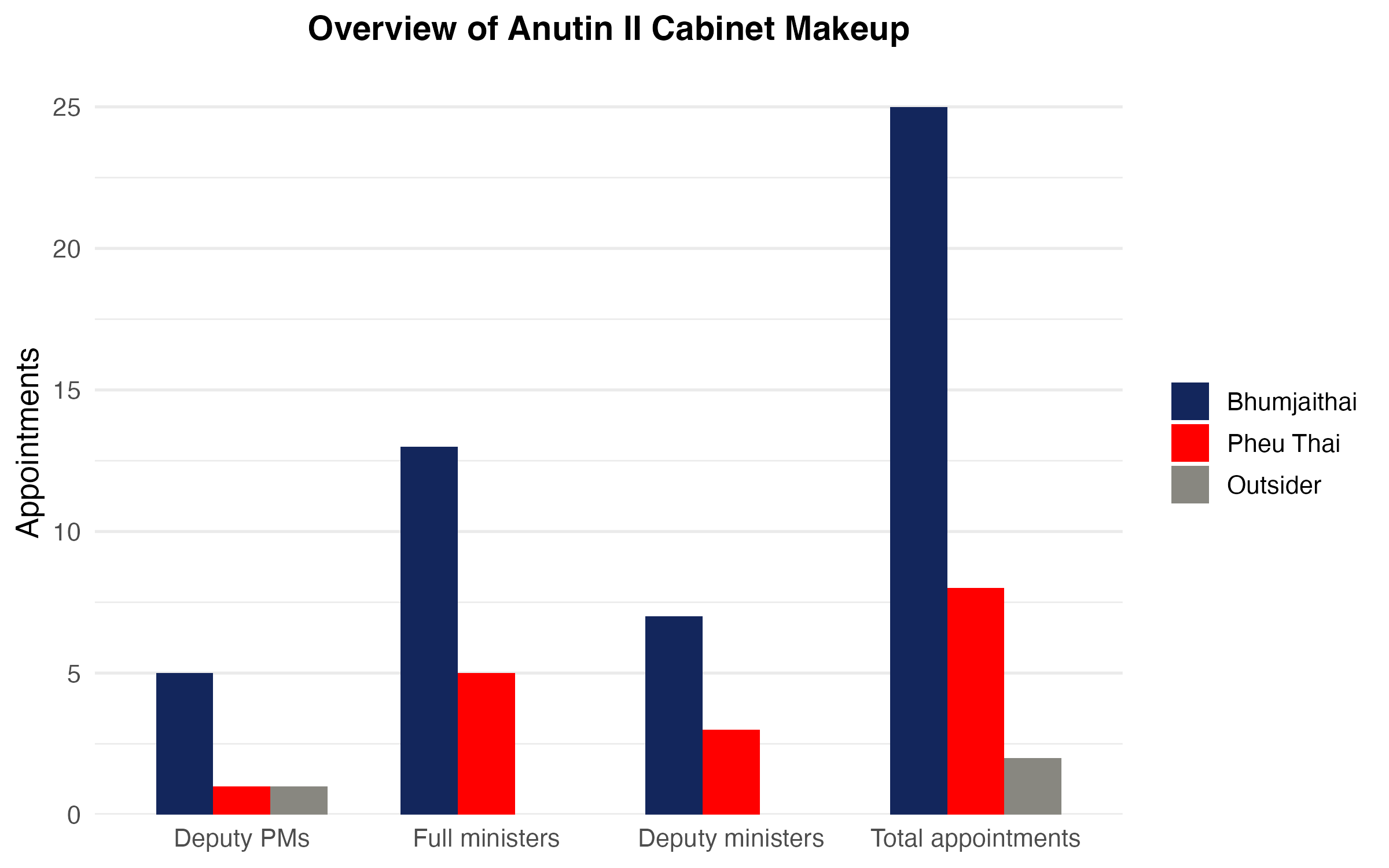
Of the 7 deputy PMs appointed, 5 were from Bhumjaithai, 1 from Pheu Thai, and 1 outsider.
Bhumjaithai received 13 full ministerial roles and while Pheu Thai received 5.
7 Bhumjaithai members were appointed deputy ministers, while 3 Pheu Thai members were appointed.
In total, of the 35 individuals who were appointed to this cabinet, 25 are from Bhumjaithai, 8 are from Pheu Thai, and 2 do not have partisan affiliations.
In parliament, Bhumjaithai’s MPs make up around 65 percent of the coalition, while Pheu Thai makes up around 25 percent — so Pheu Thai has received roughly a fair allocation, while Bhumjaithai is slightly overrepresented. There is room for this because the remaining 10 percent of MPs are from small parties which did not win enough seats to warrant a place in the cabinet.1
A reflection of Bhumjaithai’s internal dynamics
This cabinet reflects the internal pressures of Bhumjaithai’s party management.
Anutin kept his promise to reappoint his three popular technocrats (Supajee Suthumpun, Sihasak Phuangketkeow, and Ekniti Nitithanpraphas) to their current roles, and top it up with deputy PM positions. This is unsurprising given how central they have been to the Bhumjaithai election campaign, but must still have been difficult because of the large number of factions within the party that were demanding positions.
Bhumjaithai clearly tried to balance rewarding longtime party loyalists and the thanking the large numbers of defecting factions who had been so critical to the party’s election victory. Prominent switchers like Varawut Silpa-archa (formerly head of the Chart Thai Pattana party) and Akanat Promphan (previously secretary-general of the United Thai Nation Party) both received cabinet roles. Some newcomers received their first-ever positions, such as Sanphet Bunyamanee, son of former senior Democrat Niphon Bunyamanee.
Inevitably, some defectors were disappointed — we saw Anucha Sasomsap hint to the press that his Nakhon Pathom faction contained four MPs and that it would be up to Anutin to consider whether he should be upgraded to a ministerial role. (In the end, he did not receive a cabinet position). Some of the original batch of defectors who had helped make the first Anutin government possible also did not receive appointments, including ex-industry minister Thanakorn Wangboonkongchana and ex-deputy interior minister Sakda Vicheansil (who actually lost his own constituency seat in a shock result).
We also see the increasing prominence of what has been dubbed the “Lookthep Gang”2 . This is a faction of heirs to prominent local clans who are seen as close to Bhumjaithai’s secretary-general, Chaichanok Chidchob (son of Newin Chidchob). The origins of this grouping can be tracked back to 2024, when Bhumjaithai decided to refresh the party image by bringing in younger politicians. Several received appointments in this cabinet, but some of the older generation in Bhumjaithai are reportedly dissatisfied with this grouping’s rise in influence. In addition to the large number of cabinet seats offered to the technocrats, this is another potential flashpoint for Bhumjaithai when reshuffles are placed on the horizon.
Other noteworthy points
Pheu Thai’s division of cabinet roles was interesting. It is no surprise that Prof. Yodchanan Wongsawat, the party’s main candidate in the past election, became deputy prime minister. It is, I believe, the first time in history that this role will be held concurrently with the higher education portfolio, a reflection of Yodchanan’s academic background. Suriya Juangroongrueangkit, who will now be holding a cabinet role under his sixth prime minister (stretching back to Chuan Leekpai in the 1990s!), must be breaking some sort of record. Notably absent is Somsak Thepsuthin, who rivals Suriya in ministerial experience but seems to have been dropped in a bid to let some newer faces into cabinet.
Gen. Natthaphon Narkphanit, defense minister in the first Anutin cabinet, is out. The new defense minister is Lt Gen Adul Boonthamcharoen, who was previously deputy defense minister. I’ve classified him as a nonpartisan appointment because he is not technically a member of any party. The former commander of the second army region, he has military experience in the lower northeast, including along the Cambodian border.
It is noteworthy that Dr. Bowornsak Uwanno, who was deputy prime minister responsible for legal affairs, has departed from the cabinet. We heard conflicting reports about why this was the case, but the most likely explanation appears to be due to his independent streak. We do know that he is an original thinker with his own ideas, seen most clearly during his time as constitution drafting committee where his vision reportedly diverged from the military government’s. Anutin instead decided to appoint Pakorn Nilprapunt, secretary-general of the Council of State. Pakorn comes with legal experience, and indeed he was recommended for his previous Council of State role by the most prominent legal mind of recent Thai governments, Wissanu Kruea-ngarm.
The new cabinet will not be able to begin conducting its duties until Anutin has made his policy declaration to parliament. In the meantime, the interim government will continue in office.
Early reports indicated that five-seat Palang Pracharath would have gotten a cabinet seat, which they didn’t eventually didn’t get. It would have been difficult to justify while the PPRP got a ministerial allocation when Prachachat, with equal number of seats, didn’t.
A lookthep, loosely translatable as an angel doll, is a doll that has been through an occult ritual or a spiritual blessing, and are cared for in order to bring good fortune.