

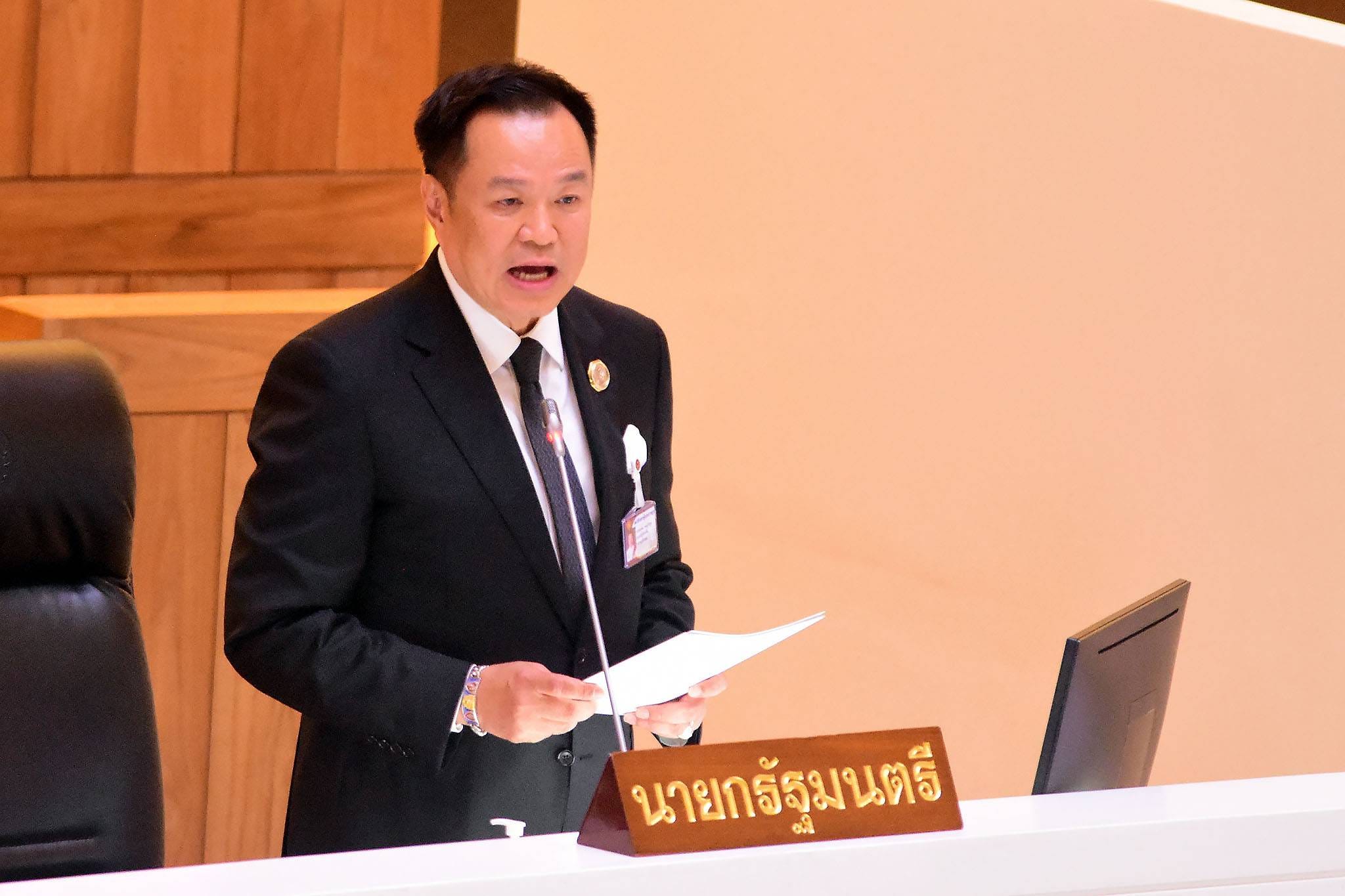
Sometimes writing on the formation of Prime Minister Anutin Charnvirakul’s second cabinet is it all feels a bit like déjà vu. Anutin made his new declaration of policy to parliament today — his last one was in October, just six months ago! Here we are again to analyze this latest statement. The full policy declaration is available in English here.
Anutin’s second policy declaration does differ markedly from the first, of course. Back in October, he had focused on laying out plans for a short-term premiership. Anutin alluded to his first term in this policy declaration, explaining that his government had “assumed the administration of state affairs under circumstances in which Thailand is surrounded by uncertainty on matters of the economy, society, politics, international relations and global geopolitics.” The previous government delivered “Quick Big Wins” through policies like the Khon La Khrueng scheme and resolving the Cambodian border conflict.
Anutin noted that the government had been able to increase economic growth in the fourth quarter of 2025, but Thailand is now facing renewed challenges due to the conflict in the Middle East. He thus declared that the government will be managing public resources with fiscal discipline “in order to increase flexibility in managing potential emergencies in the future to come.” Unlike in October, Anutin’s new statement also nods to his long-term vision for the country. He said that Thailand still faces several growth-reducing pressures. To this end, his government will seek to “flexibly adapt to new global rules and shifting power dynamics amidst ongoing uncertainty, while driving inclusive, high-quality growth to its maximum potential.”
Bhumjaithai is promising to follow through on many election pledges. It promises to continue the wildly popular Khon La Khrueng Plus scheme. On the security side, it also pledges to develop a 100,000-strong volunteer military program where Thai men can enlist on a four-year basis with “clear remuneration and performance evaluation systems.” And the government promises to expedite studying how to terminate MoU 44, the agreement between Thailand and Cambodia governing overlapping maritime claims and exploration of natural resources in the Gulf of Thailand. On the other hand, it doesn’t look like Pheu Thai’s flagship policies made the cut. There is no mention of the one million baht giveaway or a debt moratorium, for example — two major policies that Pheu Thai had run on during the election. This probably owes to the fact that none of the “economic ministries” (save the Ministry of Agriculture) were assigned to the party.
One thing that is new to this policy declaration is the inclusion of an “Integrated Strategic Cluster System” to manage state affairs. The five clusters are: 1. Macroeconomics, Investment and Future Industries, 2. Production, Trade and Services, 3. Infrastructure, Natural Resources and Environment, 4. Social and Welfare, and 5. Foreign Affairs and Security. Deputy government spokesperson Ratchada Dhnadirek said that the government will use these clusters to “[bring] together the private sector and the public, while repositioning the state as a supporter and facilitator for the people.” It’s probably too early to tell whether or not this is just a rebrand of pre-existing approaches or a genuine rethink of how to approach the achievement of long-term strategic goals in Thailand.
While Anutin acknowledged the holding of a referendum on amending the constitution (through which the public granted assent), there was no discussion of constitutional reform as a priority for the government. It’s probably safe to say that Bhumjaithai will not be moving forward aggressively on constitutional issues. Unless the opposition can unite on this issue (unlikely) and seek the support of some coalition partners (even more unlikely), no one will be able to force Anutin to follow through on the referendum result.
The opposition’s response
People’s Party leader Natthaphong Rueangpanyawut adopted the government’s five-cluster terminology to argue that this government is actually dominated by five clusters of powerful groups. (See here for the five clusters). He also said that the biggest challenge facing the country is not an external crisis but crises within; one example is the clean air crisis, which a trusted government would be dealing with by passing the Clean Air Act.
Kla Tham MP Atthakorn Sirilatthayakorn (who seems to be emerging as the party’s main spokesperson in parliament) acknowledged that the prime minister has “bad luck” and is facing a crisis immediately after taking office. But he then pointed out a litany of questions he had about the government, ranging from what he alleges is the limited visibility of star minister Suphajee Suthumpun, the high costs attached to policies like the volunteer military scheme, and the low likelihood of achieving the government’s goal of three percent GDP growth.
Democrat Party leader Abhisit Vejjajiva called the policy statement one that is largely unobjectionable but “lacks concreteness, lacks clear time frames, and lacks indicators” for measuring success. He noted that some major election pledges made by Bhumjaithai were missing in this policy statement. He pointed out that some Bhumjaithai figures had talked about building a land bridge during the campaign, but this did not appear in the election policies submitted to the Electoral Commission nor in the policy statement, turning it into a “secretive policy.”
Given the large majority enjoyed by the Bhumjaithai-led coalition, the policy declaration is sure to pass. After that, the new government will be able to get to work. Bhumjaithai’s slogan was “we walk the talk.” Anutin has spoken; now his government will have to deliver.
Next week is the Songkran holiday. Happy Thai New Year to everyone, and we’ll be back afterwards!
Happy Thai New Year ! Are you going to join the water fight?