


Good morning from The Coffee Parliament. Today, I’m going to focus on Bhumjaithai’s new proposals on how to honor the referendum result and move forward with constitutional reform. And also: a short Morning Coffee Briefing is attached at the end!
Bhumjaithai unveils their proposals on constitutional reform
On May 20, the Bhumjaithai Party officially submitted its draft bill on constitutional reform to Sophon Zaram, the Speaker of the House of Representatives. After criticism that constitutional reform appears to be stalled, the government appears eager to demonstrate that it does intend to honor the results of the constitutional referendum held earlier this year. If any bill on constitutional reform passes in this parliamentary term, it will almost certainly be the Bhumjaithai draft, given that the government holds a substantial majority. As such, it’s worth taking a look at what this draft contains.
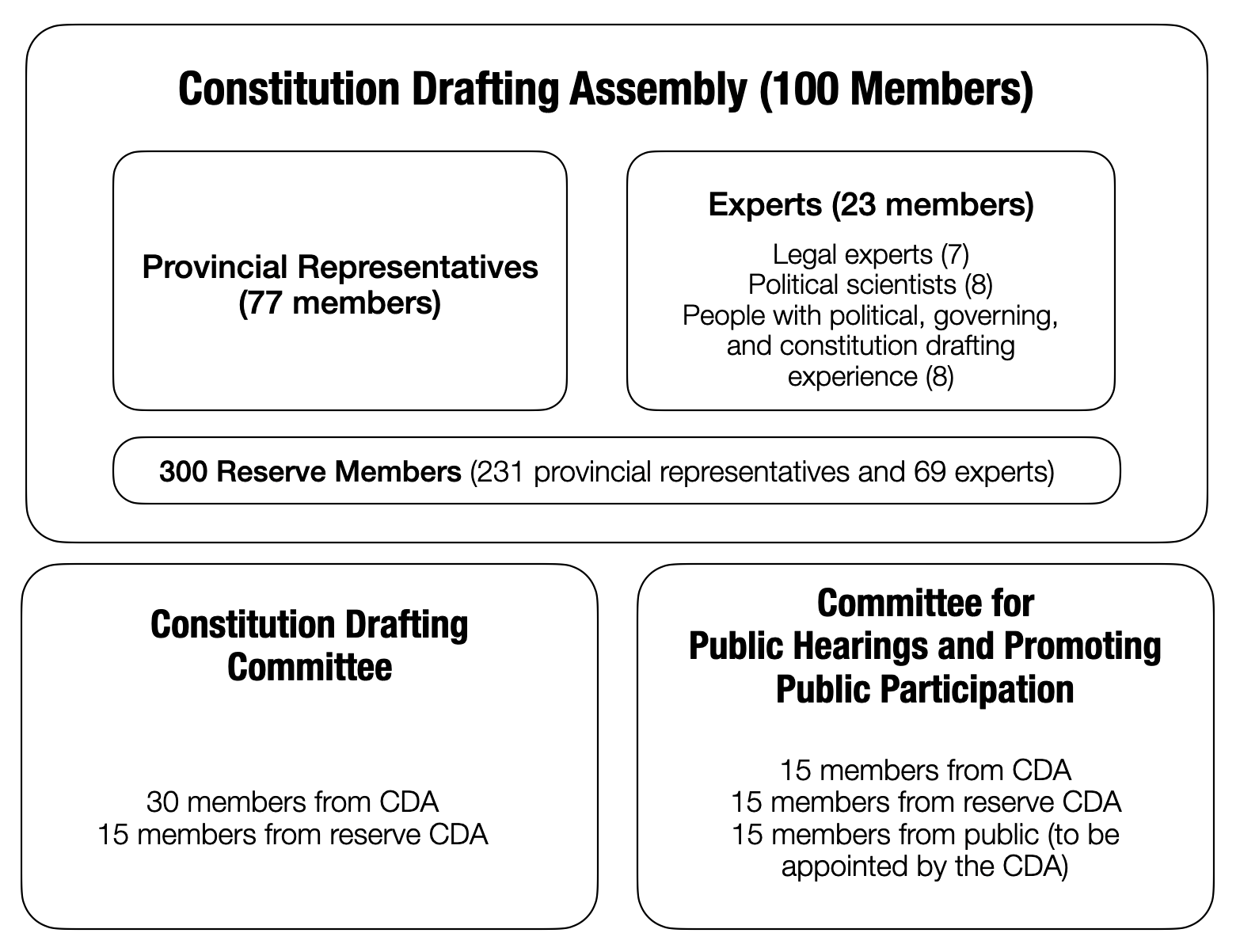
The new draft that Bhumjaithai unveiled is quite similar to the previous version it submitted to parliament back in September 2025. The Constitution Drafting Assembly will be composed of one hundred members, including representatives from each of Thailand’s 77 provinces and 23 members with legal and political expertise. A further 300 reserve members will also be selected. From these members of the CDA, a Constitution Drafting Committee and a Committee for Public Hearings and Promoting Public Participation will be appointed. (See diagram below for full breakdown).
Technically, this legislation is submitted as an amendment to Section 256 of the 2017 Constitution (which governs how constitutional change can be conducted). One major change that Bhumjaithai has made in the 2026 version of this draft compared to the 2025 version is the parliamentary threshold by which a new constitution has to be pass in order to be approved. It mandates that a new draft requires the approval of more than half of all parliamentarians — which works out to 351 MPs and senators out of the 700 total. This must include at least 1 in 4 senators. In the previous draft, the minimum number of senators was 1 in 5. (Given what we know about the political affinities of the current Senate…) The draft also requires the approval of 20% of the MPs from parties who are not represented in the cabinet or the parliamentary leadership (i.e. opposition parties and minor coalition members).
Following the Constitutional Court’s ruling last year that the CDA cannot be directly appointed, Bhumjaithai’s draft will have the CDA be selected by parliament. Bhumjaithai proposes that the number of CDA members each party can select will be proportional to the number of MPs it has. This means that if the selection process occurs before a dissolution of parliament, the House of Representatives-selected portion of the CDA will reflect the 2026 election results, in which Bhumjaithai is the largest party. I have not seen official confirmation of how the Senate-selected portion of the CDA would be broken down yet.
The opposition parties are not entirely happy with Bhumjaithai’s draft. The People’s Party is particularly displeased with the proposed method of selecting the CDA, with leader Natthaphong Rueangpanyawut, asking whether it would allow some political groups to monopolize power in the drafting of the new charter.1 It’s also worth noting that the Bhumjaithai draft bans any amendment of Sections 1 and 2 of the Constitution (which deals with the basic structure of the state and the monarchy), while the PP has long stated it does not agree with such restrictions. Meanwhile, Democrat Party leader Abhisit Vejjajiva appears to be treading the middle ground, arguing that a reform proposal should allow for broader participation by the public while also putting Sections 1 and 2 off-limits. Acknowledging that the Democrats do not have enough seats to propose its own version of charter amendment, Abhisit said he will seek cooperation with other small like-minded parties.
Nikorn Chamnong, Bhumjaithai’s chief spokesperson on constitutional matters, has estimatedhttps://www.bbc.com/thai/articles/cj6p9n2y8k9o that the selection of a CDA can occur next year. Should the new draft constitution pass the two remaining required referendums, it would likely come in effect by 2029. All of that is contingent, of course, on the draft legislation passing. I do believe that Bhumjaithai will make a real attempt to pass its draft — this is likely to produce a CDA that is most friendly to its own vision. But for a party like the PP, it is caught between a rock and a hard place. This might be the only shot of pursuing constitutional change in the short term, but CDA members selected by the party will form a very small minority. In other words, it is unlikely that a new constitution will be produced that incorporates the PP’s vision.
Morning Coffee Briefing
It’s been two weeks since the last Morning Coffee Briefing; here is a roundup of some important updates since then. (I couldn’t get this out in time for morning coffee in Thailand, but hopefully you can enjoy it with your Monday lunch!)
1. The race for Bangkok governor appears to be mostly set, with Chatchart Sittipunt having resigned from office and preparing to run for re-election.
The Democrat Party unveiled Anucha Burapachaisri, a former Bangkok MP and Prayut government spokesman, as its candidate for governor.
For now, polling points to a race that is not at all close: a Suan Dusit Poll had Chatchart leading the field at 57.68%, with an enormous lead over his closest challenger, the People’s Party candidate Chaiwat Sathawornwichit at 17.90%. This is partly due to the campaign not having properly started yet, so all of Chadchart’s competitors suffer from lack of name recognition. But that’s a lot of ground to make up in one month.
2. The 400 billion baht loan is facing a major legal challenge, as the Constitutional Court has accepted the petition by opposition parties asking it to evaluate the bill’s constitutionality.
See last briefing for more details about this loan decree.
3. Prime Minister Anutin Charnvirakul has spent the past few days in France, in a visit that is scheduled to take six days.
Today, the prime minister plans to sign a “Joint Action Plan for Strengthening Thailand - France Partnership 2026-2028.” According to the Thai government: “It aims to elevate bilateral relations to a Strategic Partnership, while expanding collaboration in areas that are aligned with global trends, such as transition to decarbonized energy, and promotion of Thailand’s soft power in fashion, film, and cuisine.”
Thai firms have been urging Anutin to prioritize negotiations over the Thailand - EU Free Trade Agreement.
Cambodia and Thailand both are currently making their appeals to France. Perhaps it's fitting that the word "overtures" comes from Old French. Meanwhile, talk of war and militarization grows on both sides. Is another outbreak of violence inevitable?
No! Cambodia and Thailand largely agree upon what they can't agree upon. And most importantly, they agree that neither one really wants the fighting to resume. The rest should be decided on the field of sports, not the field of battle. Settle it with balls, not bombs.
A recurring sports tournament can decide the fate of the Overlapping Areas. A recurring sports tournament can create an economically significant event for Cambodian and Thai businesses in the media, transportation, and hospitality sectors. A recurring sports tournament can let free up both militaries to do their best jobs: demining and demarcation.
Imagine a world in which we got to enjoy the fruits of our hard fighting because we didn't have to go die in a war nobody wanted to fight in the first place. Take the game away from the old generals and give the future back to the youth generation who fights for it best; on the field, in the water, and head-to-head. Play For It!
https://sites.google.com/view/playforit/