

Good morning, and happy Monday! Welcome back to your weekly iteration of the Morning Coffee Briefing. This week saw a frenzy of activity emanating from Prime Minister Anutin Charnvirakul’s cabinet, so that will be the locus of our focus today.
This week’s Thailand top three:
The Anutin government officially cancelled the maritime agreement with Cambodia, MOU 44
The cabinet is moving forward with an emergency decree to borrow 400 billion baht
Constitutional reform looks set to be stalled
1. MOU 44 is officially revoked
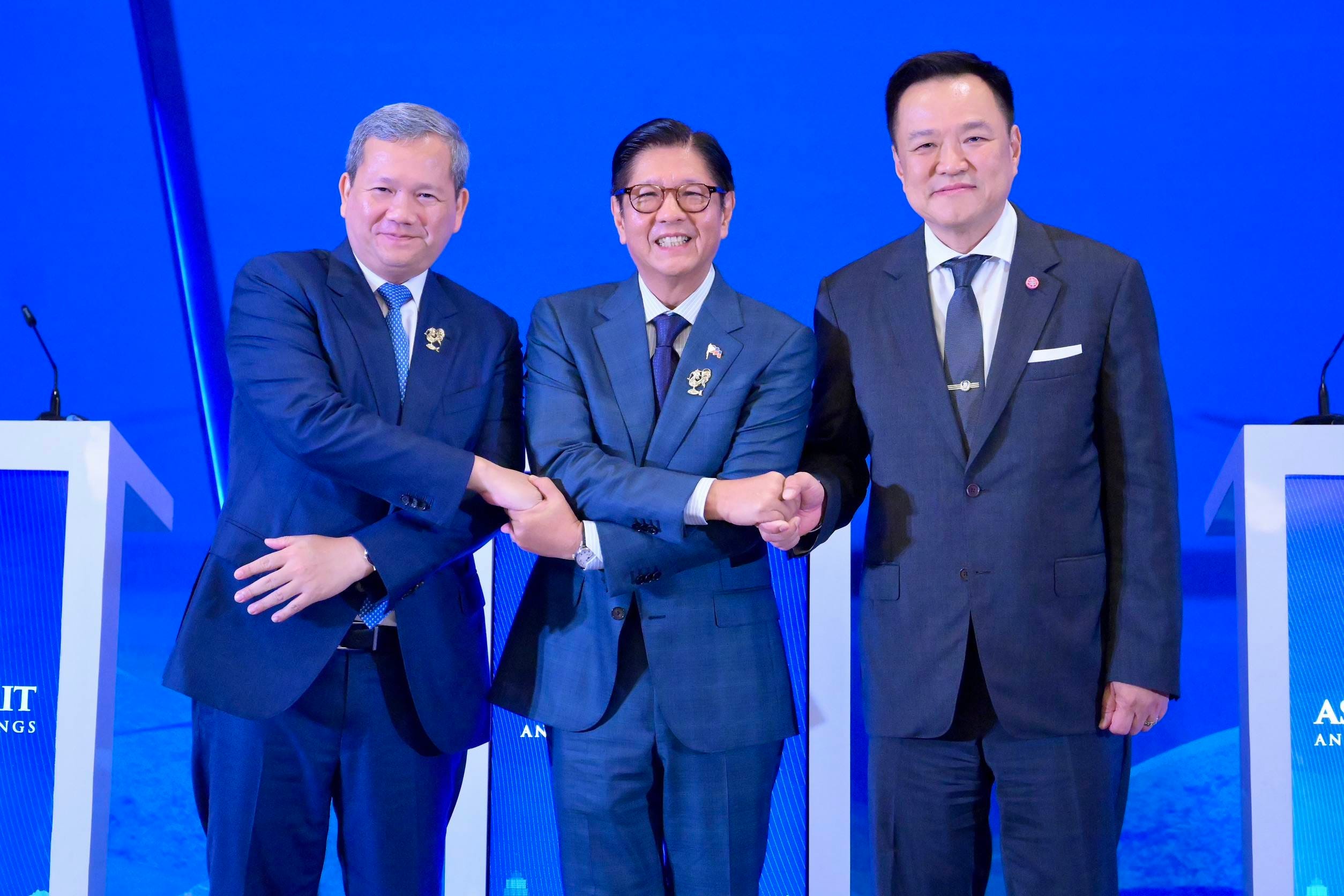
The cabinet, on the recommendation of Deputy Prime Minister and Foreign Minister Sihasak Phuangketkeow, moved to unilaterally revoke MOU 44 on May 5. Anutin informed Cambodia’s prime minister, Hun Manet, of his decision at the ASEAN Summit in the Philippines. Without MOU 44, Thailand and Cambodia will fall back to UNCLOS mechanisms; Hun Manet has already pledged to move forward with compulsory conciliation, a move that Anutin welcomed. (This is a non-binding process led by a five-member commission). However, the Ministry of Foreign Affairs said that while Thailand is aware of Cambodia’s desire to use this process, Bangkok has not necessarily agreed.
What’s MOU 44, again? This is a bilateral agreement between Thailand and Cambodia, signed in 2001 under the Thaksin Shinawatra government, where the two governments established a framework to negotiate overlapping maritime boundary claims in the Gulf of Thailand. It also proposed a Joint Development Area to explore petroleum and natural gas reserves before a final boundary is agreed upon. Critics have argued that MOU 44 posed a risk to Thailand’s sovereignty over Koh Kood island. This is also the rationale behind which the government is choosing to pitch the necessity of cancelling MOU 44. Anutin posted on Facebook that “without MOU 44, there will no longer be a line drawn through Koh Kood to cause further doubt or concern. My fellow citizens can rest assured: #KohKoodBelongsToThailand.” Of course, MOU 44 dealt with more than just Koh Kood and it remains to be seen what the outcome of UNCLOS compulsory conciliation (if it happens) would be for the maritime borders.
2. Government seeks to borrow 400 billion baht
The Anutin cabinet also approved a draft emergency decree that authorizies the Ministry of Finance to borrow up to 400 billion baht. As the Public Relations Department summarized, the funds will be used “to ease impacts on people’s living costs caused by the energy crisis and to support the restructuring of Thailand’s energy sector to reduce vulnerability and strengthen energy security in the long run.” Of these funds, 200 billion baht will be used to alleviate the impact of rising costs for vulnerable groups, and another 200 billion baht will be used to facilitate the transition to renewable energy and reduce dependence on imported fuels.
Unsurprisingly, this borrowing scheme is controversial. Thailand’s public debt already stands at around 66 percent of GDP, leading to earlier reports that the government may seek to raise the debt ceiling (currently at 70 percent).1 The constitution, however, mandates that “the issuance of an Emergency Decree under paragraph one shall be made only when the Council of Ministers is of the opinion that it is an emergency of necessity and urgency which is unavoidable.”2 Deputy Prime Minister and Finance Minister Ekniti Nititanpraphas argues that to avoid cascading crises stemming from raising energy prices, which could lead to stagflation, this borrowing is necessary. However, both the People’s Party and the Democrat Party raised questions about the necessity of this borrowing and how the funds will be used. Both parties say they plan to raise a challenge on the legality of this decree with the courts.
3. Constitutional reform stalled
Our final major update concerns something the cabinet didn’t do: the cabinet did not select the constitutional amendment bills still pending from the previous parliament to carry over to the current parliament. Minister attached to the Prime Minister’s office Paradon Prissanananthakul said that the last dissolution of parliament was caused by disagreement over the constitution reform process, and that meant it would be unlikely that the draft would fail to pass once again.
I believe I am correct in saying that the 2026 constitutional referendum led to the biggest popular mandate in Thai history, with over 21 million people voting to draft a new constitution. Yet drafting a new constitution was not included as a government priority in its policy declaration to parliament. For his part, Anutin has maintained that the referendum result was a “command” from the people that is “beyond just a policy” and must be obeyed. However, the People’s Party’s Parit Wacharasindhu said that the government “lacks sincerity” in following the referendum result, while the former election commissioner, Somchai Srisutthiyakorn, asked if this meant the constitutional reform process would be delayed by another two years.
In other news…
Former prime minister Thaksin Shinawatra was released on parole today, as we discussed last week.
The People’s Party officially launched their campaign for the Bangkok local elections, with Chaiwat Sathawornwichit as their candidate for governor.
The Democrats will launch their Bangkok election campaign on May 16. Their candidate is a male businessman with political experience aged between 50 to 60. It’s anyone’s guess who that is.
The government now insists that the debt limit will not be breached.
See Section 172 of the 2017 Constitution.