

Thank you to everyone who reached out to me both privately and in the article comments about my news roundup last week. The consensus appears to be that it was helpful. So here is a second morning coffee briefing to start off your Monday!
I still can’t promise that this will be a regular feature — and to be upfront, if I do turn on paid subscriptions to this newsletter I may make some of these news roundups subscriber-only. But for now, they are completely free, and I hope you enjoy them!
This week’s Thailand Top Three:
The Anutin government revives proposals for a land bridge in Southern Thailand
Thaksin Shinawatra approved for early parole
Agricultural minister Suriya Juangroongrueangkit finds himself in hot water over a bureaucratic transfer
1. A land bridge to nowhere?
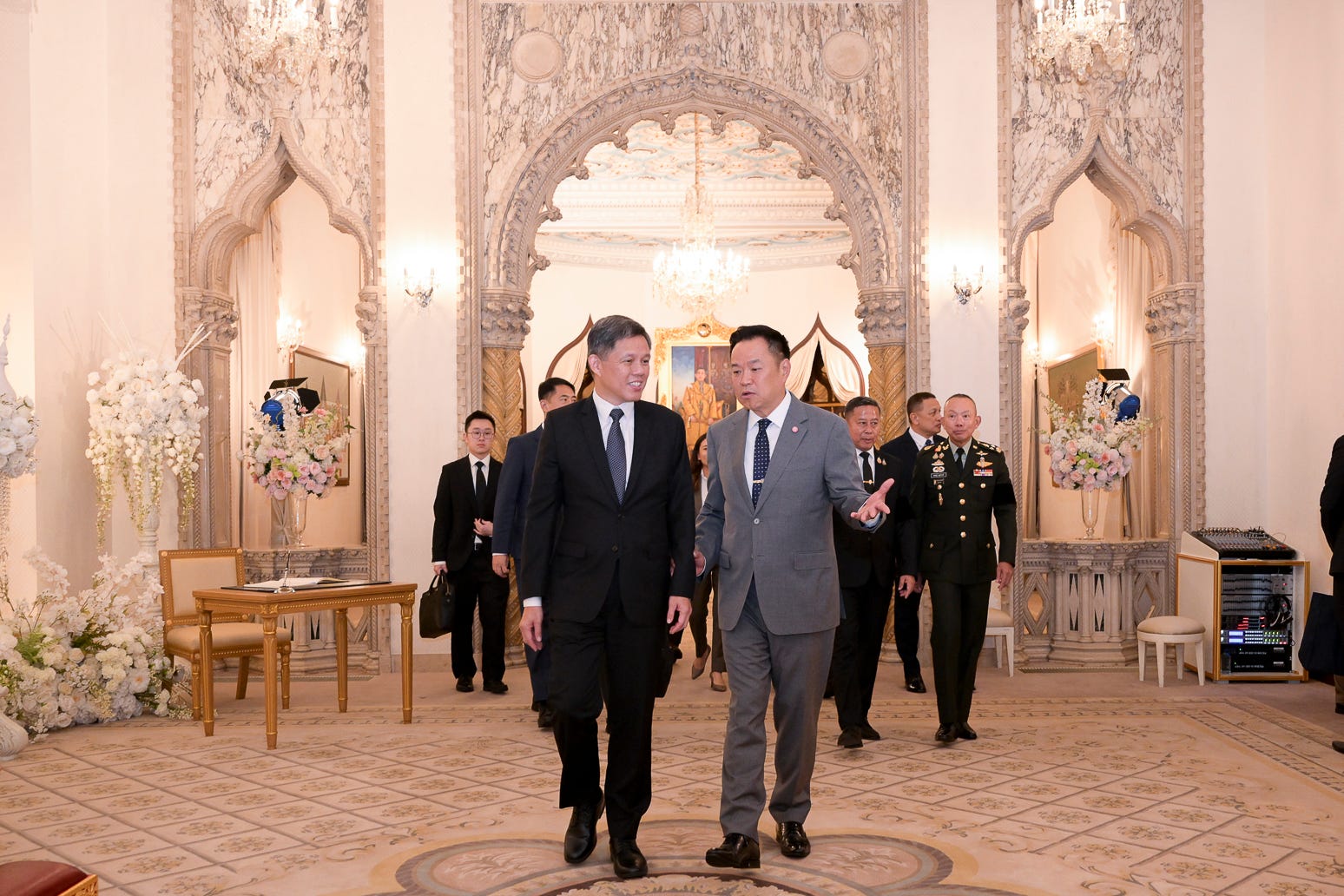
The crisis in the Hormuz strait has led to a revival of plans around a “land bridge” in Southern Thailand. Instead of summarizing everything to do with this on-again, off-again mega-project vision here, recommend Aidan Jones’ article in the South China Morning Post here on the land bridge scheme. Prime Minister Anutin Charnvirakul pitched the land bridge vision to visiting Singaporean Defense Minister Chan Chun Sing; the Thai readout stated that “Singapore expressed interest in Thailand’s Land Bridge project, viewing it as a means of transport connection between the two coasts to reduce risks and enhance logistics capacity.”
Predictably, the revival of the land bridge has been controversial. The People’s Party has called for a re-evaluation of the land bridge. The Democrats said that Bhumjaithai did not include a land bridge in their policy proposals during the election campaign, and that shipping companies have privately told the party they would not be interested in using it. There has also been some friendly fire: Industry Minister Varawut Silpa-archa said there must be a thorough environmental assessment, leading Deputy Prime Minister Phiphat Ratchakitprakan to joke that Varawut was setting out a position based on his role as the former environment minister and “may be forgetting that he is currently industry minister.”
Given the high price tag of pursuing such a scheme, expect the land bridge to continue dominating policy debates if the Anutin government is serious about pursuing it. But for the land bridge enthusiasts out there, I wouldn’t get too excited yet: a land bridge has been under discussion since the Prayut Chan-o-cha government, and so far the scheme has gotten nowhere.
2. Thaksin to go home
Former prime minister Thaksin Shinawatra was returned to prison in September year after the Supreme Court ruled that his stay at the Police-General Hospital between 2023 and 2024 was unwarranted. Since then, we have heard very little from him, aside from what his family has reported after their regular visits to see him in prison. (He reportedly sang a version of “Let It Be” after hearing about the election results in February). Now, Thaksin is coming out: he was granted early parole owing to his age and health.
We still don’t know how public a political role Thaksin will play on his return. Pheu Thai leader Julapun Amornvivat said that Thaksin is unlikely to take up an official advisory position, but remains the “spirit” of the party. Yes, Thaksin could finally make good on his pledge to focus on taking care of his grandchildren. But it’s difficult to imagine Thaksin divorcing himself entirely from politics.
3. Controversial bureaucratic transfer
Agricultural Minister Suriya Juangroongrueangkit has found himself shrouded in controversy this week. Rachen Sillaparaya, the director-general of the Royal Rainmaking Department1, resigned from the bureaucracy after he was transferred to another position in the ministry. Rachen was due to retire in only five months.
Rachen stated in his resignation letter that he was “unable to meet the demands” of the political appointees. Suriya first clarified that he had transferred Rachen because he wanted someone younger in post, “not an old person nearing retirement.” Rachen then alleged that Suriya’s nephew, who runs an airline, had tried to contact him (but that he had not taken the meeting). This prompted Suriya to respond that he had been unaware of his nephew’s attempt to contact Rachen. The drama took another turn when Rachen was also forced to respond to rumors that he was planning to field his daughter as an MP candidate in Sakhon Nakhon; Rachen dismissed these rumors by noting that his daughters are only in primary school. His sister, however, ran as a Bhumjaithai candidate in the past.
While this might initially look like standard conflict between politicians and bureaucrats, this particular controversy could have important implications. Already, a petitioner has asked the Electoral Commission to investigate whether this transfer qualifies as an ethical violation; if the case is taken up, this could potentially lead to Suriya’s removal. Pheu Thai would much prefer for publicity to be concentrated on Deputy Prime Minister and Minister of Higher Education Yodchanan Wongsawat, who is currently the face of the party; the transfer controversy provides the party with unwelcome headlines instead.
In other news…
The People’s Party launched a quasi-shadow cabinet. (I say quasi because there is no shadow minister assigned to each cabinet minister).
Deputy Prime Minister and Commerce Minister Supajee Suthumpun has found herself in a prickly situation due to her decision to team up with a famous livestreamer to sell durian for 100 baht per kilogram.
Bangkok Governor Chadchart Sittipunt sent the strongest signals yet that he’s running for a second term. The People’s Party is likely to field deputy leader Chaiwat Sathawornwichit, while the Democrats say they have a candidate but cannot yet reveal who it is. The Economic Party says their candidate, whose name starts with a “J” (จ), has wide name recognition.
Royal rainmaking refers to an artificial rainmaking initiative launched by His Majesty King Bhumibol Adulyadej.