

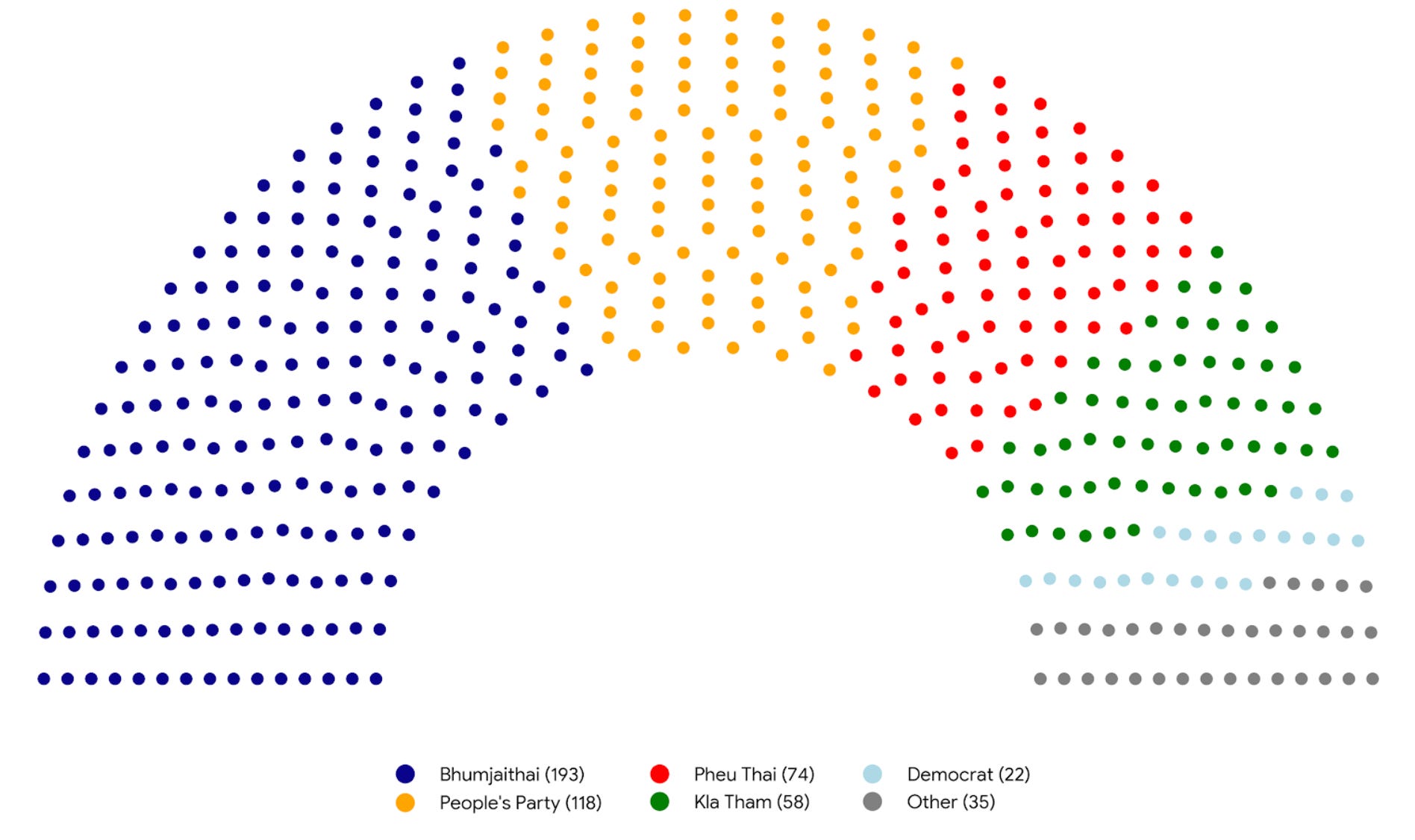
Yesterday, at 31 percent reporting, Bhumjaithai was on track to win the general election by a sizable margin. That result has held. According to ThaiPBS, these are the current projections of seats at 94 percent reporting:
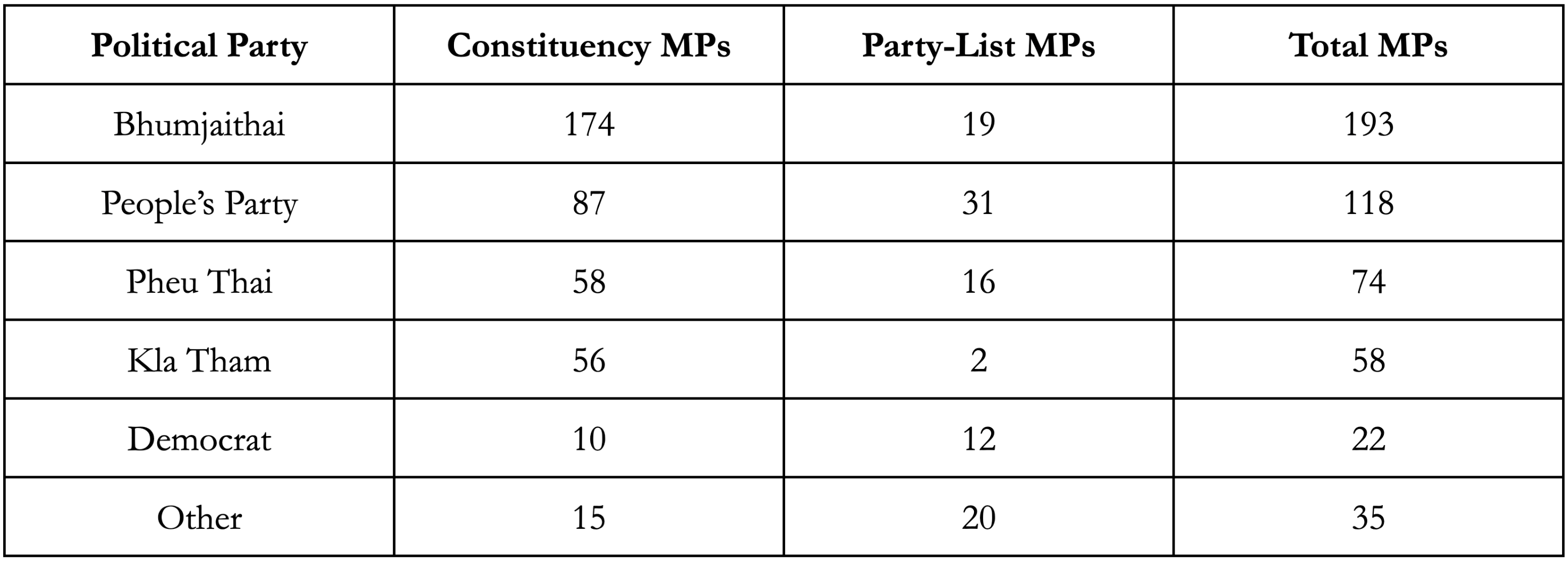
We have a clear Bhumjaithai victory.
The key takeaway: Bhumjaithai’s win
In the last piece before the general election, I wrote:
Thammasat University professor Prajak Kongkirati has noted, “Since 2001, when the party-list was introduced, no party has ever won the most seats without winning the party-list vote.” This general election will prove whether this law of Thai politics holds. On its surface, this is a much less dramatic narrative than the originally promised storyline. But it could be no less dramatic in its electoral outcome.
The outcome has been dramatic indeed. Bhumjaithai became the first party to successfully divorce its constituency results from the party-list vote share, allowing the PP to prevail on the seat-poor party list while winning a major haul of the seat-rich constituency ballot.
How did this happen? Perhaps it is because this was in many ways an ambiguous election: there was no single issue that animated voters. The issues that did come to the forefront, like the border conflict, were the ones that motivated conservative voters to support Bhumjaithai. Turnout fell from 75 percent in 2023 to 65 percent in 2026, likely reflecting the antipathy of PP and PT voters. These conditions favored the strong local networks of Bhumjaithai.
The PP did have a polling surge near the end of the campaign. “If those leads do not sweep away the local Bhumjaithai incumbents,” I wrote, “Anutin will have a good night. If they do, his hold on the premiership will look tenuous.” Remarkably, very few Bhumjaithai incumbents lost. Some were felled here and there; by and large, however, they held on, and made important gains. Anutin had a very good night.
Party by party instant analysis
All went according to plan for Bhumjaithai
I’ll have a longer piece out soon on the factors that led to Bhumjaithai’s victory, and I already described what I think were Bhumjaithai’s strengths in my previous piece. So I won’t say much more here other than to note that everything went to plan. In addition to its successful local strategy, the party successfully consolidated the conservative electorate behind it, winning even more party-list votes than Prayut Chan-o-cha did with United Thai Nation in 2023.
Strategic mistakes by the People’s Party put victory out of reach
The PP made at least two major strategic mistakes that doomed its election campaign. The first was its support for Anutin Charnvirakul as prime minister, after which the party’s popularity significantly decreased. While the numbers recovered in later polling, I would not be surprised if it was precisely these lukewarm PP supporters who couldn’t bother to turn out. Placing the benefits of incumbency in Anutin’s hands will likely be seen in retrospect as one of the clearest instances of political self-harm in recent Thai history. As Anutin said, “Without them on that day, there is no us today.” The party’s choice of prime minister candidates was its second strategic mistake: the slate simply could not excite its supporters in the same ways that Thanathorn Juangroongrueangkit or Pita Limjaroenrat did. All of this resulted in the party losing five million party-list votes since 2023.
In a consolation prize, the PP swept all of Bangkok’s 33 constituencies — something never done before in history, defying my own expectations that the PP’s decreased popularity might have allowed PT to snatch a few constituencies back. The gain of one Bangkok seat cannot make up for its loss of over twenty constituencies elsewhere, however, where the party’s decreased momentum appears to have faltered against Bhumjaithai and Kla Tham’s local networks.
Pheu Thai falters
PT saw both their constituency seats and their party-list vote share halved. This is a devastating result for the party. It was wiped out in its former stronghold of Chiang Mai and faltered in many areas in the North and Northeast. For the first time in its history, PT will be a mid-sized party that can at most play the role of a junior coalition partner. This isn’t necessarily an indictment of Yodchanan Wongsawat, who actually proved to be a capable campaigner. The party’s baggage from the previous administration has likely proven too heavy for anyone to lead the party to victory.
Kla Tham’s local-first strategy bears fruit
Kla Tham became the clearest example of how willing Thai voters are to split their ballots. The party won on the party-list ballot in only Phayao province, Thammanat Promphao’s stronghold. In total, they won only two party-list seats. But Kla Tham swept 56 constituencies, distributed across the country. That is more than even many expert forecasts, which already trended to emphasize local strength. It is a validation of what Thammanat has affirmed as his core political strategy: “Local politics is the root of larger politics…building a local political foundation is the most important thing.”
The Democrat Party lives to fight another day
On the surface, the Democrat Party’s performance seems disappointing; despite all the talk of revival the party actually lost seats compared to its 2023 performance. With only eight incumbent MPs left at the time of dissolution, the Democrats faced an uphill battle in winning constituency seats, and like the PP they failed to prevail over Bhumjaithai and Kla Tham’s local networks. But that top-line number disguises important trends. On the party-list ballot, at the time of writing the party has won 3.6 million votes. That is very close to the Democrats’ performance in 2019. That means that within just a few months of returning to lead the party, Abhisit Vejjajiva has managed to win back a substantial number of previous supporters. The map of party list results showed that the South has returned to being a sea of light blue. For a party that was widely seen as comatose just a few months earlier, living to fight another day will be seen as mission accomplished.
What comes next?
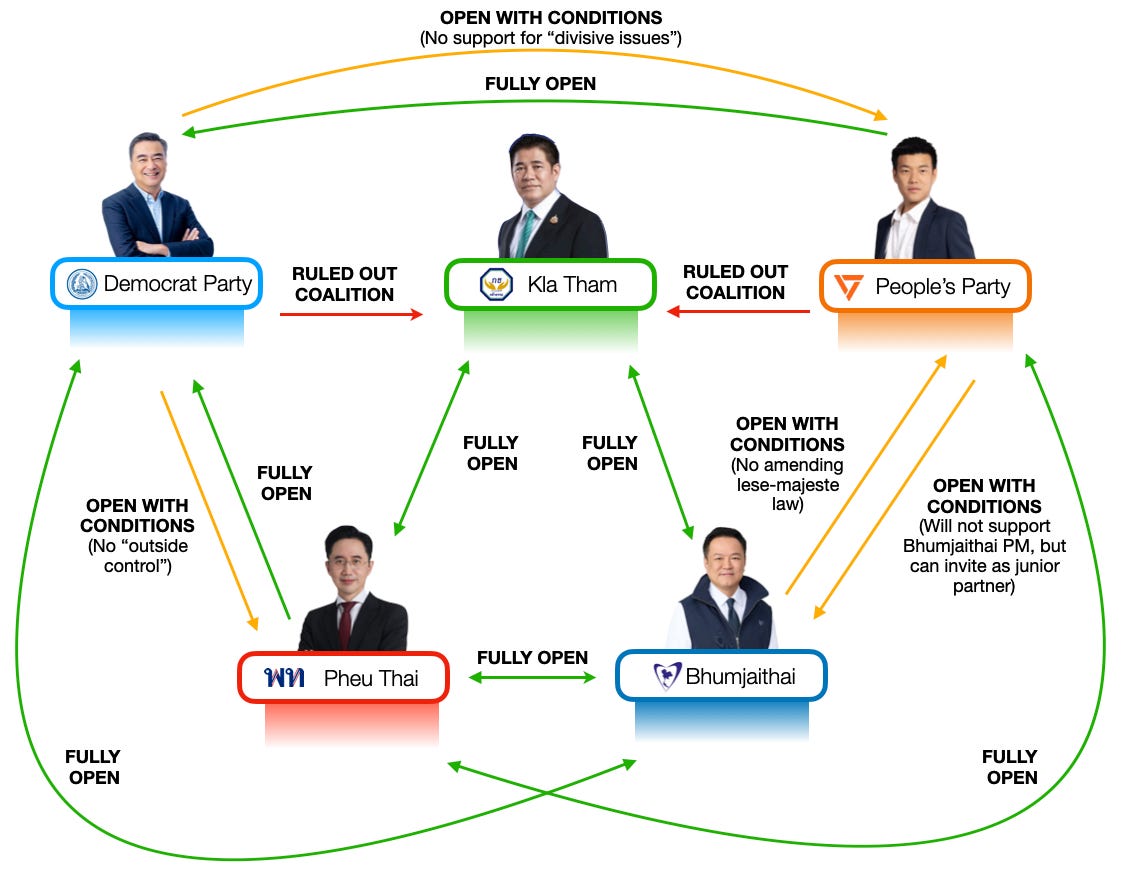
It’s early, but let’s run through some of the coalition math. First, some red lines:
The People’s Party will keep its promise not to try to form a government if it lost the election, guaranteeing that they will lead the opposition
Abhisit says that the Democrats are likely to be in opposition, as the party does not have enough seats to successfully pursue its policies, although he has left the door open to coalition talks
This leaves Pheu Thai and Kla Tham as the most likely coalition partners.
Technically, Bhumjaithai could form a government with its current partner Kla Tham. Or it could partner with just Pheu Thai. But that would make for a razor-thin majority that would be highly vulnerable to a vote of no confidence. Anutin is unlikely to risk that. He could invite some of the 35 MPs from the smaller parties, but not all of those parties will be willing to join this coalition.
It thus seems more likely to me that Anutin would want both Pheu Thai and a mid-sized coalition partner. He would thus have to make a choice between Kla Tham and the Democrats. A BJT + PT + KT coalition would create a very stable coalition (325 seats), while a BJT + PT + Democrat coalition would lead to a government that is stable enough (289 seats).
We’ll likely have more clarity on this front in the days ahead.
Any thoughts on inside sources saying Anutin tried contracting PP to persuade them of joining the coalition government (prior to NACC forwarding the 44 MFP case to the Supreme Court probably) and that Bhumjaithai still have reservations about partnering up with KT (with KT's history of being untrustworthy)? https://x.com/MorningNewsTV3/status/2020740976768327992?s=20
BJT + KT is a lock. Not up in the air as many speculate.
The reason is clear from their electoral strategy. There was undeniable collusion between BJT and KT, where both parties essentially did not contest the same constituencies.
It was very similar to Pheu Thai and Thai Raksa Chart, except BJT and KT did run in the same constituencies, they just didn't actually campaign there.
You can see from the results. In areas KT won, BJT barely got votes (noticeably low votes in the low thousands). And inversely, where BJT won, KT got a few thousand votes.