

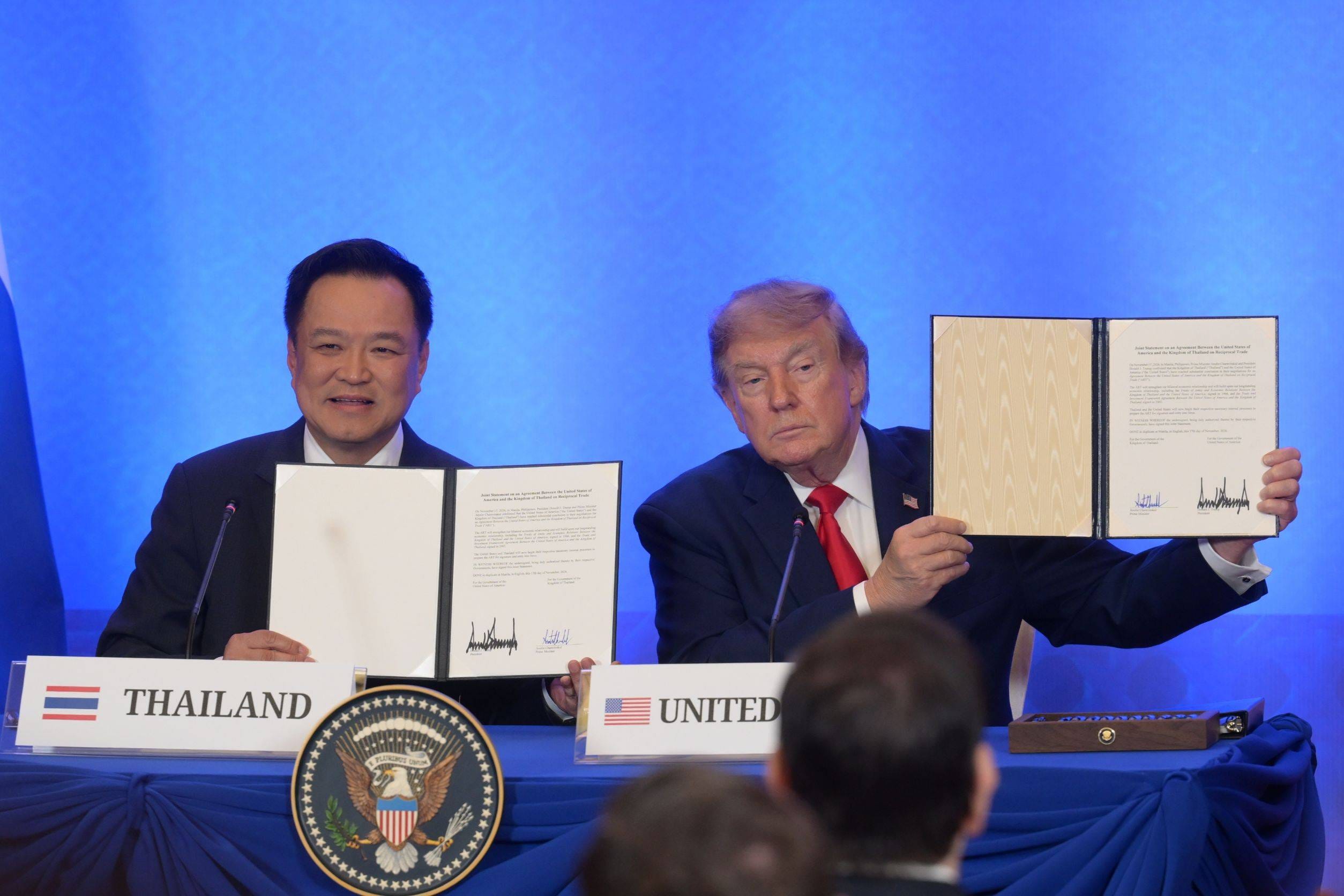
Good morning from The Coffee Parliament. It’s been a week of summitry for Prime Minister Anutin Charnvirakul as he flew first to Manila for the ASEAN summit then to Shenzhen for the APEC summit. On the sidelines of the ASEAN summit, Anutin and US President Donald Trump signed the Thailand-US Joint Statement on Reciprocal Trade (ART). We haven’t discussed trade enough in this newsletter and this gives us a perfect opportunity to do so.
First, a brief overview of how US tariffs on Thailand have evolved since Trump’s return to the White House. Trump’s initial tariff rate on Thailand set on “Liberation Day” in April 2025 was 36 percent, but talks between the Trump administration officials and Thai negotiators from the Paetongtarn Shinawatra government had reduced the rate to 19 percent. (In between, Trump had pegged the successful completion of trade talks on an end to the military conflict between Thailand and Cambodia). That agreement required Thailand to make substantial concessions, including exempting 99% of US products from tariffs and importing 2.6 billion dollars worth of US agricultural goods. However, those tariffs had been imposed using the International Emergency Economic Powers Act (IEEPA), which the US Supreme Court found did not authorize Trump to unilaterally impose tariffs, rendering the initial set of tariffs moot.
Despite the setback, the Trump administration pivoted to using Section 122 of the Trade Act of 1974, which grants the president authority to impose tariffs for a maximum of 150 days to correct a serious balance-of-payments crisis. Trump thus imposed a global tariff rate of 10 percent, but this expired in July. Trump thus turned to Section 301, which allows the president to impose tariffs on countries that are too lax in enforcing forced labor import bans. This allowed him to place a tariff on 12.5% on Thai goods. In addition, Thailand remains subjected to additional tariffs under Section 232 of the Trade Expansion Act, which allows Trump to add tariffs on specific products under national security grounds.
In Manila, Trump said that Thailand had committed to eliminating tariffs on 99% of US goods and purchase 2.6 billion dollars worth of US agricultural products. This deal may sound familiar, because that is exactly what the Paetongtarn Shinawatra government had committed to! Interestingly, Deputy Prime Minister and Commerce Minister Suphajee Suthumpun later said that Trump had been referring to previous terms agreed to by the Pheu Thai negotiators, which Suphajee said that Trump had raised to “make Americans feel good.” That said, some newspaper reports on Suphajee’s statements do indicate that the terms were kept, but that the elimination of tariffs on US goods will come in gradual phases.
Overall, Thailand appears to have been considerably more reticent in explaining the contours of the agreement, but the White House has already released Fact Sheet which clearly sort of deal the two countries are looking at:
The trade deal, once signed, will eliminate tariffs on 99 percent of goods and remove non-tariff barriers on American vehicles, medical devices, pharmaceuticals, ethanol, and poultry, increasing market access for a full range of U.S. industrial and agricultural exports.
The trade deal will also protect and enforce U.S. intellectual property, increase economic security alignment, and strengthen and enforce Thai labor and environmental laws to balance trade.
Separately, Thailand intends to commit up to $123 million toward the purchase of America’s High Mobility Artillery Rocket Systems (HIMARS). The sale would give America’s treaty Ally long-range precision fires and support 400 American jobs and the U.S. defense industrial base. Once concluded, it would be the first deal of its kind in mainland Southeast Asia.
The reason that this situation still appears fluid is because the Joint Statement that Anutin and Trump signed is not a final trade agreement but rather a note that the two had “reached substantial conclusion in their negotiations.” Indeed, Anutin said at their signing that “there is a little more to do.”
The ambiguity of the situation has opened the government up to criticism. Democrat Party leader Abhisit Vejjajiva said that he was concerned about the trade negotiations, noting that there were still no details on what benefits Thailand would receive from the trade agreement. A deputy government spokesperson fired back, asking if Abhisit is not aware that Trump was referring to the 2025 talks, while Suphajee shared multiple posts on Facebook responding to Abhisit. In my view, we could use some more clarity on how much of the 2025 agreement still applies. (Thai PBS also reported that the Anutin government wants to reduce Thailand’s Section 301 tariffs reduced from 12.5% to 10%, but we have not seen public discussion of that so far).
Additionally, Thailand may have some future friction with the US due to the fallout from the Jensen Huang/NVIDIA scandal. A new interim rule from the Commerce Department imposes restrictions on several Southeast Asian countries’ abilities to purchase advanced AI chips from the United States. Anutin has welcomed data center investment in Thailand, but his will likely have an adverse impact on the region’s data center boom.
So we’ll have to keep watching to see what the final trade agreement looks like. You would be well-advised to brace yourself for substantial concessions from the Thai side, however. As Deputy Prime Minister and Foreign Minister Sihasak Phuangketkeow told Bloomberg: “We all have to make sacrifices and compromise. But what can we do? The US is a big market.”
Side note from the past week: While at the APEC Summit, Anutin also held bilaterals with Chinese President Xi Jinping and Russian President Vladimir Putin. At the very least, the prime minister had a good time at his summits, with Trump praising Anutin’s performance as prime minister and Anutin getting another opportunity to show off his language skills by merrily talking to reporters in Cantonese. He now returns to a tenser situation at home, with youth protests adding to the existing threats to the Bhumjaithai government.
I really enjoy all your analysis of Thailand's government. Prime Minister Anutin continues to show strong leadership. AI, critical minerals, and data centers are the future, and Thailand is well positioned to be at the center of all three. Whoever is in the White House, Thailand's leader should have a direct line to the American President. That partnership matters to both countries.
The first thing that entered my head was who in their right mind makes a deal with Trump? Lame duck or not he is venal and will only do things that he can crow about or make money for his family.