

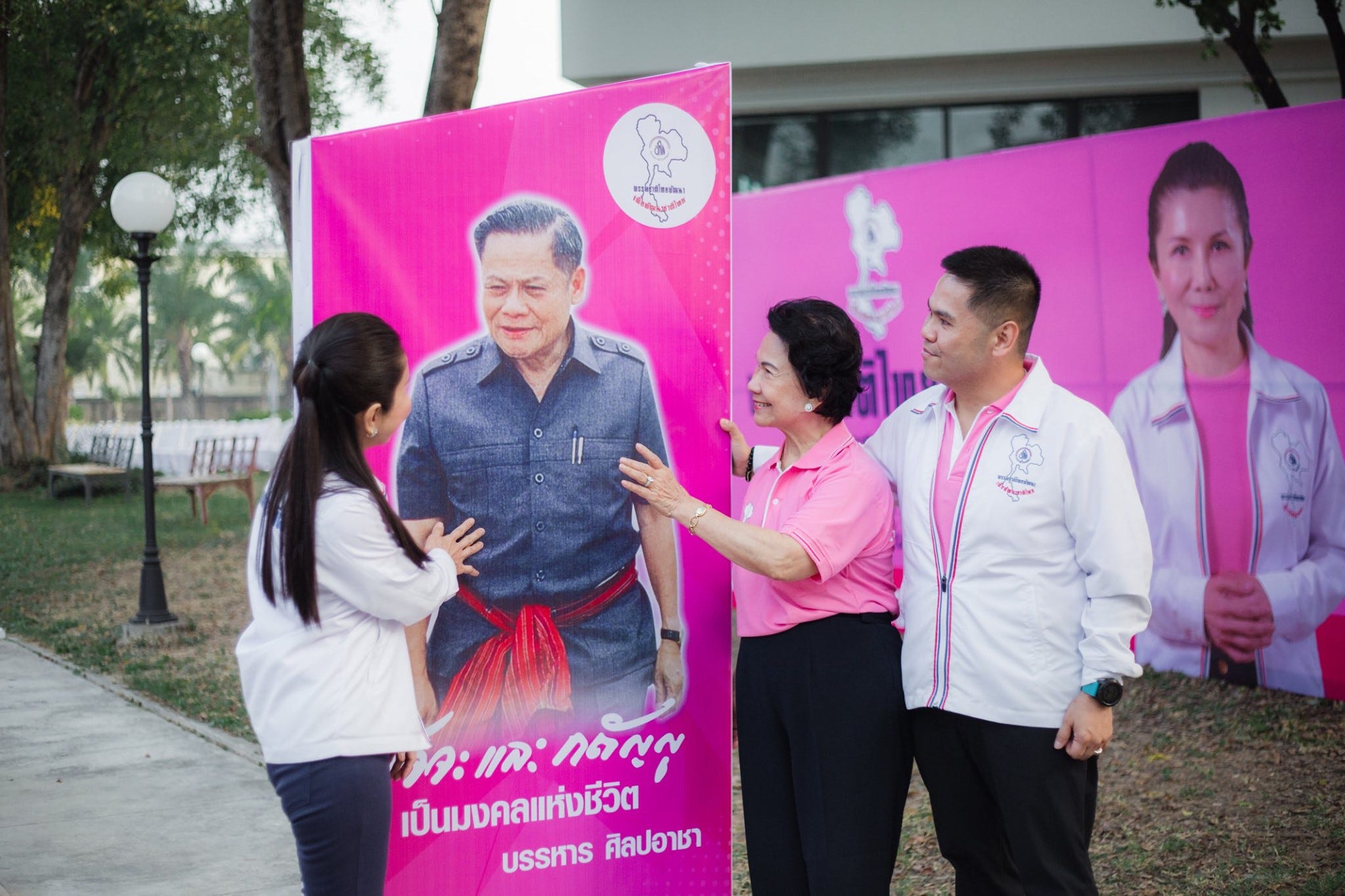
In the Thai media, it is often to refer to the Democrat Party as phak kao kae — “the old party.” They, after all, are the oldest party currently in existence, and by a good margin. Prachakorn Thai (founded in 1979) still technically exists and so does New Aspiration (founded in 1990) — but neither have played a meaningful role in Thai politics in the past 25 years. So if you ask which party is the second oldest Thai party still in existence, most will draw a blank.
But measuring the ages of parties in Thailand can be a funky business. In recent decades political parties have been marred by court-ordered dissolutions, only for the core leaders of those parties to promptly regroup and found new parties that are virtually indistinguishable from their forcibly-dissolved predecessors. If you consider those parties to be continuous in existence, then the second oldest party still surviving would be the Chart Thai Party, founded in 1974 and reincarnated as Chart Thai Pattana in 2008.
Over the course of its existence (and rebirth), the Chart Thai Party has underwent dramatic evolution. The party was originally founded as the organizational vehicle of the Soi Ratchakru Group, a faction of military generals which initially supported Field Marshal Plaek Phibulsongkram as prime minister. The suspension of democracy during the authoritarian period of the 1960s sidelined this group from power, but the subsequent return to democracy provided an opening for the group to return to power. The Chart Thai Party was thus founded by two prominent members of the Ratchakru Group, Pramarn Adireksarn and Chatichai Choonhavan. (The two were linked with family ties, Pramarn having married Chatichai’s sister). Initially, the Chart Thai Party became a representative of Thailand’s rightwing forces. The founders declared that the goal of the party was to “oppose the expansion of the Communist Party of Thailand.”
The party was electorally successful from the 1970s to the 1990s. In 1988, the retirement of the long-serving premier Prem Tinsulanonda allowed Chatichai Choonhavan to form a coalition government with Chart Thai at the core. But the 1991 military coup forced Chatichai from power, and the party was soon to be taken over by someone from outside the Ratchakru clan. Banharn Silpa-archa, a construction magnate, was not a blood relative of the Choonhavans or the Adireksarns, but he had been one of the party’s main financiers.
His rise to the party’s leadership would permanently transform the party. Banharn’s dominance of his province, Suphanburi, was the stuff of legend, to the point where it was often nicknamed Banharnburi. An unrivaled attention to local detail and the sponsorship of provincial infrastructure ensured that Suphanburi would become Barnharn’s permanent stronghold. As Yoshinori Nishizaki writes:
Suphanburi was once a typical “backward” province in Thailand, owing to the negligence of the central state. Since the 1960s, however, Banharn has rectified this condition by using a combination of his personal funds and institutional power in the state, to a point where Suphanburi now boasts many roads, schools, and other development works of superior quality. The reason why many Suphanburians support Banharn is because all the developmental initiatives he has taken visually represent his valiant efforts to enhance the image, prestige, reputation, or social status of their province. For these people, Banharn…has developed the formerly backward Suphanburi on behalf of, or in contrast to, the callous, inept, and lackadaisical central state.1
Even as the party continuously shrank election after election after his one-year premiership between 1995 and 1996, Suphanburi would never fail to return Chart Thai MPs. By 2019, with the party now under the leader of his son Varawut Silpa-archa, the Chart Thai Pattana Party counted almost all of its constituency seats from Suphanburi. The same applied in 2023, when the party swept Suphanburi but won little else, aside from an allied clan winning some seats in Nakhon Pathom province and a stray seat in the distant northeastern province of Roi Et. This Suphanburian strength explains why the party could live into old age: even as other parties collapsed with their founders or were swept away by unfavorable national headwinds, Chart Thai Pattana could count on the fervent loyalty of its local stronghold.
Decision time came up, however, with the next general election coming up. Varawut could perhaps count on the continued loyalty of the electorate in Suphanburi and once again return a small contingent of MPs to parliament — which would be sufficient to bargain for a ministerial seat or two. But this strategy is not free from risks. The 2023 general election had been marked by pervasive ballot-splitting, with Chart Thai Pattana in Suphanburi gaining only 110,046 votes on the party list compared to 227,983 on the constituency ballot. If that number declined further, the party may not win a single party-list seat. And even their constituency MPs were not necessarily safe. Many of the “big houses” in other provinces had already been felled by the Move Forward machine in 2023, and there was no guarantee that the Silpa-archas could be fortified against national swings forever.
But it was still a bit of a surprise when Varawut indicated his intention to take his MPs to the Bhumjaithai Party. The party said that the move was required to “get past the limitations of a small party” — a party with less than 20 MPs cannot independently sponsor legislation — and better assist with helping local people. The Bhumjaithai Party, they explained, was filled with ex-Chart Thai members, making them an appropriate new home. Nikorn Chamnong, a longtime party member, explained further that Varawut was allocated the Ministry of Social Development and Human Security in the last Pheu Thai cabinet, which allowed him to work with the marginalized but was different from when the party held the Agriculture Ministry, which could assist more people directly.
This move comes with major risks of its own. The Chart Thai Pattana Party will still be around, with Banharn’s daughter Kanchana Silpa-archa taking over as leader, but for now it does not appear that the party will be playing any active role while most of its politicians are in Bhumjaithai. Yet it would be difficult to revive the party in the future once it has been left for dead. Would Suphanburi still be loyal? Would the Banharn brand still mean something? Can these connections be revived? Varawut’s own bargaining power is also diminished in Bhumjaithai. In Chart Thai Pattana he ran his own fiefdom, but in Bhumjaithai he becomes one of many local faction leaders.
But what is happening to Chart Thai Pattana now may ultimately simply be a concession to reality: that politics in Thailand is increasingly nationalized and national parties are playing a bigger role, even in local races. There are very few local parties left. The Palang Chon Party, which won several seats in the eastern region, has basically collapsed. Chart Pattana — also founded by Chatichai, after his party’s takeover by Banharn — still exists, but its claims to be the party of Nakhon Ratchasima has rang increasingly hollow as it failed to win any seats there in 2023.
Even a local legacy as formidable as Banharnburi, it seems, may no longer be enough in this national environment.
See page 19 of Political Authority and Provincial Identity in Thailand: The Making of Banharn-buri by Yoshinori Nishizaki.
In 1991, a journalist of The Nation newspaper (3 March) characterized Banharn's role in Suphanburi as follows: “Many structures in the provincial town were named after him [Banharn] and his wife, Jamsai, indicating the couple has sponsored or somehow helped support their construction. In the heart of the town stands the ‘Banharn-Jamsai’ clock tower. Nearby there are the ‘Banharn-Jamsai’ secondary and vocational schools. Ailing locals go to the ‘Banharn-Jamsai’ hospital. Policemen rest in a ‘Banharn-Jamsai’ police booth. Devout Buddhists make merit at the ‘Banharn-Jamsai’ Temple in Danchang district. On their way to the temple, some travel along ‘Banharn-Jamsai’ road or pass the ‘Banharn-Jamsai’ intersection. Families can soon visit the ‘Banharn-Jamsai’ park, presently being created. A sign in the town reads: ‘Suphan Buri people are grateful for the contributions of Your Excellency Banharn Silapaarcha’” (The Nation, March 3, 1991).
If Chart Thai Pattana can actually consistently get 10 or so MPs, it’s actually dumb to join BJT.
They could join any government coalition they wanted. Let's say in the next election the People's Party came first but needed partners, they would gladly invite CTP.
Or BJT won and needed allies, they too would invite CTP.
And unlike many other parties, people from all sides actually view CTP favorably. I don't see any reason to dilute their importance by joining BJT.
What do they gain? Now they're at the mercy of party leadership. Negotiating for MP posts is much easier as a small party than as a faction in the party.