


In the past week, I’ve done a few interviews on former prime minister Thaksin Shinawatra’s release from prison last Monday. I wanted to gather together some thoughts into a full post. As such, there will be no Morning Coffee Briefing this week — my apologies!
I also recently wrote a piece for Latitude Ten on how Thailand is a nation of self-help books: check it out here.
From resilience to rejection
In 1996, Thaksin Shinawatra led the Palang Dharma Party into a general election. The previous year, the party had won 23 seats in parliament — a respectable number, although lower than in recent elections. But the 1996 general election proved to be fatal. Palang Dharma won only one seat. It was a mortal wound: the party would never win a seat again in an election. Thaksin felt compelled to resign from the party leadership.
Leading a party to such an electoral defeat would probably be fatal to most politicians. But of course, just five years later Thaksin would lead his new Thai Rak Thai Party to what was at that point the biggest election victory in Thai democratic history. 2001 marked the beginning of what Jonathan Head and Hataikarn Treesuwan call the “Thaksin era,” something that they note “is now almost certainly over.”
Whether or not the Thaksin era is over is a matter for legitimate debate. The former prime minister has proven to be one of the most resilient characters of Thai politics, with him and his family surviving two coups and several unfavorable judicial rulings. Thaksin has proven perfectly capable of getting up when he is knocked down: the 1996 election is firm evidence that he can never be counted out. His return to Thailand in 2023 was another example of a previously-unimaginable comeback.
Indeed, can you think of another politician who has been as politically relevant as him for as long? When Thaksin first entered politics in 1990s, the major political players were men like Chuan Leekpai, Chavalit Yongchaiyudh, Banharn Silpa-archa, and Chamlong Srimuang. Banharn is dead; Chavalit and Chamlong have long retired from politics. Only Chuan remains an active politician, but as a backbencher. The sheer length of Thaksin’s level of influence is virtually unprecedented.
But the challenges that now lie against him do put into question whether or not a comeback will finally elude one of Thailand’s most wily politicians.
The question is thus: can a “Thaksin thinks, Pheu Thai acts” approach to politics still work? The Thaksin-fueled Pheu Thai brand was built on an anti-status quo orientation and generous economic schemes. But it appears that the Pheu Thai playbook has finally been exhausted. Ironically, the dealmaking of Pheu Thai in 2023 may have lost some of its political resonance, given that Thaksin has now served his prison sentence and the People’s Party engaged in curious dealmaking of its own in 2025. But its latest tenure in government was in its own terms damaging to the party brand. Its signature 10,000 baht giveaway scheme was delivered only partially, and the economy was lackluster at best.
Unfortunately, the party appears to have run out of ideas and ways to make people talk about their ideas. Twenty-five years ago Thai Rak Thai’s policies and campaigning methods were a novelty. Now they are commonplace, and room to innovate has narrowed considerably. Recall that this year, their flashiest election pledge was a proposal to give one million baht to nine people a day. In elections past it would have been one of the central talking points of the campaign. Remarkably, this proposal faded from the headlines rather quickly, and few still discuss it today. Pheu Thai’s ability to control the national conversation simply is not what it once was.
And all of this is before we even consider the baggage that comes up with the Shinawatras. Prime Minister Paetongtarn Shinawatra’s premiership ended in deep controversy over her phone call with Cambodia. (That was enough for me to write in July 2025 that this signaled the end of the family’s political dominance). Thaksin himself remains a deeply polarizing figure, someone who can inspire enough hatred that tens of thousands of people came out to protest against him, his brother-in-law, and his sister in the late 2000s and early 2010s.
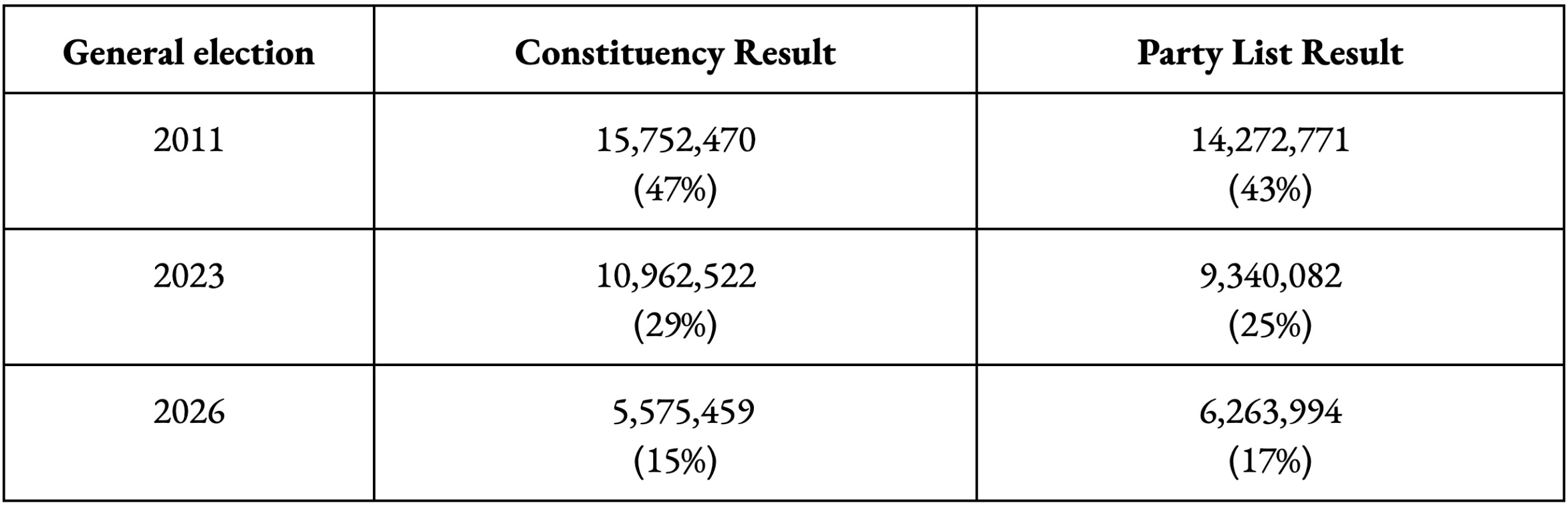
Which brings us to where we are today: a party suffering from a precipitous decline. Take a look at the trend of Pheu Thai’s electoral performance in the past three elections where there was a two ballot system. The trend of decline is starkly visible. Between 2011 and 2026, Pheu Thai has lost about 10 million constituency votes and 8 million party-list votes. This gives us all the information we need about the declining efficacy of Pheu Thai’s electoral strategy.
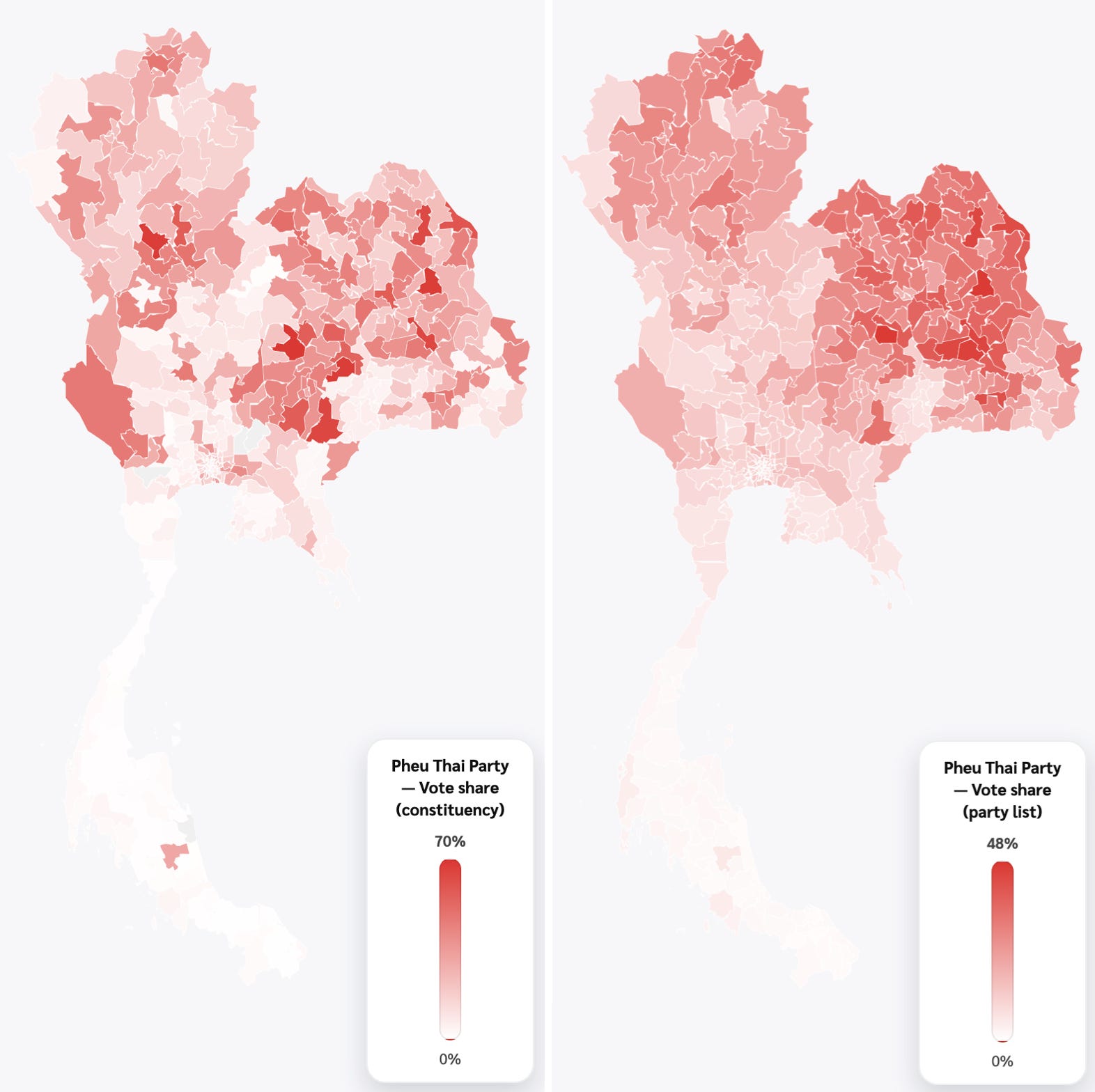
Pheu Thai has clearly lost its luster even in the strongholds where the Shinawatra brand had counted most. Consider results in the last general election. The party lost major ground in the Northeast to Bhumjaithai and Kla Tham and in the North to Kla Tham and the People’s Party. In former strongholds, the results were devastating. Take Chiang Mai, Thaksin’s birthplace, for example. This was a province where Pheu Thai won 65 percent of the vote in 2011. They had lost a lot of ground in 2023 to Move Forward. Shockingly, they were completely wiped out this year.
Pheu Thai as a mid-sized player
The fundamental question facing Pheu Thai is this: is it satisfied with being a mid-sized party? Some media reports have said that it is. Already, we are seeing signs of retrenchment. The party, for example, will not be officially fielding councillors in the Bangkok local elections, even as it allows some candidates to use the party logo. This comes just four years after Pheu Thai became the largest party on the Bangkok Metropolitan Council.1
Being a medium-sized party with anything between 30 to 80 seats is not an impossible task, as long as they prevent valuable local factions from jumping ship. In this scenario, Pheu Thai could remain a relevant political player for years to come. Like Bhumjaithai or Chart Thai in the past, it could be an indispensable coalition partner that makes up the numbers for a majority and does not put too much of a fuss about the terms of joining a government. Yet this is a hazardous path. Mid-sized parties focused on just a few provinces or regions find it difficult to generate national krasae2 and thus tend to become smaller over time. The example of Chart Thai Pattana is a cautionary tale; the more it became identified with Suphanburi, the less viable it became outside the province. And the less powerful a party becomes, the more difficult the task of holding on to the local clans that are so important to powering constituency victories.
If it is not satisfied with medium-power status, however, we are not yet seeing Pheu Thai take any steps that would pave the way for a broader revival. Today in coalition with Bhumjaithai, Pheu Thai has limited opportunities to reinvigorate its own brand. It can hope that the latest member of the extended Shinawatra clan to hold high office, Deputy Prime Minister Yodchanan Wongsawat, will perform well and win back the party some votes. This could still work; few have strong opinions on Yodchanan, who is relatively fresh to the political scene. Yet Thai history is littered with examples of coalition partners hoping to “generate results” and then unfortunately finding that no one took notice.
But what would a path returning to greatness look like? The party’s existence has been so intertwined with Thaksin that it is virtually impossible to think of the party without Thaksin. But it is also increasingly difficult to think of a path forward for the party with Thaksin at the fore. To put it simply: Thaksin reminds people of the past. It is now 25 years since his first election victory. The youngest voters today were born after the first military coup that ousted his government; an even larger portion yet have basically no recollection of his premiership.
The Shinawatras’ role in politics is far from over, but the years of Pheu Thai electoral dominance is almost certainly at an end.
It’s worth noting, however, that the most electorally successful former Pheu Thai figure in recent years has been Bangkok governor Chatchart Sittipunt, who ran as an independent.
Thai phrase meaning, loosely, the national sentiment.
Thaksin won the 2001 election investing large sums of money in buying the votes controlled by the many provincial godfathers, which as you have previously pointed out, is how Bhumjaithai won the last election. So, is the "Thaksin era" just Thaksin and his bought votes and fake "populism" or is the political technique of buying the provincial votes?