

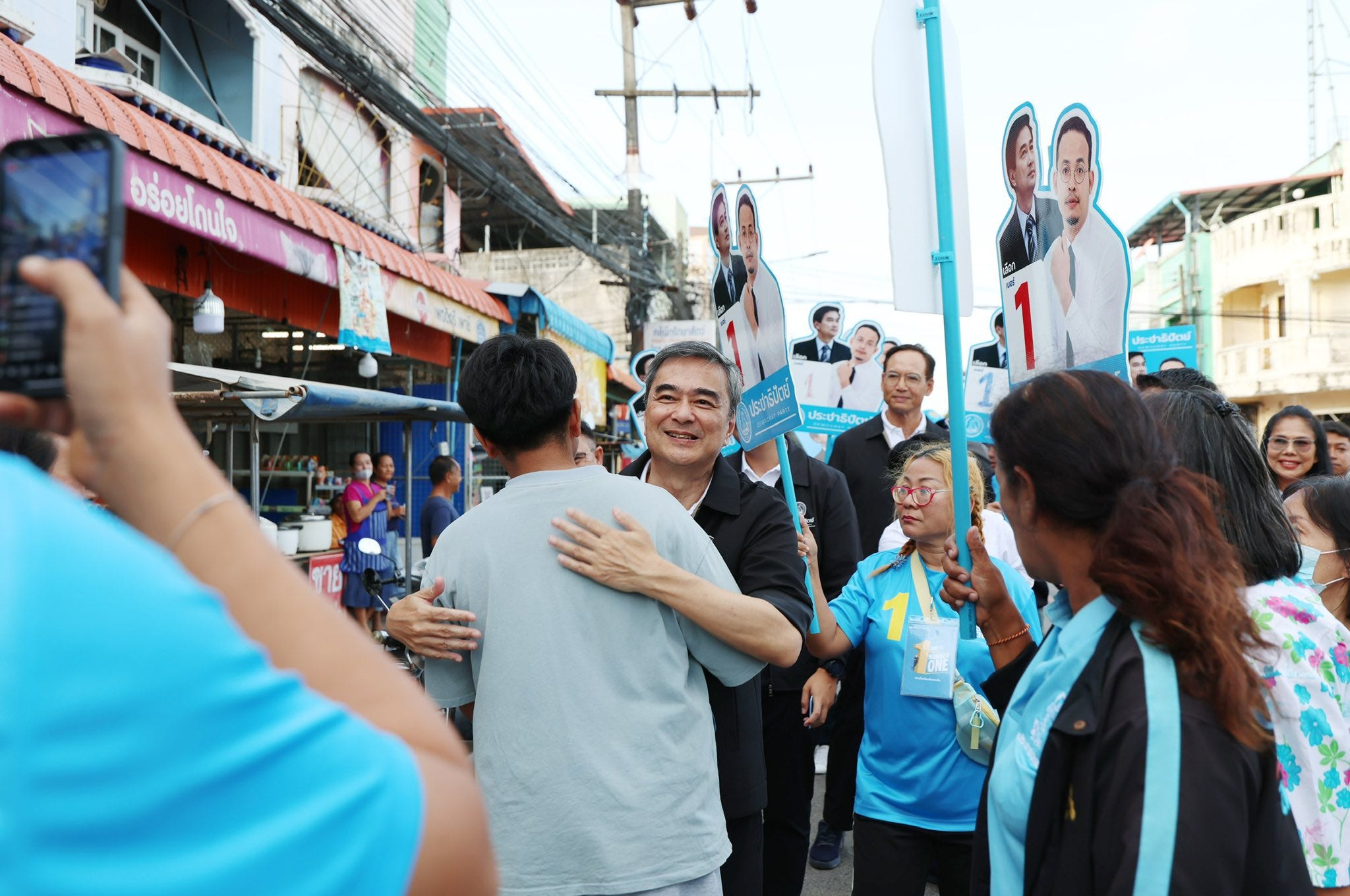
Southern Thailand has emerged as one of the most fiercely contested battlegrounds in this election, with a different dynamic to the other regions. I thought it was worth taking some time today to examine what has been happening in this region.
The South is, of course, the historical stronghold of the Democrat Party. There was a time when it was said that the party could field an electric pole as a candidate and the pole would win. But the Democrats’ dominance have faded over the past two elections. From a unified, unending stretch of light blue, Democrat control of the South was greatly diminished by 2023, reduced to a rump in the lower South as other parties ate into their vote share. The southern candidates that had won in 2023 had done so less based on the strength of the party brand and more on their individual local capacities. When a parliamentary dissolution was put on the horizon, these candidates began negotiating to move parties. And with their exit, a potential Democrat extinction in the South.
Among the parties the defectors have chosen is Bhumjaithai. At this election, Bhumjaithai’s Southern strategist Phiphat Ratchakitprakarn has announced that the party is aiming to win at least 31 of the region’s 59 constituencies. That would be up from the 12 won in 2023, and it is clearly an important component of Bhumjaithai’s bid to become the largest party in parliament. In a tight election such as this, Bhumjaithai’s ability to win big in the South could very well be the difference between first and second place. Kla Tham, meanwhile, has also re-homed several ex-Democrat incumbents, with former Democrat leader Chalermchai Sri-orn himself appearing at a Kla Tham event to express support for Thammanat Promphao.
But Abhisit Vejjajiva’s return to the Democrats has immediately revived a moribund party. A NIDA poll from Songkhla province showed Abhisit and the Democrats polling at upwards of 40 percent, far ahead of both the People’s Party and Bhumjaithai. It is a tally that is likely representative from the region as a whole. Abhisit’s return, to put in another way, seems to have reawakened the region’s historic attachment to the party — something much easier to do now that former prime minister Prayut Chan-o-cha is out of the picture. At first glance, this should indicate that the Democrats would be able to win back the South. But the reality is not so simple.
Let’s take Songkhla province, where the NIDA poll was conducted. Songkhla is home to nine constituencies:
District 1: The Bhumjaithai incumbent (who recently switched from the Democrats) is almost certain to win.
District 2: A three-way contest between Bhumjaithai incumbent Sarttra Sripan, popular Democrat candidate Jury Numkaew (a famous TikTok star), and a strong People’s Party challenger Supat Hasuwannakit. The result here will be a coin toss.
District 3: The heavy favorite is the Bhumjaithai candidate, an ex-Democrat who recently switched parties.
District 4: A Kla Tham incumbent was favored, although a legal inquiry against him may open up room for the Democrats.
District 5: Previously held by former Democrat secretary-general Dech-it Khaothong, his son is now running under the Kla Tham banner and is currently favored.
District 6: A two-way contest between Bhumjaithai and Kla Tham.
District 7: A Bhumjaithai candidate is favored, although former Democrat MP Sirichok Sopha is mounting a stiff challenge to retake his seat.
District 8: Appears to mainly be a two-way contest between a Kla Tham incumbent who switched from the Democrats, and a Bhumjaithai challenger.
District 9: The Democrat incumbent (another son of Dech-it’s) is heavily favored.
The result of this analysis is counterintuitive: in a province where the Democrats are way ahead in the polls, they are currently virtually guaranteed to win in only one constituency, with a good chance in another and an outside chance in two more! A similar picture repeats itself across the region. There are a few constituencies here and there where Democrat incumbents look impregnable, but in many cases Bhumjaithai and Kla Tham are the main contestants. In the worst case scenario, it is possible that the Democrats’ seat-total in the South could be in the low single digits.
But if the Democrats’ polling continue to improve, then the baan yai might become vulnerable to an upset, similarly to how Move Forward was able to use its momentum to topple a bunch of provincial clans in 2023. In that case, all bets are off, and we could see the Democrats significantly overperform expectations. In the meantime, however, the constituency candidates can only try to persuade voters to mark down the Democrats in both ballots. As Sirichok Sopha pleaded on his Facebook post, “if you love the Democrats and love Abhisit, you cannot give just half your love.”
Will such a message work? Bhumjaithai’s position in the campaign is a little complicated, which does provide an opening: it has after all been weighed down by the recent floods. Phiphat is thus making a bet that Southern voters will be receptive to another pitch: that they should “take back the thirty lost years” — implying that the Southern region has not grown sufficiently under the Democrats’ stewardship — and vote for Bhumjaithai in order to bring infrastructure development. In response, former Democrat prime minister Chuan Leekpai retorted that under his premiership, he did not focus only on regions that voted for him, while Abhisit noted that the Democrats have rarely ever had control of infrastructure-heavy ministries.
How the South swings could end up being an important determinant of the larger national picture. Prime Minister Anutin Charnvirakul has said that academic projections that Bhumjaithai will win around 150 seats are “too low.” But the fact that the South has been unwilling to end its decades-long loyalty towards the Democrats, at least on the party-list, could pose a challenge to Bhumjaithai’s ability to meet its larger goals.
One more factor is: you cannot underestimate the power of habits in elections.
I have Yellow Shirt → PDRC relatives who were diehard Democrats. Then, Prayut came and they voted for him twice.
This means they haven't voted for Abhisit/Democrats for 2 elections now. Once you break a habit, it's hard to start again.
For all the articles talking about Abhisit nostalgia or whatever, I still think going back is not as easy as people think.
Oh and by the way, those relatives now are mocking Abhisit. “Democrats will get 5-10 seats, it’s stupid to vote for them.”
No one wants to vote for a loser. Prayut could win. Abhisit never could.
The Democrats had a solid 6 seats in Songkhla in 2023. Their vote share was basically equal to that of BJT, UTN, and PPRP combined. So, I assume the assumption is that those candidates who left the party will make the difference against the Democrats, supposing that their replacements are much weaker. Is this the case?