

With the dissolution of parliament last week, Thailand has now shifted into full election mode. My plan is to post a little more frequently during the campaign to highlight notable news as the campaign progresses. If you’d like to read my election analysis during the election season, a subscription to The Coffee Parliament is currently completely free.
The Border Conflict and the Possibility of an Election Delay
In yet another instance of the international and the domestic being intertwined, the crisis at the Cambodian border may disrupt the 2026 general election. So first some updates on that front. There is no sign yet that the fighting will stop. Prime Minister Anutin Charnvirakul has repeatedly stated that his government is not currently pursuing a ceasefire. On December 13, he wrote (in a response to a social media post by US President Donald Trump) that “Thailand will continue to perform military actions until we feel no more harm and threats to our land and people.” Yesterday, Anutin posted a text message from Malaysian Prime Minister Anwar Ibrahim after Thai media reported that Anwar had seemingly ordered a ceasefire to take effect; Anwar clarified that this was merely a “suggestion.” All of this suggests that there will be no quick ending to the conflict.
The prospect of an extended military operation has raised questions about whether or not the election can be held as anticipated. Legally, an election must be held within 45 to 60 days of a dissolution of parliament, which means that the latest date in which an election must be held is February 8, 2026. However, Section 104 of the 2017 Constitution also states: “In the case where there is an unavoidable necessity constituting a cause for an inability to hold an election from taking place on the date specified by notification by the Election Commission under section 102 or section 103, the Election Commission may specify a new date for election, provided that the election must be held within thirty days as from the date such necessity ends.”
On December 13, Sawaeng Boonmee, secretary-general of the Election Commission said that “if an election is not held throughout the kingdom at the same time, then the election could be annulled.” If a crisis leads to this situation, the Election Commission would have two options: “bringing people to the polling stations” or delaying the election no longer than 30 days after the special circumstances end. There was some controversy about this statement. The former election commissioner, Somchai Srisutthiyakorn, argued that the election can be delayed in just some areas. However, a Thai PBS fact check did state that the secretary-general’s comments are legally accurate.
It’s too early to say whether or not we will be in a situation where an election delay is a possibility; February is still some time away, and the border situation may have calmed down by then. What if the conflict flares up again closer to the election date, however? These legal questions add more uncertainty into the political atmosphere.
NIDA’s Q4 Polling
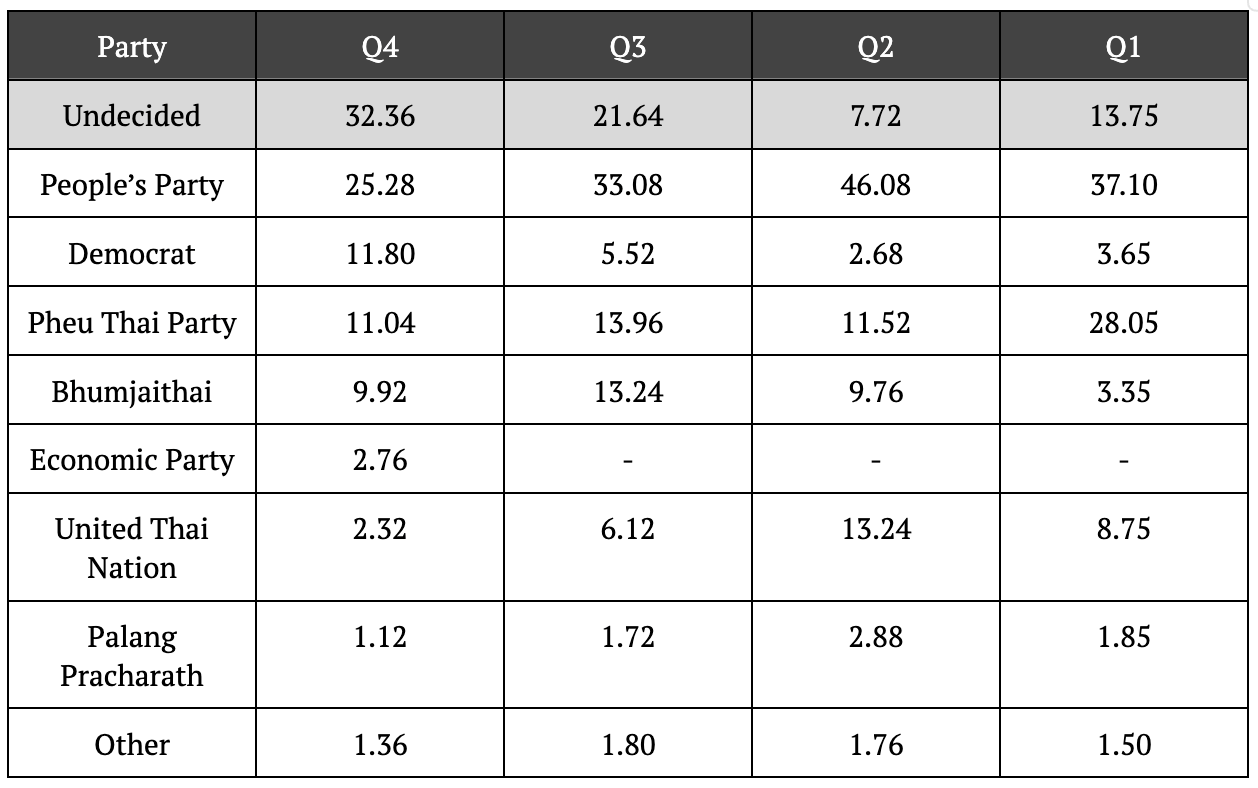
The latest national NIDA poll is out, and it gives us another clue at what the pre-campaigning baseline is. The poll was fielded between December 4 to 12, so mostly before the dissolution of parliament.
NIDA polling by party
NIDA polling by candidate
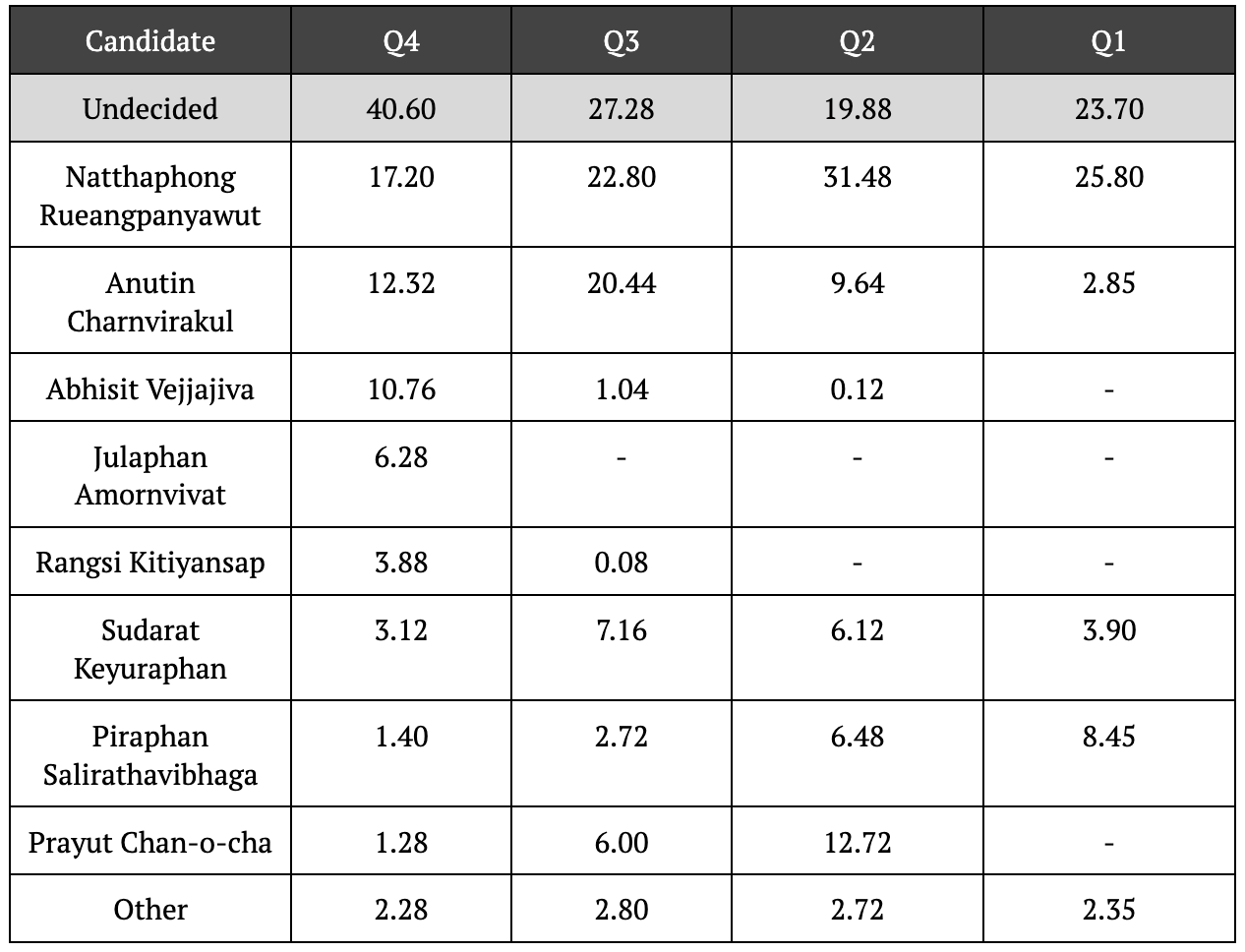
The number of undecided voters is higher than ever, exceeding the number of People’s Party supporters — indicating high levels of dissatisfaction with the current political options.
The People’s Party registered its worst polling result since it was formed after the dissolution of the Move Forward Party. It is clear that the party is facing several unfavorable headwinds; the party has had to hold an “apology picnic” after the collapse of its MOA with Bhumjaithai, and the party has been unable to find its footing amidst the conflict with Cambodia. Party leader Natthaphong’s support is also down considerably from his Q2 peak.
The Democrat Party jumped to second place, almost certainly all thanks to the return of Abhisit Vejjajiva as party leader. It’s impossible to know for sure where the Democrats are pulling supporters from, but it’s likely a combination of dissatisfied PP ex-supporters and Bhumjaithai/United Thai Nation supporters “coming home.” It must be the first time since at least 2019 that the party has found itself in second place in a poll.
And if I were a Pheu Thai strategist, I would be freaking out a little at this poll and the fact that they’ve been outgained for the first time since who knows when by their historical Democrat foes. Pheu Thai won almost 29 percent of the party-list vote in 2023; these are really bad numbers for both the party and one of their presumptive PM candidates.
Both Anutin and Bhumjaithai are down from their Q3 peak, perhaps reflecting dissatisfaction with how they’ve governed so far. (Again, though, I’ll repeat the point that party-list seats are more a bonus to what Bhumjaithai will gain from their local seats, which is the party’s main strength — and getting about 10 percent of the party list vote will still net them a lot more seats than they got in 2023).
The Economic Party registers in the polling now — I wrote about them briefly here.
I thought this re-escalation of hostilities seemed pretty nakedly election related. Sounds like this might end up being a Constitutionally-sanctioned coup
Be interested to hear your thoughts on whether or not the Shinawatra clan are now a plus or a drag on PT support.