

A royal decree was published this morning endorsing Prime Minister Anutin Charnvirakul’s request to dissolve the House of Representatives. The decree stated that according to the Prime Minister, “as a minority government, facing many domestic political issues from several directions, the government can no longer govern in a manner that is continuous, effective, and stable.”
New elections must now be held within 45-60 days, at the earliest on January 26 and at the latest on February 10.
Why now?
Anutin still had over a month and a half before he was required to dissolve parliament by the agreement he had made with the People’s Party. So why now? We have known for a while that Anutin was willing to dissolve parliament to pre-empt any possible vote of no confidence in his government, which he had little chance of winning given he lacks a majority. The trigger finally came yesterday when Parliament voted that the constitutional amendment bill could only be passed if at least one-third of the Senate also participated in the vote. (A parliamentary committee had earlier suggested that a simple majority of all MPs and Senators would suffice, but this proposal was voted down).
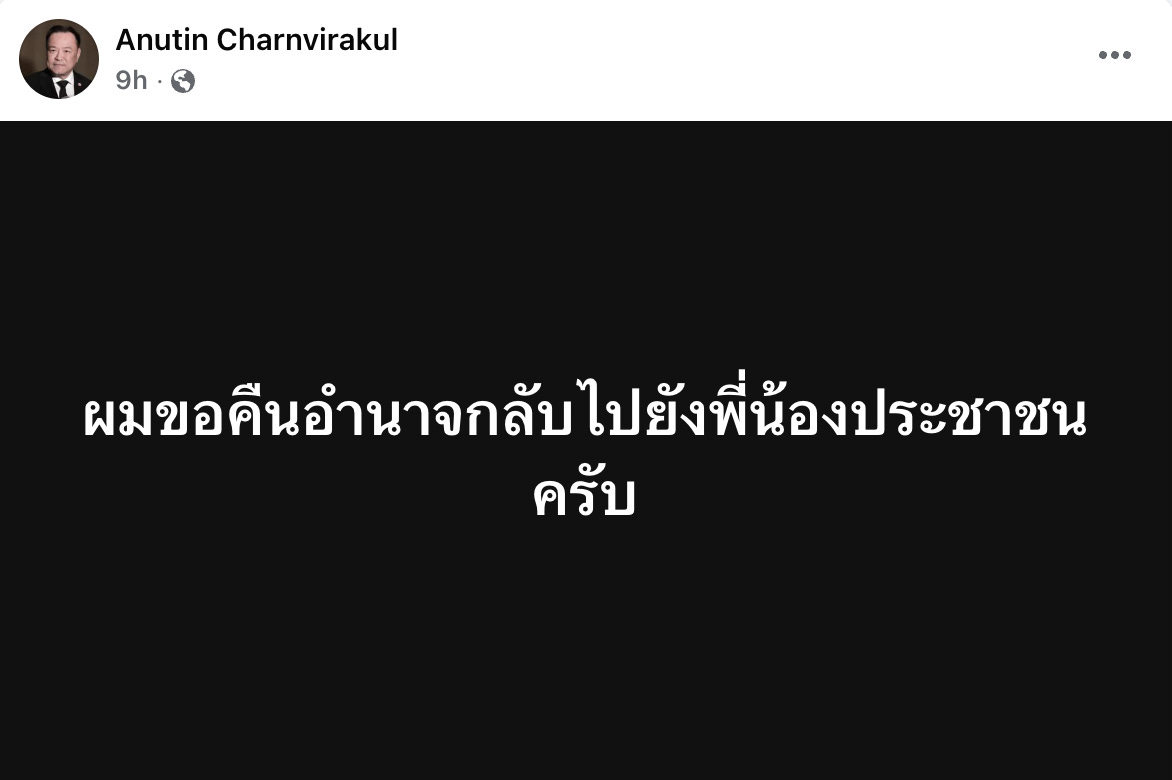
Recall that the PP had included constitutional revision as one of the key conditions of their confidence and supply agreement with the Bhumjaithai Party. The PP released a statement after the vote, saying that Bhumjaithai had initially agreed with the simple majority requirement at the committee level, but had then voted in favor of keeping the 1/3rd requirement during the joint sitting. There were reports that the PP then began gathering signatures from MPs in order to file a request for a vote of no confidence in the government. However, pre-empting legal debate about whether or not a government can dissolve parliament while a no-confidence debate is in the works, Anutin immediately requested a dissolution, posting on Facebook that he will “return power to the people.”
We’ll likely see a lot of debate over the next few days about whether or not the Memorandum of Agreement between the PP and Bhumjaithai was breached. The MOA simply states that “the two parties will begin amending the constitution and setting up an elected constitution drafting assembly before the next general election.” The PP leader, Natthaphong Rueangpanyawut, had previously said that the process of constitutional amendment should be “as connected to the people as possible” He says that the MOA has now been “torn apart.” Bhumjaithai’s spokesperson, on the other hand, argues that “not a single condition of the MOA was broken.”
I have wondered from the beginning if the PP would consider diverging visions of constitutional reform a breach of trust, but the fault seems to lie with a badly-written MOA: there was nothing in there that required Bhumjaithai to conform to the PP’s exact vision of constitutional amendment. Already, the Pheu Thai Party has seized the collapse of the MOA to attack the PP, asking whether “the person who was betrayed will realize they made the wrong choice and apologize to the people.”
Where we stand
I had written some pieces earlier on NIDA’s polling — this piece looks at the nationwide polling, and this piece looks at polls from various regions — which gives us an idea of the baseline at the start of campaigning. But of course, a general election will not be held until 45 to 60 days from now, and things can change a lot during campaign season.
I do not remember the last time that Thailand has headed to the polls in circumstances this chaotic. We have both a border conflict with Cambodia that is raging with no sign of ending, and the South is still recovering from a catastrophic flood. With so many unpredictable factors, it’s hard to say how the government’s popularity will fare. Does the Cambodian conflict raise questions about why the opposition is prioritizing constitutional reform now, and does it prompt a “rally round the flag” effect that benefits Anutin and hurts the PP? Has the Southern flood meaningfully hurt Anutin’s support in the region, where Bhumjaithai was hoping to make big gains — perhaps to the benefit of a party like the Democrats? Without more data, we cannot answer any of these questions definitively yet.
We also still don’t know who all the candidates for prime minister will be. It looks like Pheu Thai will announce their candidates on December 16th, and we are still waiting to hear who the three Bhumjaithai and Democrat candidates will be. We still don’t know what policies the different parties will propose. And I expect there will be a lot of questions about which sorts of alliances each party is willing to countenance, and that could have a meaningful impact on support. I will have much more to say as the campaigning period begins.
"the MOA was badly written". I am not so sure. It was never possible to specify in advance exactly what constitution and every step of the process. Especially given that the court added complications.
Those deals are only based on some degree of trust and mutual interests. And my personal feeling is that it was Anutin who kinda breached it by voting for the senate requirement. But it is the vague half lie type, rather than a blatant one.
Eventually, Anutin will need to do political deals with others, so he needs to be known as someone who is somewhat reliable 555