

Over the past few weeks, the National Institute of Development Administration (NIDA) has been releasing the results of a series of public opinion polls conducting in different regions1, ahead of the next general election.
We should understand these polling results less as a prediction for what the final election result will look like (there is still a whole campaign we have to get through!) but instead as a snapshot of what things look like. This is the baseline of where each of the different parties stand.
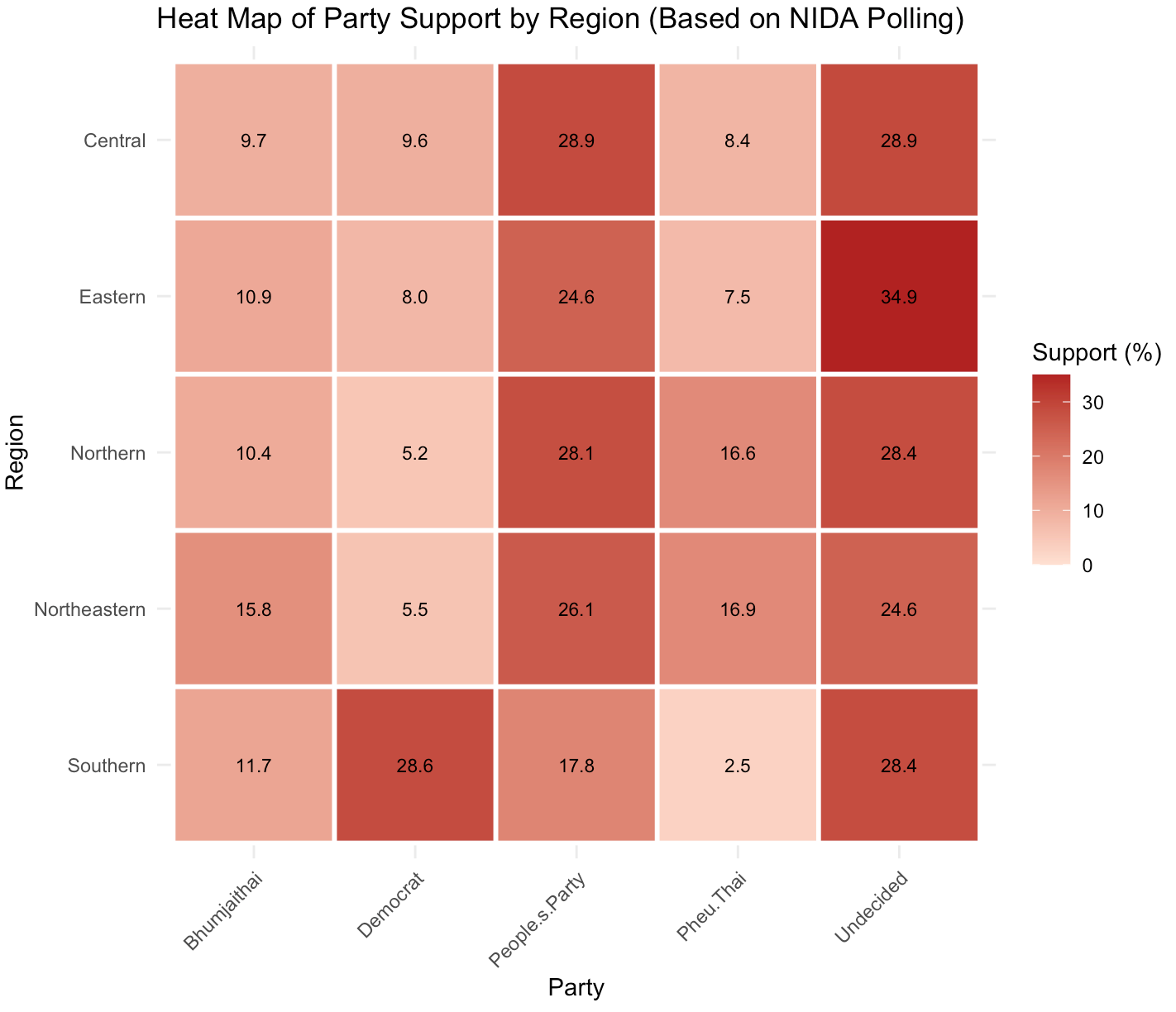
For now, I’ve decided to ignore support levels for prime minister candidates, because the options NIDA have been using still seem a little random (Prayut Chan-o-cha is still included as an option despite there being no indication at all that he will return to politics) and most parties still haven’t unveiled their PM candidates. I’ve generated a heat map of each of the highest-polling parties’ support by region here.
1. The People’s Party (PP) remains on top, but they are underperforming where Move Forward was in 2023.
Except in the South, the PP enjoys the highest level of support in every region — and so it is very reasonable to predict at this point that they are on track to win the most party-list seats. But these number disguise some concerning trends. Their polling is certainly not where they want to be if they want to significantly increase their total seat count — indeed, I’m not sure that they are even where the PP needs to keep the same tally of seats as they have currently. Let’s take the North. The PP’s support level stands at 28.1 percent according to NIDA. These numbers are down significantly from the vote share Move Forward (MFP) had won in the North in 2023. In Chiang Mai, for example, the MFP had won 45 percent of the party list vote. Even in provinces where their party list share of the vote had come second to Pheu Thai, the MFP still did much better than where the PP is polling now; in Chiang Rai, for instance, they had won close to 40 percent, while in Sukhothai they had won 34 percent of the vote.
These results provide more evidence for what NIDA’s national polling had told us earlier: that the PP’s support has taken a significant hit after their decision to back Anutin Charnvirakul for prime minister. Indeed, the PP is polling even more poorly in the provinces than they do nationwide (including Bangkok). Some of this polling was conducted after the PP unveiled their three candidates for prime minister (naming Natthaphong Rueangpanyawut, Sirikanya Tansakul and Dr. Veerayooth Kanchoochat). But there are no indicators yet that these three candidates — who are less well known than Pita Limjaroenrat was — will be able to arrest the PP’s decline in support.
2. Pheu Thai’s polling is dire even in its strongholds.
Pheu Thai has always been strongest in the Northeast and North, but even in these strongholds, they are still outpolled by ten percent or more by a weakened PP. Outside of those regions, the polling is looking pretty catastrophic: not cracking ten percent in any other region, and 2.45 percent in the South (where they have never been popular) is remarkably low. (Take a province like Trang in the South, the birthplace of Democrat prime minister Chuan Leekpai who has been consistent about his opposition to Pheu Thai. The party was still able to win almost 9 percent of the party list vote there in 2023).
Whether or not there has been a “sympathy uptick” after the imprisonment of former prime minister Thaksin Shinawatra is unknown for now, but if there is, it probably isn’t enough to put Pheu Thai in position yet to prevent a significant loss of seats. What they do have in their favor is the fact that they have not unveiled any of their PM candidates yet, and the right choices could generate some excitement. (We haven’t really seen any indication of that, however).
3. Bhumjaithai: doing far better than their 2023 polling, but perhaps a ceiling has been reached?
A couple weeks ago, I wrote a piece on what I think Bhumjaithai’s electoral strategy is if it is playing to win. I still think that the core plank of Bhumjaithai’s strategy is in its strength in local constituencies, which is difficult to capture in national-level or regional-level polling. I did outline a couple of things the party seems to be doing to capture more party-list votes: securing quick big wins, capturing the conservative market segment, and proving it is a credible party of government. These things have borne some fruit so far, with Bhumjaithai catapulting from the low single-digits of support they were polling at for years.
But I do wonder if they’re starting to hit a ceiling — except in the Northeast, nowhere do they poll higher than the national rate of 13.24 percent we saw in the previous NIDA poll. Bhumjaithai’s polling overall seems roughly in line with their earlier national polling. In fact, some of these regional numbers seem more in line with the slightly less than ten percent support nationally we saw from the second quarter. That said, their support on the party list ballot is still likely to significantly increase from 2023, and that may be enough to supplement their local strengths. Interestingly, these numbers may also confirm something that we already knew: giveaways like the Khon La Khrueng scheme is popular but does not meaningfully increase electoral support, as United Thai Nation/Palang Pracharath found out in 2023.
4. The Democrats are returning to formidable levels of support in the Southern region.
One of the biggest questions surrounding the return of former prime minister Abhisit Vejjajiva to the Democrat leadership was whether or not the South, the party’s longtime stronghold, would stick with the Democrats after flirting with Bhumjaithai, Palang Pracharath, and United Thai Nation in the past two elections. The Democrats aren’t polling too badly in the other regions, given that Abhisit has only freshly returned to the party, but their 28.6 percent support rate in the South jumps out. It’s worth noting that the poll was conducted before the catastrophic floods in the region, so if anything Bhumjaithai’s support might have decreased as more voters decide to return to the Democrats.
The NIDA Poll’s director stated that in Chumphon province, they found support rates for Abhisit and the Democrats above 50 percent. In 2023, the Democrats received only a little over 8 percent of the vote on the party list, and none of their candidates won a constituency seat — the top candidate received only a little over 30 percent of the vote. If NIDA’s findings are accurate, it is clear that the Democrats have recovered to something closer to their historical levels in the South. Whether or not that translates to constituency seats remains to be seen, as most of the party’s southern MPs have deserted the party (only six of seventeen have signaled their intention to run again under the Democrat banner). Given that the party seems to be fighting less for a chance to form a government and more to ensure survival, however, they will take heart at these results.
5. Undecided voters still exist in large numbers, and watch out for the Economic Party.
Even as we move closer to a general election, those who are still unable to pick a party remains persistently high in number, with similar rates of indecision across the different regions (except in the Eastern region). I wish we had better indicators of which group form the majority of undecided voters: hesitant MFP voters who are not keen on the latest orange incarnation? Formerly loyal Pheu Thai voters? Conservative voters not sure where their new home should be?
I’m keeping an eye on one new party: the Economic Party. This is a new party that has consistently taken attention-grabbing hardline stances, proposing for example that cases of corruption must be punished with death. Their rise in prominence has come in no small part due to the nationalist positions they took during the Thai-Cambodia conflict. Now, their party leader General Rangsi Kitiyansap is polling better than the leaders of many other established parties. In the Eastern region, Rangsi came in 5th place at 5.6 percent (less than three percent behind Abhisit, a former prime minister) and beating Pheu Thai leader Julaphan Amornvivat. The party appears to have captured an untapped hardline conservative niche.
Again, it’s worth reiterating that these are the baseline numbers for where the parties stand ahead of the next general election. We’ll continue to closely watch how public opinion shifts as campaigning ramps up in earnest.
The NIDA poll was conducted on the following dates:
Northeast: 27 - 30 October
North: 30 Oct - 4 Nov
Central: 10 - 13 November
Eastern: 13 - 18 November
Southern: 18 -24 November
Perhaps a more nuanced perspective needs to be applied to some of your analysis:
1. You claim that even though the People’s Party remains on top, they are underperforming against where they were in 2023. Given the large number of undecided voters, this is almost certainly true. But there are other factors to consider. You do not specify the denominator for 2023. Is the data you are referring to for ‘where the PP was in 2023’ an opinion poll some months out from the election or the actual election result? If you are comparing the results of the NIDA regional polling to the 2023 actual election result, it needs to be kept in mind that the NIDA polling does not include Bangkok, where the PP won all but one seat at the last election. Also, the large number of undecided voters are likely to make up their minds one way or the other by the time of the election, with a reasonable likelihood of many of them deciding to support the PP.
2. If you go back to the time when Thailand was about four months out from the 2023 election, Pita Limjaroenrat actually didn’t have a particularly high profile. He even attracted public criticism from one of the co-founders of the Future Forward Party for his low profile, with the accompanying prediction of Move Forward losing votes at the forthcoming election. As things turned out, Khun Pita ran a brilliant election campaign, outperforming pretty much everyone’s expectations. It’s ahistorical to fail to recall the position Pita and Move Forward were in at a comparable time period prior to the 2023 election. This points to the difficulties opposition parties in most democratic countries have in attracting the attention of voters, until the election campaign period gets under way.
3. You correctly state that one of Bumjaithai’s strategies to increase their vote is to prove that they are “a credible party of government.” While they initially certainly looked more credible than Thaksin’s Pheu Thai government (not hard to do), one can hardly regard their performance in recent weeks as being anything near credible. The claims that BJT’s response to the scam crisis is nothing much more than performative are growing by the day, not to mention the surely significant hit the seeming mismanagement of the response to the southern floods has had for the party’s credibility. There surely is a high likelihood that BJT’s support has taken a significant hit, not just in the south but throughout Thailand as the voters look on with interest to see how Anutin performs now he’s in the spotlight.
4. You’ve been quite critical, perhaps rightly, of the PP decision to enable BJT to form a government. You were right to point to the risks the PP were taking but perhaps did not give sufficient weight to the PP’s priority of creating or at least taking any opportunity available to them to push for reform of Thailand’s constitution. Given the credibility of the BJT government has taken a major hit over recent weeks, the PP’s enabling of the BJT government may in retrospect be seen as a masterstroke, whether intentional or not. It’s a highly unusual situation for a party which was in opposition to be given the keys to Government House for a time limited period. It has given the BJT the opportunity to shine, but it seems more and more likely that they are squandering this, all whilst the nation looks on and no doubt makes its own judgement.
Excellent work! It seems the Economic Party is an extreme-right populist party...