

Good morning from The Coffee Parliament. I have a new piece in Fulcrum on the TH-AI Passport: check it out here. Now onto some updates…
Flood fallout in Bangkok
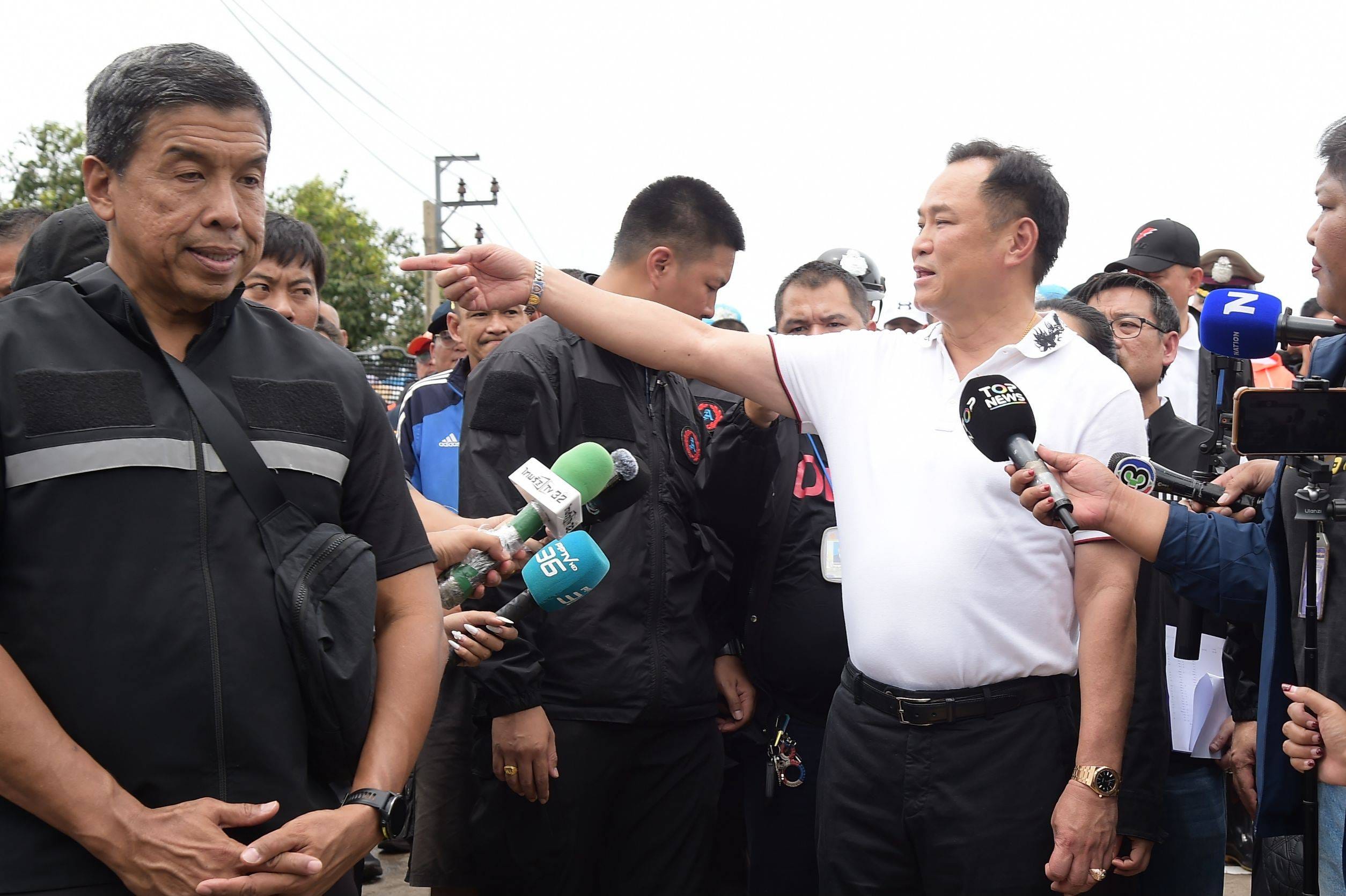
Bangkok governors in the 21st century have suffered from a second term curse. Apirak Kosayodhin resigned only a month after his re-election. M.R. Sukhumbhand Paribatra was removed from office by the NCPO. Chadchart Sittipunt won a thumping victory in June and seemed politically invincible, but the Bangkok floods have brought the most serious challenge of his tenure thus far.
Unceasing rain over several days and nights in late September caused widespread flooding in Bangkok. (The Guardian has a collection of photos here of the flooding at its worst). This has placed Chadchart on the spot. For one, Chadchart was accused of insufficiently drawing out water from Bangkok’s many canals in preparation for the increased rain. Responding to such criticism from former Bangkok governor candidate Suchatvee Suwansawat, Chadchart insisted that the BMA did deplete the canal water to the minimum possible level, but the rainfall was so heavy that flooding occurred nonetheless. The BMA released a graphic tracing the water drawdown in four major canals in late September.
We are also seeing signs of tensions between the national government and the BMA. Conservative professor Arnond Sakworawich posted on Facebook that one area of Bangkok is now dry because a Bhumjaithai deputy interior minister had taken the initiative to bring in water pumps, without the need for help from “an associate professor of engineering from the Ivy League.” Prime Minister Anutin Charnvirakul shared this Facebook post on his personal account. But Anutin also insisted that he has never considered removing Chadchart from office; doing so could needlessly inflame feeling towards the government, which is already tumbling downwards in public perception (see below).
Most seriously for the governor, critics argue that Chadchart has not pursued flood prevention projects, especially the kaem ling (“monkey pouches”) projects, water storage reservoirs which were initiated under the vision of His Majesty the late King Bhumibol Adulyadej. United Thai Nation MP Atawit Suwanpakdee argued that the kaem ling projects have disappeared from Bangkok’s urban planning, with land initially slated for water reservoirs instead being taken up by real estate developers. Chadchart, for his part, denies cancelling the projects to favor private interests. He also argued that King Bhumibol had recommended several approaches to flood management aside from the kaem ling. The Nation reports Chadchart noting that “several areas the BMA had studied for water retention were found to have limitations in terms of land and drainage systems following the major floods in 2011” and argued that the project’s price tag was very high.
It would be one thing if the questioning came from the governor’s usual critics, but we are seeing criticism come from other corners as well. Sudarat Keyuraphan, who was one of Chadchart’s co-PM candidates in the Pheu Thai Party during the 2019 campaign, publicly thanked Atavit for raising these questions. For now, my assessment is that Chadchart survives this crisis, unless controversy over the absence of the kaem ling projects have gone spirals into something even more damaging. In any case, Chadchart is term-limited so he will not be on the ballot again as Bangkok governor, so perhaps the stakes are not too high. Yet this situation has certainly not helped if he has wider political aspirations beyond the mayoralty. For now the lingering effects of the flood are uneven.
At the time of writing most areas are dry, but some neighborhoods are still flooded. (“Dobby is free after ten days,” a friend texted me following a seemingly unending entrapment that led to every day feeling like “déjà vu”). Bangkok is bracing itself for another wave of forecasted rain, but with some luck (and better preparation) the impact will be far less severe.
In other news…
The quarterly NIDA poll for Q3 was released on September 27. I’ve graphed the polling results from Q1 onwards here. A couple of quick observations below.
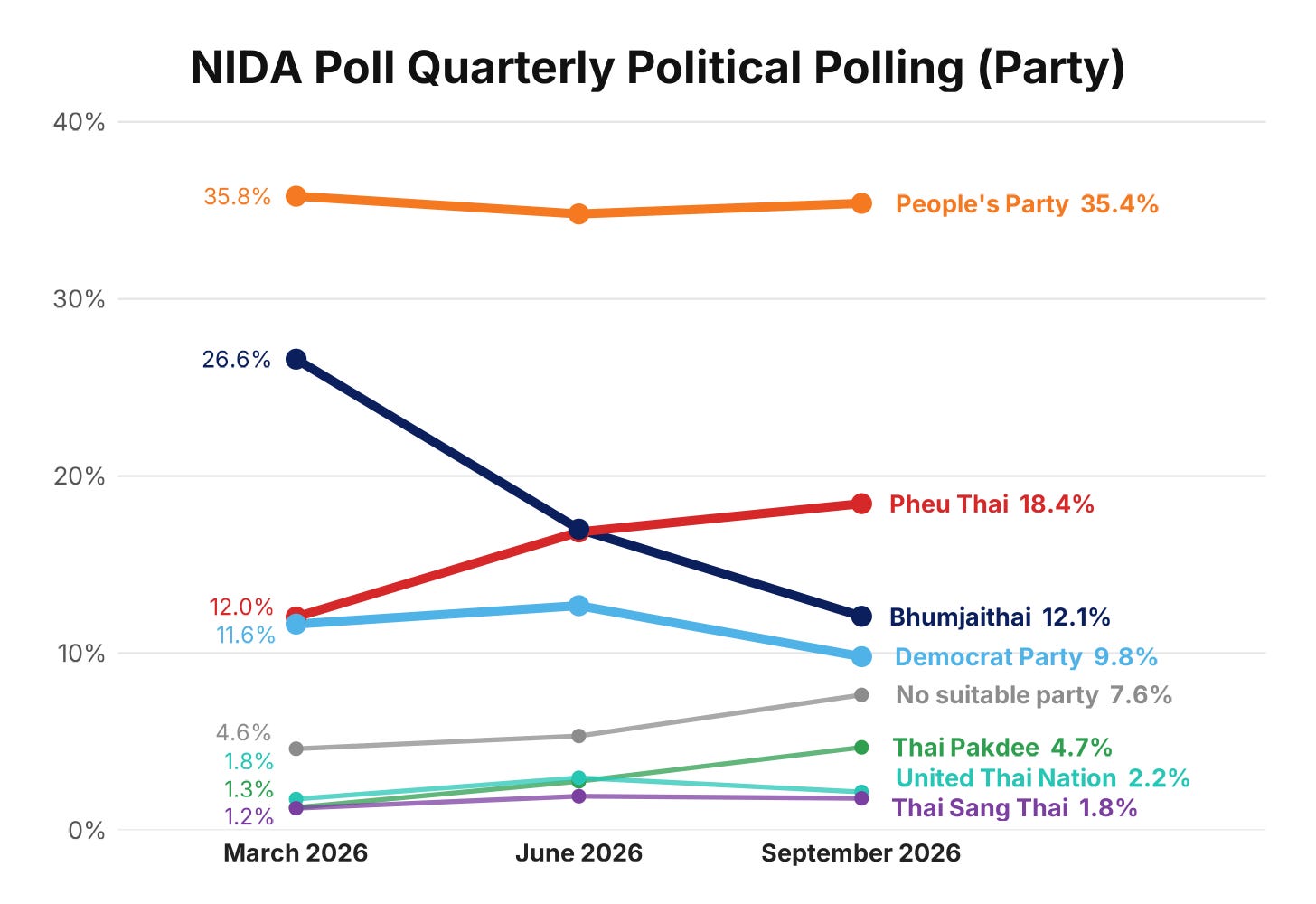
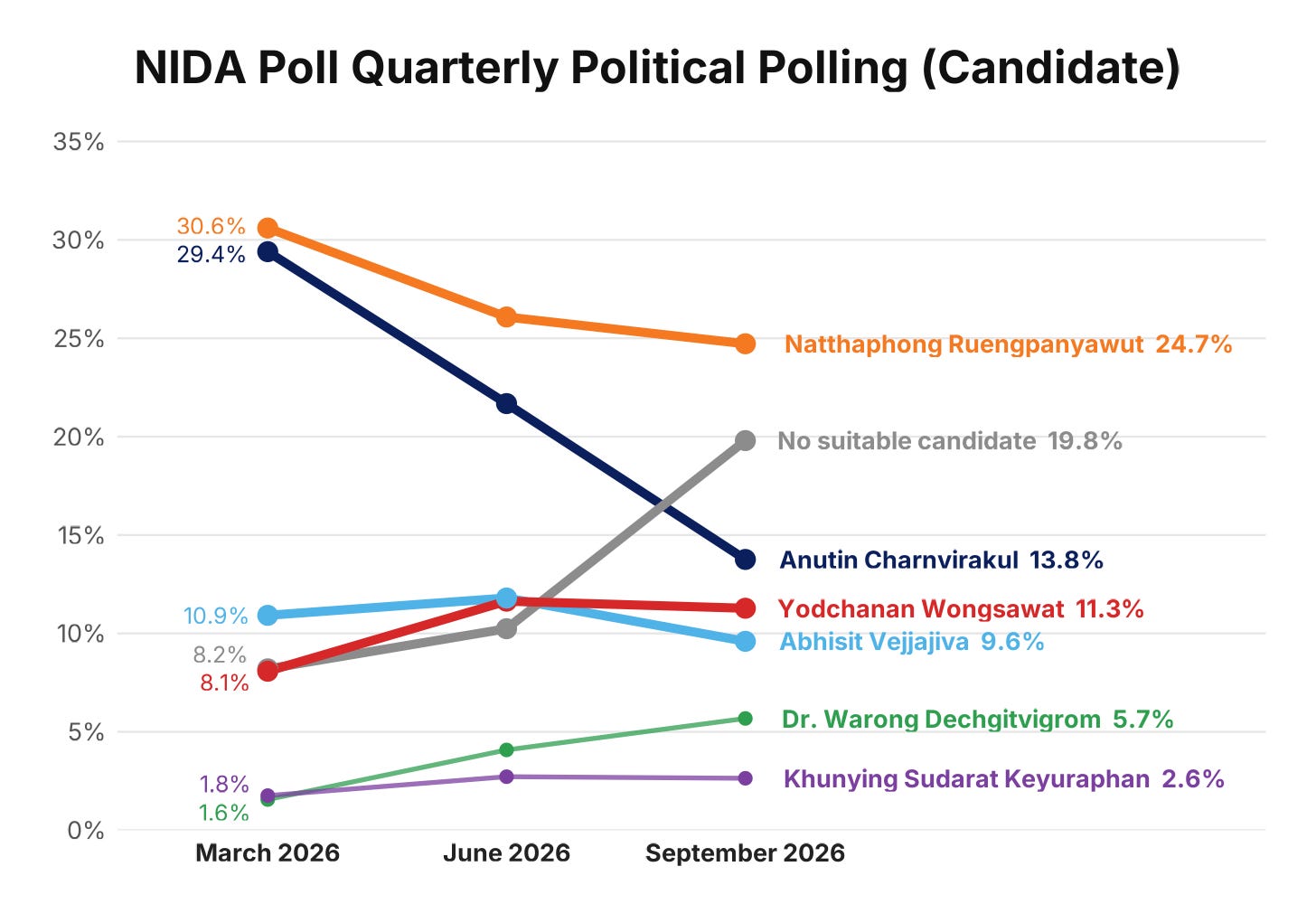
It is brutal for Bhumjaithai, which has declined from its second-place position in Q1 to third place, shedding over half of its supporters. Anutin has lost a similar amount of support. One key feature of Anutin’s first year in office — his favorability’s resilience and a lack of polarizing-ness — may no longer hold true in his second year.
Support for the People’s Party is holding steady but Natthaphong Rueangpanyawut, who has never been as popular as his predecessors, sees his support continue to dip.
Pheu Thai still has not recovered to pre-Cambodia conflict levels, but it has made noticeable gains to 18.4% compared to its low of 11.5% last year. This could be due to Yodchanan Wongsawat’s efforts to rebrand Pheu Thai, although his own personal polling is still flat. Pheu Thai’s increase in support could also be disappointed Bhumjaithai voters returning.
The Democrats experienced a slight dip but are mostly stable. This will be disappointing for the party because it shows that they have been unable so far to capitalize on the Bhumjaithai government’s increasing unpopularity; conservative voters still show no sign of “going home.”
After many months of relative stability, Thai politics may now be entering a more volatile phase.