

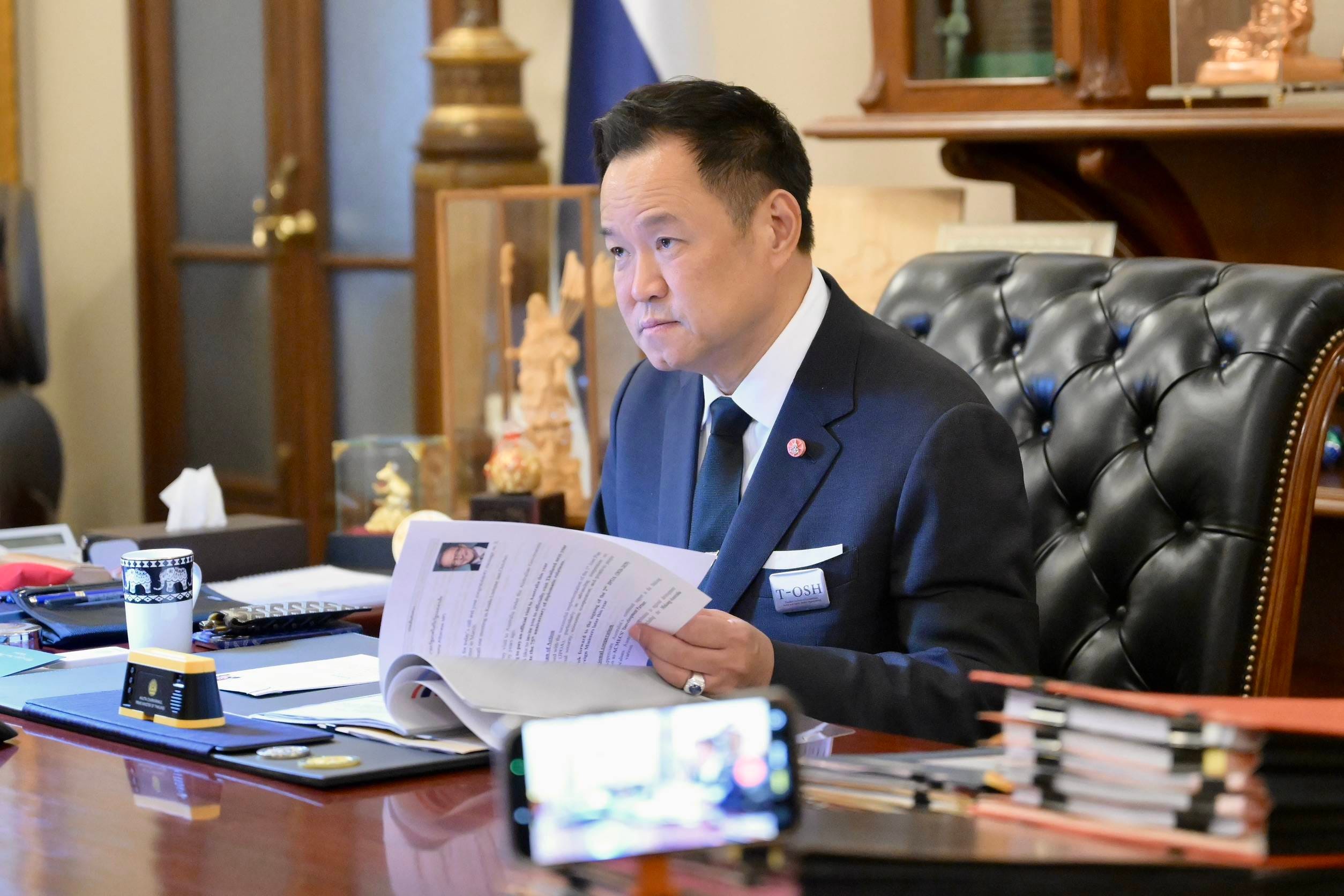
It has now been over one year since Anutin Charnvirakul took office as prime minister. From September 2025 to September 2026, Anutin has converted a short-term minority government with the most wobbly of foundations to one of the most hegemonic elected administrations in the past twenty years. If you told a Thai political observer even just five years ago that this would be the case, they would have found the prospect fanciful. In this post, I want to spend some time taking stock of everything we have learned from the first year of the Anutin era.
Anutin Charnvirakul once compared himself to kaeng ho, a northern curry that was traditionally made from leftover ingredients. A biographer interpreted this through the lens of a Carabao song: this was the process of mixing together diverse parts of society to build a resilient and successful country.1 But kaeng ho is also an apt description of the government that Anutin has built. Nothing about the Bhumjaithai system is particularly new. All of its ingredients predate Anutin’s ascension as prime minister. What is new is how the party has mixed these diverse — in some ways discordant — elements together to build a system that is greater than the sum of its parts.
What are some of these elements? Bhumjaithai has built on its reputation of strong local service delivery, first in its stronghold of Buriram (where the party’s popularity rivals Banharn Silpa-archa’s in Suphanburi in his heyday), and then expanding across the lower northeast and central regions. By the 2026 general election, the party built an electoral death star with a constellation of local families coming together to give the party unparalleled constituency strength. “Local politics is the root of larger politics,” Kla Tham leader Thammanat once said. It turns out that no one understood this better than his former allies in Bhumjaithai. Allegations of election irregularities aside, it was this local strength that became decisive in ensuring Bhumjaithai would become the first party to win an election despite not being the most popular party nationally on the party-list ballot.
At the same time, Anutin combined this (to some extent preexisting) local strength with a new conservative rebrand of Bhumjaithai. It was a steady effort that Bhumjaithai had begun embarking on since the 2023 general election, and by this year, the transformation has become complete. No major party is now more closely identified with defending the traditional institutions than Bhumjaithai, and no party has been bolder in asserting its nationalist credentials. (“If you’re going to be obsessed with Thailand, take it to the extreme,” Anutin said during the campaign). Once the conservative standard bearer was General Prayut Chan-o-cha; Anutin appears to have been successful when he beseeched “Lung Tu’s voters” to vote for “Lung Nu” instead. For moderate voters concerned about competent management, Anutin has also ensured that he has met their concerns. A decade or two ago one would have said technocratic management was the domain of the Democrats. Bhumjaithai’s technocratic turn — as much as one might want to contest this branding — has given the party a sense of governing credibility that it did not previously have.
Governing is different from campaigning, of course, and here the record is far more mixed. The Anutin administration sometimes appears to resemble an iPhone Duo, the result of a diverse party giving way to a kaleidoscopic cabinet operating along different lines. We have Deputy Prime Minister and Finance Minister Ekniti Nitithanpraphas, whose fiefdom is the macroeconomy. One of the administration’s most difficult and potentially most impactful reform efforts, an initiative to reduce the size of government, appears to be the turf of Deputy Prime Minister Pakorn Nilprapunt. But at the same time, we have the so-called lookthep faction of ministers who hail from the local families. There are mounting concerns over the TH-AI Passport or the Land Bridge project (eventually shelved). Scandals within the Interior Ministry, which Anutin himself has now headed for years, remains a problem. The government’s initial handling of the energy crisis was so widely panned that it placed Ekniti in charge to resurrect credibility. One still wonders, when push comes to shove, which side of the Duo government has to fold.
And what of Anutin himself, as prime minister? Anutin seems to make the headlines more often for his musical diplomacy — singing with Lawrence Wong, serenading Li Qiang, providing the saxophone accompaniment for Anwar Ibrahim — than for policy pronouncements. When one thought of previous prime ministers, signature projects came to mind: Thaksin Shinawatra’s many initiatives, Abhisit Vejjajiva’s Thai Khemkhaeng program, Prayut Chan-o-cha’s Thailand 4.0 vision and the Eastern Economic Corridor. A year into his premiership, where Anutin’s foremost priorities lie can still feel like a bit of a mystery.
But perhaps it is also the easy-going demeanor of the prime minister that has kept the government secure. One year into his tenure, he has not yet become ridiculously unpopular. That is not faint praise. His favorability has dropped, to be sure — NIDA poll’s second quarter had him trailing People’s Party leader Natthaphong Rueangpanyawut by five percent — but recent prime ministers had suffered far larger deficits. At one point, Srettha Thavisin was over 30 points behind Pita Limjaroenrat. To some extent this is explainable by the fact that Anutin, for whatever reason, simply does not engender the same level of affection or disdain that some of his predecessors, like Thaksin or Prayut, ever did. Few will defend him to the last; at the same time, he is not a hate figure. In an age where incumbents of all stripes across the world are unpopular, that is not a bad place to be.
Even more important, however, is the fact that the Bhumjaithai government took office for a second term with the opposition in a state of disarray. The People’s Party still finds itself taunted on virtually a weekly basis by senior Bhumjaithai figures for its support of Anutin’s minority government last year. It has made few changes to its leadership lineup in spite of a distinct lack of buzz. The Democrat Party is too small to pose any real threat to the government, and its path forward remains unclear. Kla Tham continues to toss signals of friendship to Bhumjaithai (last week voting as a bloc in support of the government budget), thus decreasing the number of reliable opposition votes even further. With the opposition weakened and divided, the only real threat to Anutin can only come from within. Here, too, the government still looks strong one year later. Despite rumors of intra-party disputes, Bhumjaithai still appears united enough to function. Pheu Thai has proven to be a cooperative ally so far, with Thaksin, perhaps chastened by his recent experiences, mostly lying low. A traffic light coalition does not look like it is truly on the cards yet.
Just as crucial for Bhumjaithai is its hegemony within the political system as a whole. The courts have not yet had a chance to rule on the Senate collusion case, but regardless of how they came to be selected, analysts have widely noted that allies of the government form a majority of the upper house. This is particularly important given the Senate’s role in handling appointments to the independent agencies and the Constitutional Court. Except for the second year of Prayut’s term, when the Senate was wholly appointed by the preceding military junta, there are few parallels for an elected government that has had as much power outside the lower house.
And so we have learned a lot in the first year of Bhumjaithai’s government, which we can summarize as three major planks of the Bhumjaithai system. 1) The kaeng ho political synergy allowed Anutin to convert his minority government into a majority coalition. This led to 2) the administrative reality of the dual-track technocratic/look thep cabinet. While this arrangement has yet to bear fruit in terms of developmental outcomes, and indeed has already produced some policy misses, 3) the systemic dominance of the Bhumjaithai government has ensured that there is little threat to the coalition, at least for now. In one year, we have seen the playbook for how Bhumjaithai has gained, managed, and protected its power.
On the day he was elected, I wrote: “Anutin has been widely praised for flying his own private jet in his spare time to deliver needed organs to the sick. As a prime minister navigating unprecedented circumstances, managing a minority government, it will take immense political skill for him not to fly too close to the sun.” Undeniably, as a skilled political operator, Anutin the party leader has played his cards very well in the first year of his premiership. But as the challenges of governing mount, whether Anutin the prime minister will be able to sustain the dominance of his party remains to be seen.
From Mi Ru Mi Nu (มีรูมีหนู) by Ram Pansonthi, pages 119-20.