

Over the past few weeks, I’ve written a few pieces on rumors of how the Bhumjaithai government has begun to wobble. In early July, I wrote about the various reasons contributing to the declining stability of the Bhumjaithai coalition. And earlier this week, I noted the rumors — quickly squashed — of a “Monaco deal” between Kla Tham leader Thammanat Promphao and former prime minister Thaksin Shinawatra.
The origins of the potential fissure in the Bhumjaithai government lies in its decision to exclude the Kla Tham Party from the coalition, which has left its former ally out in the wilderness over the past few months. Kla Tham has done a remarkable job at keeping its MPs loyal — there has been no defections from a party that unexpectedly found itself in opposition despite what everyone thought was a sure path back to government — and as a result remains a significant political force in parliament, even if it has largely kept quiet over the past few months. This means that it could remain an important political actor, either as an alternative ally for Bhumjaithai or a supporter of an alternative coalition.
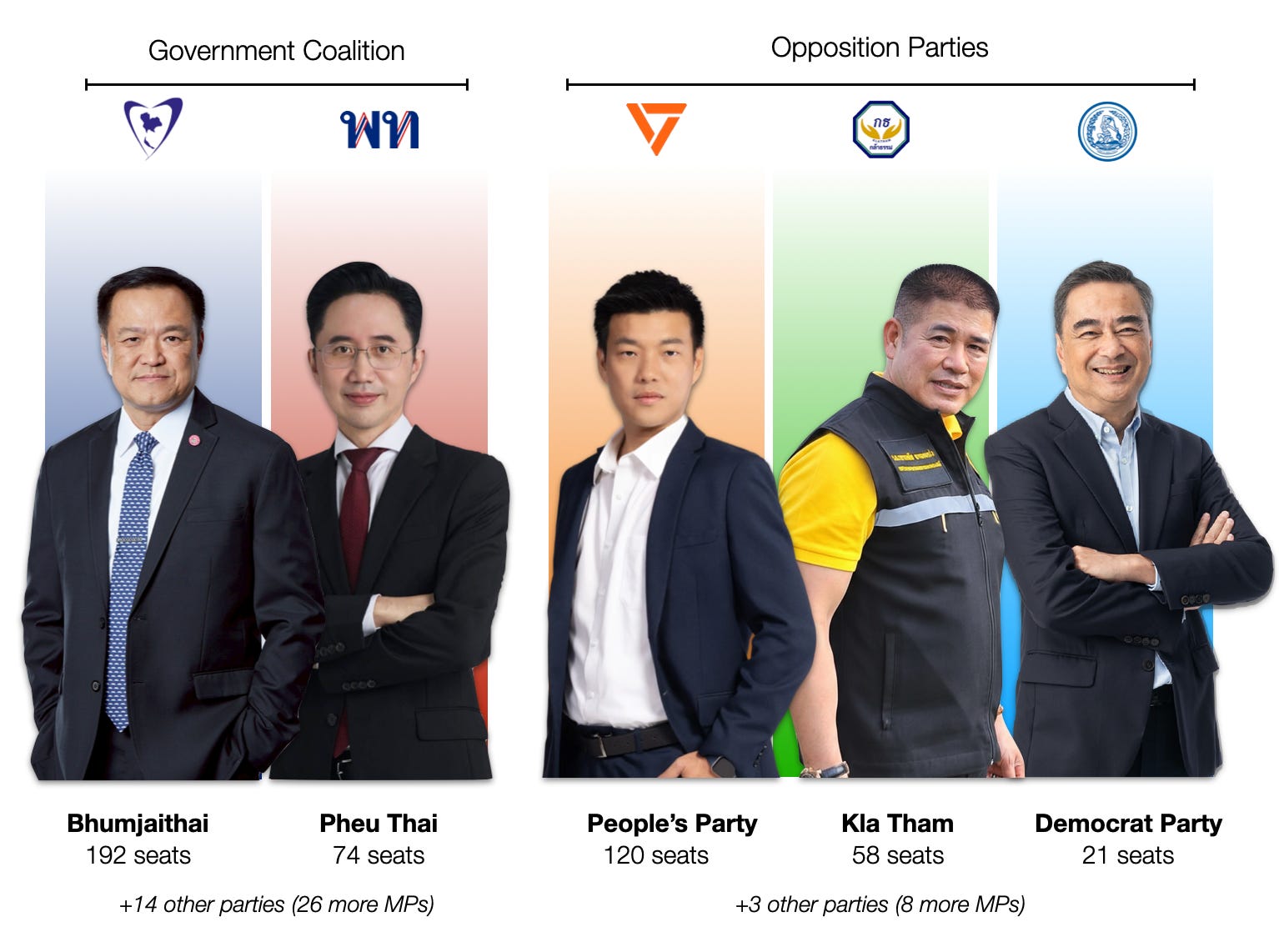
But up to this point, an alternative coalition seemed impossible. As I noted in my last post, an agreement by Pheu Thai (74 seats) and Kla Tham (58 seats) to topple Bhumjaithai (191 seats) is unworkable because that would be far off from a parliamentary majority without the People’s Party (120 seats). The People’s Party pledged during the election campaign that it would not form a government with Kla Tham, of course, which would mean that it is virtually impossible for any alternative government excluding Bhumjaithai to emerge, unless the PP is willing to form another confidence and supply agreement — and one would think that the party was sufficiently burned by its last attempt.
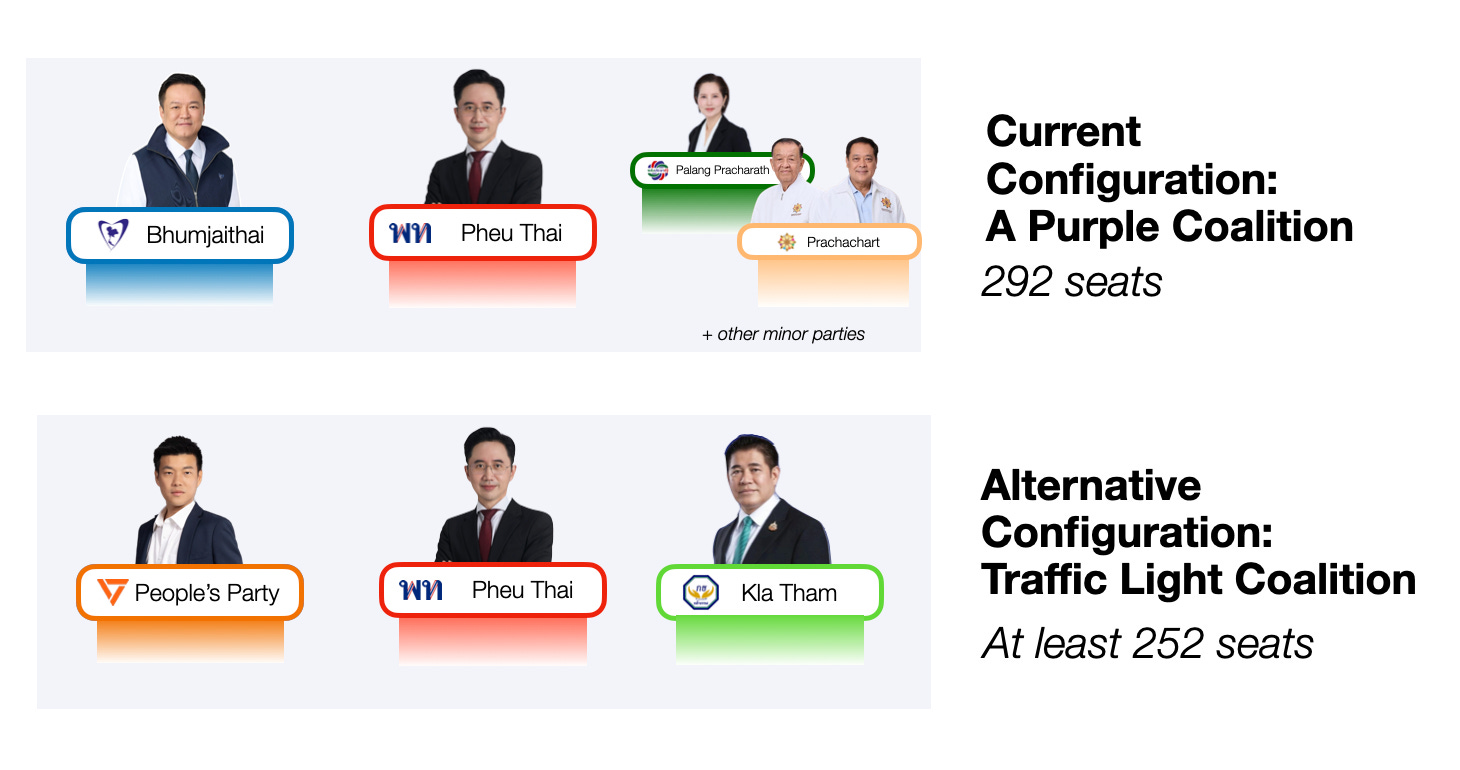
Such was the situation until the People’s Party deputy leader Sirikanya Tansakun gave an interview on coalition configurations this week. While she ruled out any future deal with Bhumjaithai, when asked about a red-green coalition, she signaled that the party would be open to such discussions, given that without the People’s Party the “political equation would be incomplete.” When Thammanat was asked about Sirikanya’s remarks, he said that he has now “forgotten everything that happened before the election” (a reference to the PP’s anti-Kla Tham pledge). “Before the election, people who were enemies and still come back and love each other.”
Of course, Thammanat denied that an alternative coalition is currently in the making, saying that he wants to give an opportunity for the elected government to work first, and only if “one day they can no longer proceed” should “discussions” happen. Prime Minister Anutin Charnvirakul has also moved quickly to try to squash these talks of an alternative coalition, publicly hugging Pheu Thai leader Julaphun Amornvivat.1 When reporters said that there may be a new mix of red, green, and orange, Anutin joked that red and green should be mixed with condensed milk.2
Undoubtedly, talks of an alternative coalition forming is premature. Pheu Thai does not seem like it has any appetite for risk right now, fresh from a bruising electoral fiasco and Thaksin only recently having been released from prison. The People’s Party is already being warned that should the party go back on its promise not to partner with Kla Tham, its brand would suffer even further. And Kla Tham seems content, for now, to telegraph its desire for friendship to all political parties, in order to keep its options open. All in all, I maintain my assessment that there is still no grave immediate risk to Bhumjaithai, and while a cabinet reshuffle may be headed our way at some point, the government is not yet at any risk of falling.
But the fact that an alternative “traffic light coalition” is even remotely possible certainly adds a level of political pressure on Bhumjaithai.3 Up until this point, the “purple coalition” of Bhumjaithai and Pheu Thai (plus other minor parties) has been the only viable configuration because of commitments by the People’s Party and the Democrats that they will not work with Kla Tham. This meant that Bhumjaithai held all the cards over its coalition partners; there was no real alternative and any threat to leave the government was not truly credible. Now, however, public signals that these commitments are not so set in stone as to be unbreakable means Bhumjaithai will need to work harder to keep its coalition partners satisfied.
I have to say that over the course of Thai political history, when political leaders are hugging each other it’s more often than not a sign that not all is well.
Red and green syrup are the most popular choices for shaved ice in Thailand, which of course also needs condensed milk.
Of course, a genuine traffic light coalition needs a yellow party, but orange is close enough, right?
An entertaining read. I thought PP voters were still angry about the party’s support for Anutin election as PM. Now we are expected to believe they will acquiesce to the PP voting for a Kla Tham government. There’s more chance of me winning a cool 6 million baht in the lottery.