
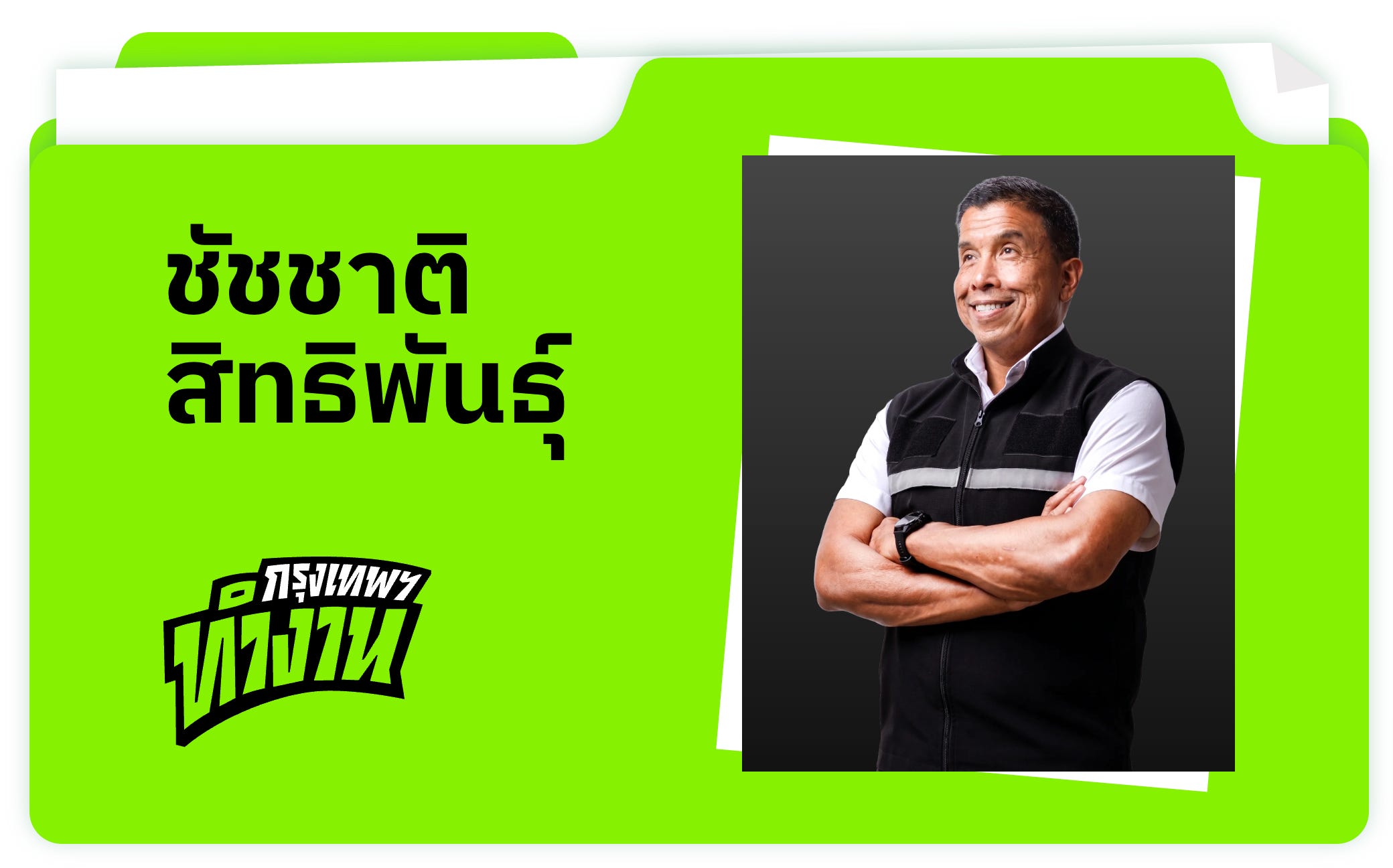
Two political experts, Stithorn Thananithichot and Suranand Vejjajiva, recently predicted that Chadchart Sittipunt is virtually guaranteed to win re-election for Bangkok governor next month. I think that this is probably a common opinion.
As a political scientist, however, I feel compelled to do a deeper dive into why exactly Chadchart is in such a strong position. While this is not necessarily a prediction, we have enough data to say that Chadchart is almost a lock to be re-elected as governor for three reasons. 1) He remains popular, 2) His competitors are not as strong as in 2022, and 3) Bangkok voters are unlikely to prioritize party over personality. Let’s take these arguments in turn.
1. Chadchart was very popular in 2022 and appears to remain popular
It would probably not be wrong to say that Chadchart is one of Thailand’s most popular politicians. Initially fueled by memes about his “strength” and down-to-earth personality, his support base evolved into a dedicated fandom. Although initially aligned with Pheu Thai (he served as transport minister in Yingluck Shinawara’s cabinet and was one of the party’s candidates for prime minister in 2019), he has largely shed his former partisanship in favor of a less divisive independent brand. All of this produced, for Chadchart, a dominant victory in 2022.
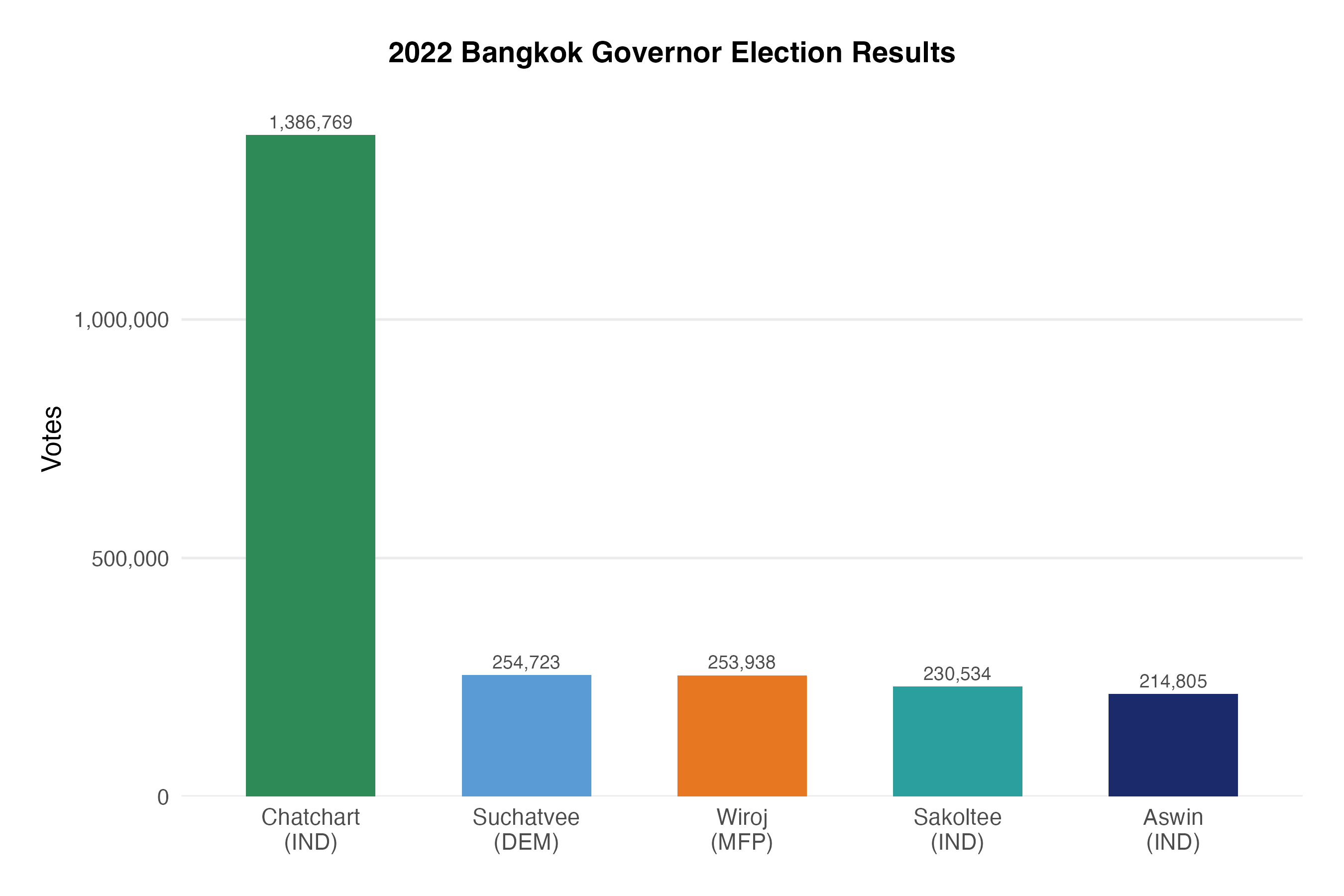
That victory is particularly impressive because it came against a very strong field. He faced perhaps the most qualified group of candidates to ever run for Bangkok governor, a field that included the incumbent governor and deputy governor (Aswin Kwanmuang and Sakoltee Phattiyakul), a famous engineering expert with a prominent media profile (the Democrats’ Suchatvee Suwansawat), and a famous MP with high name recognition (the MFP’s Wiroj Lakkhanaadisorn). Despite the tough competition, Chadchart still managed to win over 50% of the vote, relegating Suchatvee to a distant second place, clustering with Wiroj, Sakoltee and Aswin.
I wondered for a while if Chadchart would be able to retain his popularity over four years as governor. It is an unforgiving job; voters in the past have blamed governors for all of Bangkok’s intractable problems from traffic jams to flooding. But the evidence seems to indicate that Chadchart remains more or less broadly popular. A NIDA poll conducted during his third year on the job found that 48 percent of respondents planned to vote for him again, and around 74 percent of respondents were either very satisfied or largely satisfied with his performance. Given this level of satisfaction with the status quo, it begs the question of why these voters would take a risk on the unknown.
That Chadchart remains popular is visible in the fact that many Bangkok Metropolitan Council candidates are choosing to eschew party labels in order of affiliations with pro-Chadchart groups. Parties like the Democrats were publicly struggling to find a candidate to take on the governor, while Bhumjaithai chose not to even contest the race; these are indications that party polling must indicate a low likelihood of success. And speaking of struggling to find candidates…
2. Chadchart faces a lesser known field of candidates
This year, Chadchart’s competitors include:
People’s Party candidate Chaiwat Sathornwichit
Democrat Party candidate Anucha Burapachaisri
Economic Party candidate Chanthep Selawet
Independent candidate Mallika Mahasook
Independent candidate ML Kornkasiwat Kasemsri
Independent candidate Komsan Panwichartkul
The major party candidates are less known to the public compared to the 2022 slate of candidates, such as Suchatvee, Wiroj, or Aswin. Chaiwat has been a relatively low-profile PP MP. Anucha was a former Bangkok MP and the Prayut government’s chief spokesman, but he is not a household name. Mallika and ML Kornkasiwat are known for their media appearances and activism respectively, but whether that translates to support in a gubernatorial race is unclear. Things could change as the campaign begins in earnest, but they have a lot more to do to catch up to Chadchart’s universal name recognition.
The early polling indicates this name recognition problem. A Suan Dusit Poll found that Chadchart was supported by around 57 percent of respondents, while Chaiwat registered around 18 percent. No other candidate broke five percent. I do not know if this poll is fully accurate, but the wide margin is unlikely to be completely erroneous. While I expect the polls to tighten as the billboards go up and the other candidates become better known, the gap could well prove insurmountable.
Many of these candidates appear to acknowledge themselves that it is going to be difficult to defeat Chadchart. Chaiwat has said that “we must do better than Chadchart, who is already doing a good job.” Democrat Party leader Abhisit Vejjajiva said that he would give Chadchart a better score than the 5 out of 10 that he has given himself, noting that the governor is dedicated to his job. These are not the pitches of parties that sound determined and confident about unseating the incumbent.
3. Bangkok voters prioritize personality over party in the gubernatorial election
There are two ways in which Chatchart could lose. The first is that supporters of the People’s Party can be persuaded to stick with their party. In the 2026 general election, 1.4 million voters cast a party-list ballot for the People’s Party. The party dyed the capital completely orange, in many constituencies winning more votes than the next three parties combined. If the vast majority of 2026 PP voters cast a vote for Chaiwat Sathawornwichit, there would be no question that he would win.
Another scenario is if the conservative camp manages to unify around a candidate while PP and Pheu Thai voters fragment between Chatchart and Chaiwat. In 2026, a group of political parties that I will loosely group together as conservative parties (namely Bhumjaithai, the Democrat Party, United Thai Nation, the Economic Party, and Thai Pakdee) won a little over a million votes collectively. They are a group I would broadly characterize as anti-orange and anti-Thaksin (and hence the disapproval extends to Chadchart). The conservative-leaning Naewna newspaper has suggested that if the conservative camp can “dissolve their conflicts and unify their votes as a singular power, the game can be changed.”
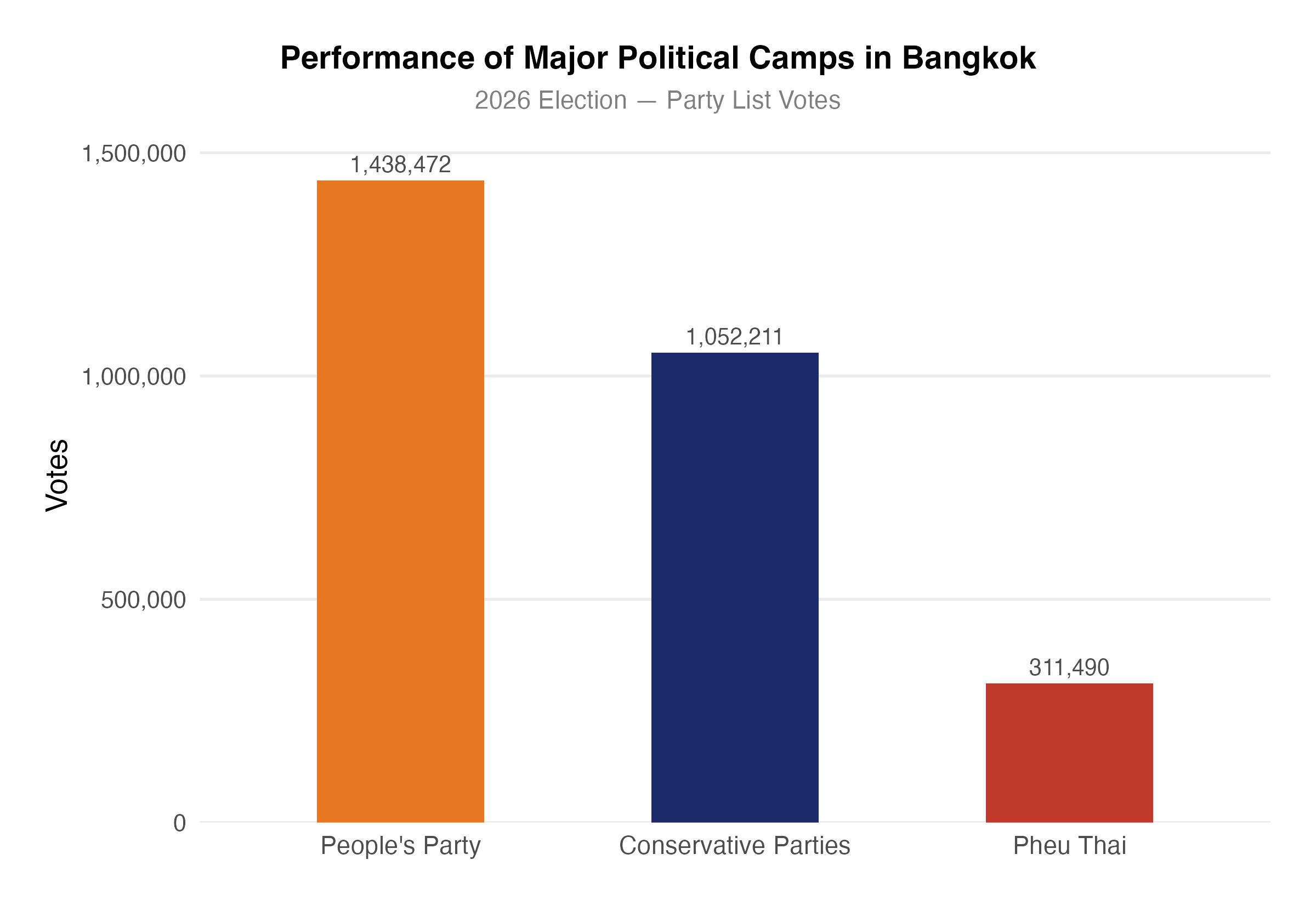
On paper these are plausible suggestions; the graph above shows that the “progressive” and “conservative” camps both potentially have enough voters to defeat Chadchart. In practice, this is highly unlikely.
Take a look at a comparison of candidate performances in 2022 against political party performances on the party-list ballot in the 2023 general election. Chadchart outperformed his old party, Pheu Thai, by over 700,000 votes. It indicates that Chadchart possesses cross-party appeal and is able to attract votes from across the political spectrum. He received support from far more than just his natural base of supporters (Pheu Thai fans), meaning that he was able to draw in votes from progressive and conservative voters as well. His independent affiliation has allowed him to successfully erase his image as a former Pheu Thai figure and given license for people who would normally not vote for the Thaksin camp to vote for him.
Secondly, it shows that Bangkok’s progressive voters have different calculations in mind when voting in local elections. Wiroj underperformed the MFP’s subsequent performance by over 1.4 million votes. The progressives are not so loyal to the various incarnation of orange parties that it is unthinkable to vote for another non-orange candidate they like. It is thus highly unlikely that all of the PP’s 1.4 million voters will cast a vote for Chaiwat; a significant portion will certainly break for Chatchart. Larger political trends aren’t helping, either. The PP just suffered a bruising election defeat and there seems to be no indication that the party has been able to recover any semblance of wind in their sails. Unless something changes in the next month, even their supporters are probably not feeling all that enthusiastic about the party.
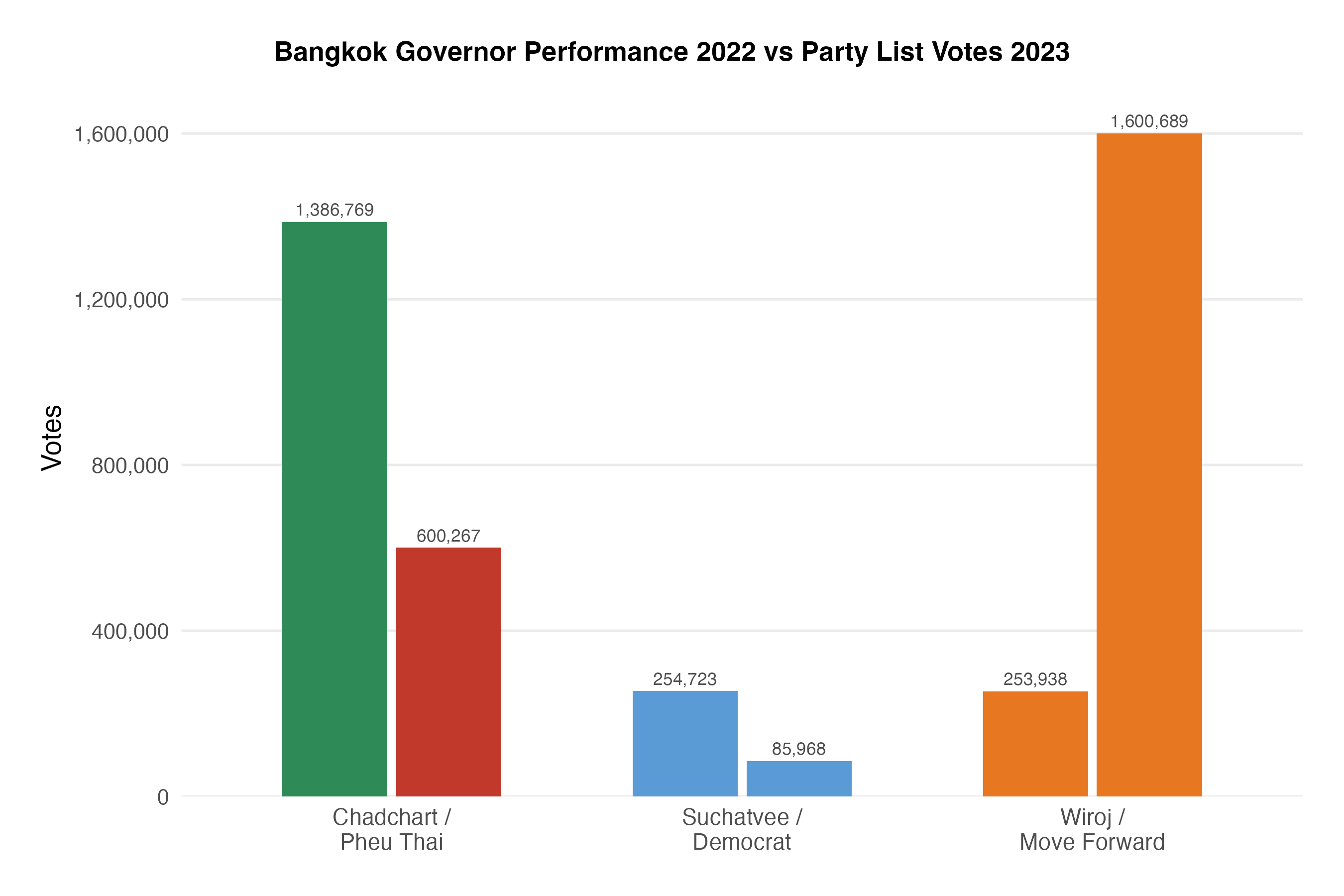
Meanwhile, conservative voters split in many directions in 2022, and the race became personality-driven rather than party-driven — Suchatvee significantly outperformed the Democrats’ subsequent performance in 2022. The fact that there was no clear “regime candidate” (Palang Pracharath did not field a candidate) made unification difficult. We will probably see something similar play out this time. In the past few elections, conservative voters have never shown any indication of an ability to unify. We tend to treat them as homogeneous camp, but they are anything but: of the roughly 1 million “conservative” voters, around half a million supported Bhumjaithai in 2026, while a little over 300,000 voted for the Democrats.
Given that Bhumjaithai is not fielding a candidate, the half a million will have to go somewhere. But instead of unifying behind a candidate, they will likely split between Anucha, Mallika, Chanthep, and ML Kornkasiwat. None appear to me to be a clear choice. The Democrats won four gubernatorial elections in a row this century, but that era is gone. It is not a given that the 300,000 who voted for the Democrats in the general election will vote for Anucha; at the same time, there are many Bhumjaithai voters who are probably incensed at the Democrats’ role in opposition and would not vote for him either. Indeed, in a bid to ensure that the PP’s Chaiwat does not win, some will likely cast a vote for Chatchart.
There is still a month of campaigning to go, and it will be interesting to see how the candidates’ vision for Bangkok differ. But at this early stage, the frontrunner to win is unusually clear.
Bangkok is certainly a peculiar case. Nobody seems to actually know what the governor's statutory responsibilities actually are. I was also a bit surprised that Chudchart decided to resign to attend his son's graduation in Washington, and his entire team did the same as well, putting civil servants in charge of the capital. The campaigning period is also fascinatingly short, even though we have known for a long time that it was happening---it wasn't like this was a snap election or anything. A number of parties seemed unprepared to field candidates for governor and Bangkok Parliament. And where do you even politically go after being governor? And what of these random Bangkok Parliamentary candidates who say they're "Working People" but Chudchart is saying he did not endorse them? So many questions..
Thanks Ken for your comprehensive coverage of this foregone conclusion election