

All reports indicate that the Bhumjaithai government cabinet lineup is finalized, but I figured that it wouldn’t be too late to wait for the final list before we dissect it. Prime Minister Anutin Charnvirakul is also grappling with the continued effects of the energy shock, with prices increasing. Foreign Minister Sihasak Phuangketkeow said that Iran has assured the safe passage of Thai ships in the Strait of Hormuz.
Even as the world moves on to watching the geopolitical situation, I do want to take time to fully analyze the implications of the 2026 general election. So here is the second post in my series of election retrospectives, after my analysis of the results in Bangkok.
Last month, Joel Selway on Thai Data Points discussed the question of whether Bhumjaithai’s victory had been driven by nationalism. I encourage you to read the full piece, but the gist of his argument is that while nationalism likely played a role in motivating voters already predisposed towards Bhumjaithai, coordination in local races was the more important determinant of victory.
One thing that’s worth wondering about, however, is whether the Cambodian conflict played into voters’ calculations differently depending on where they were located. In what I will call the “regionalized nationalism” hypothesis, voters in areas that were directly affected by the conflict, or close enough to have gotten a scare from evacuation orders, would theoretically be more receptive to political pitches centered around national security.
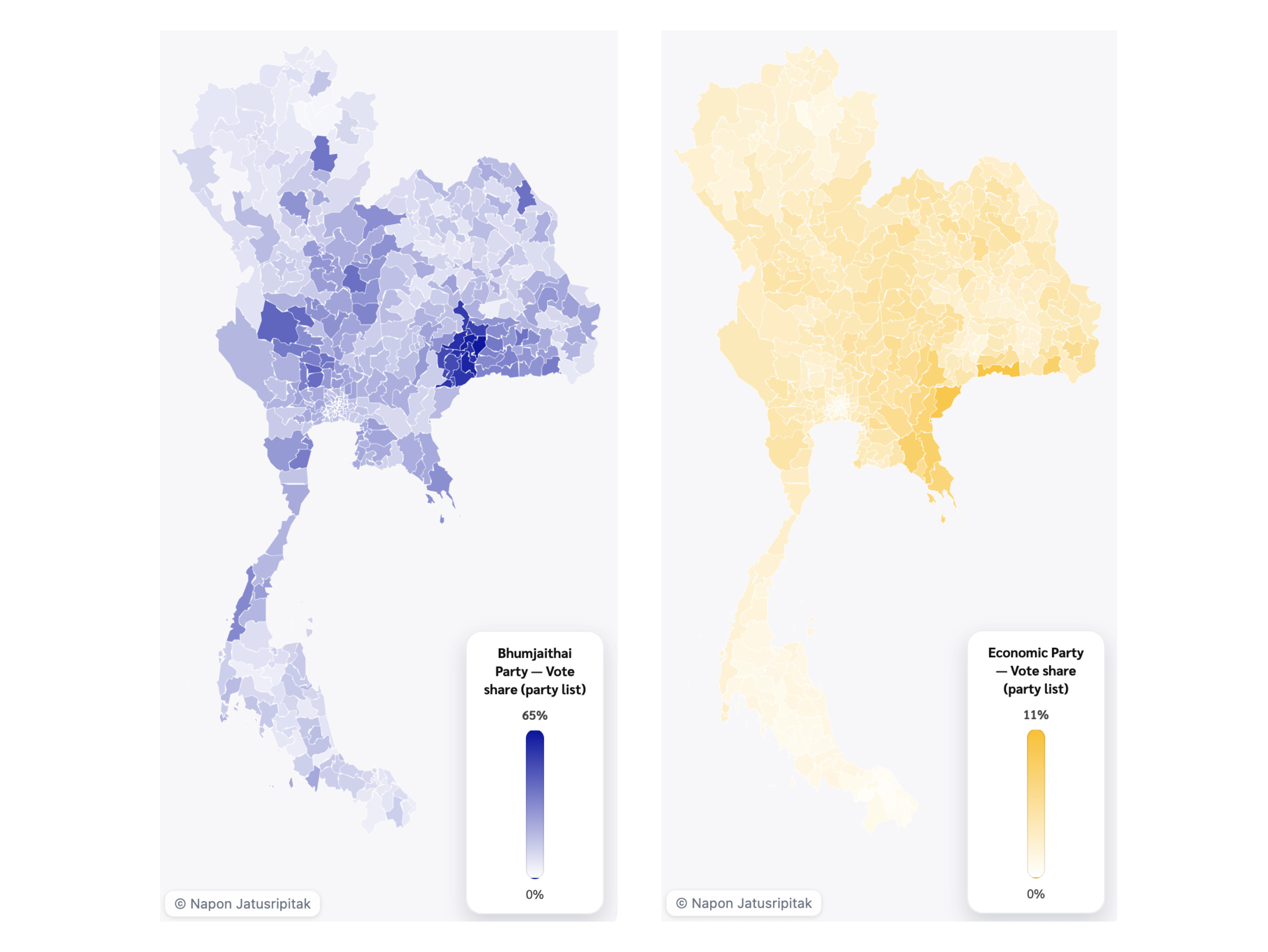
One way to examine whether this hypothesis is accurate would be to see whether more nationalist parties performed better in provinces close to Cambodia. Two of the most stridently nationalist parties in this election were Bhumjaithai and the Economic Party. Below are maps of Thailand colored by party vote share, courtesy of Napon Jatusripitak’s election dashboard. (One note of caution: these maps are based on incomplete data at 94 percent reporting, but for our purposes here this shouldn’t significantly change the overall picture). Evacuations occurred in Buriram, Chanthaburi, Sa Kaeo, Si Sa Ket, Surin, Trat and Ubon Ratchathani.
The nationalist credentials of these two parties were very clear during the campaign. The Bhumjaithai government presided over the second round of the conflict between December 8-27 in late 2025. During the election campaign, the party pledged to build a border fence and to scrap MOU 44.
The Economic Party is, in some ways, the more interesting case study. It is a new party1 and lacks strong local networks. It was instead relying essentially solely on the nationalist wave. The party endorsed a border fence and scrapping MOU 44 and took even stronger stances on Cambodia than Bhumjaithai. Its leader, General Rangsi Kittiyanasap, made a name for himself with his straight-talking TV appearances where he proposed hardline measures on Cambodia. At one point, Rangsi said that “if Cambodia shoots at us, we must fire back with one hundred times the intensity” and appeared to suggest that Thailand can bring Hun Sen over to face justice (à la Maduro). The party also used the slogan “Thailand First” during the campaign. Thus, it’s reasonable to infer that people voting for the Economic Party did so mainly because of its policy program, not because of individual local candidates.
Bhumjaithai’s performance
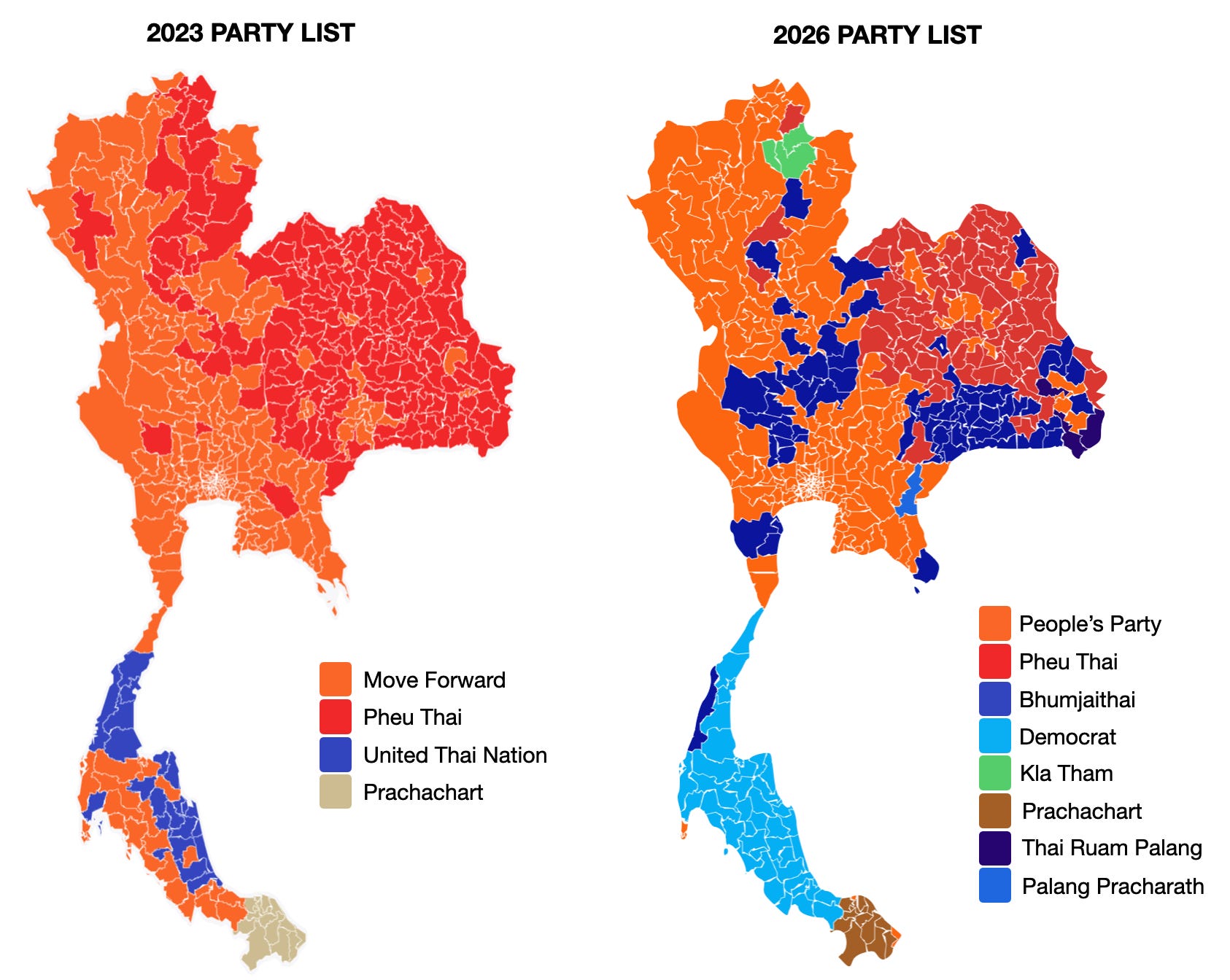
Firstly, it’s worth noting that the lower northeast (which sits closest to Cambodia) voted differently on the party-list in 2026 than in 2023. Move Forward and Pheu Thai were the two parties that topped the party list vote in every constituency in this region in 2023. In 2026, Bhumjaithai had the most party-list votes in the lion’s share of constituencies. But Bhumjaithai also bested the other two parties in the Central region, where they also developed a high degree of local strength. It’s thus impossible to say for sure that the lower northeast performance was a regionalized result of nationalism.
To get a more granular picture, we’ll zoom into the border regions closest to Cambodia. Bhumjaithai saw its best performance on the party list ballot in one border province: Buriram. (See first map: the darkest shades of blue are concentrated in Buriram). Throughout the province, it won over 50 percent of the vote in every constituency, indeed in some areas winning close to 65 percent of the vote. But this is where Bhumjaithai has historically been strongest (Buriram is essentially the party’s capital city), and so its stratospheric performance here is unsurprising. Interestingly, the party failed to replicate this level of support outside of Buriram. Cross over to the border constituencies in Surin, Chanthaburi, and Sri Saket, and Bhumjaithai’s vote share decreases to closer to 30-40 percent of the vote. In Sa Kaeo, another province bordering Buriram, the party’s vote share declines to around 10 to 20 percent. In the Ubon Ratchathani constituencies directly bordering Cambodia, Bhumjaithai won as little as 6-8 percent of the vote.
This is still much higher than in 2023, of course, and given that nationally Bhumjaithai won 18 percent of the party-list vote, it can be said that in some border provinces Bhumjaithai did over-perform. Such results are perhaps attributable to nationalism. In Si Saket’s District 5, which sits on the border, Pheu Thai’s vote share collapsed from around 45 percent in 2023 to just 25 percent in 2026. That is a rather precipitous fall. Was this because voters were blaming Pheu Thai for mismanaging the border issues, and voters transferring their allegiance to Bhumjaithai? We would need survey data to draw a firm conclusion, but it would be a reasonable guess that at least some voters were behaving according to this logic.
We do have one point of caution to suggest that Cambodia was only one of many drivers of the Bhumjaithai vote in the border areas, however: the vote share varied considerably depending on which party possessed local strength. In some constituencies where Bhumjaithai faced dominant competitors, it underperformed. In Sa Kaeo’s district 2, for example, Bhumjaithai won just around 10 percent of the vote, while Palang Pracharath (which had a miserable election night otherwise) won around 27 percent. This is the district of PPRP leader Trinuch Thienthong, and this was the party’s strongest constituency nationwide. Here, local dynamics seem to have been key.
The Economic Party’s performance
What is more interesting is the Economic Party’s performance. Nationally, the party won around 3 percent of the party-list vote share (roughly a little over a million votes). But it was in the border areas that the Economic Party saw its strongest results. In the map, you can see that the darkest shades of yellow is clustered around the Cambodian border! Here were some of the party’s best constituencies:
In Surin’s eighth district, the party won around 10 percent of the party-list vote; it had a similar performance in Sa Kaeo’s third district where they won a little over 9 percent. Both of these constituencies directly border Cambodia.
In Sa Kaeo’s border constituencies (including Trinuch’s) it won 7 to 9 percent of the vote.
In Chanthaburi’s third district and Si Saket’s fourth district, it won 8 percent of the vote.
It’s worth noting that we do not see similar performances anywhere else in the country. If the nationalist wave had swept through all of Thailand, you would expect to see the Economic Party to do respectably in Bangkok, the province most attuned to the national sentiment. But there, the Economic Party usually won between 1-3 percent of the party-list vote (in line with its national performance). The nationalist effect thus appears to be highly regionalized.
So what conclusions can we draw? There are too many confounding factors to say with complete certainty that Bhumjaithai performed well in the lower northeast because of the Cambodia factor. However, the strength of its performance on the party-list ballot, where voters are directly choosing a party instead of a local candidate, makes it plausible that Bhumjaithai may have indeed peeled off some nationalist voters from other parties. At least some Pheu Thai and People’s Party voters probably drifted towards Bhumjaithai because of the nationalism factor. Additionally, as Joel Selway wrote, nationalism likely played a role in turning out conservative voters who already were attuned to Bhumjaithai’s offerings in this election. In addition, the over-performance of the Economic Party in border areas indicates that the Cambodian conflict did play a role in driving the calculations of at least one major segment of the population in these provinces.
Yet if I were a party leader thinking of using nationalism as the main factor to drive support for my party, these results would give me pause. There were many facilitating causes underpinning Bhumjaithai’s victory, and nationalism was only one of them. The party that was riding solely on the nationalist wave was the Economic Party. The fact that their most outstanding performances show up clearest in constituencies that sit directly on the border and fade the further away you go indicate that even this regionalized version of nationalism may have had limited effects on voter behavior in the lower northeast. Indeed, even in some constituencies very close to the border, the Economic Party did not significantly over-perform.
The best conclusion we can draw based on the limited data we have is regionalized nationalism played at least some role in driving how voters behaved in 2026. That is not as clean a narrative as the one that the media offered in their reporting of the election results. Unfortunately, politics is rarely that clear-cut.
Technically it’s not a brand-new party, as it had contested the 2023 general election under the Zendai Party name. This is its first election in its current incarnation, however.