

Good morning from The Coffee Parliament. A very busy week is coming up for me, so there will be no newsletter next week. To make up for it, I’m covering two topics today, as I’ve realized that since the February general election I’ve unintentionally neglected the opposition parties (except, funnily enough, Kla Tham, which is now not even an official member of the opposition whip).
Piyabutr attacks the “Entertainocracy”
Since the Future Forward Party was dissolved, co-founder and former secretary-general Piyabutr Saengkanokkul has distanced himself from the Move Forward and People’s Party leadership and operated more as a disgruntled critic from the left. Last week he outlined “four things the party must avoid,” including: 1) “Entertainocracy” politics, 2) “Hyperpolitics”, 3) A politics that focuses only on exposing others but lacks new visions and proposals, and 4) A “digital party” with “hyperleadership.” Piyabutr is still writing this series of posts, but he has already sparked controversy with his thoughts on how the entertainocracy has infiltrated the People’s Party.
In his post, Piyabutr decried a politics in which “politics feels overwhelming” but “no change can be created.” “Political parties and politicians may need to use ‘entertainment’ as a communication tool…this is not abnormal, and may indeed even be a requirement,” Piyabutr wrote. “But if the party cannot control its politicians and actors so that they use ‘entertainment’ in service of the party and its larger direction…the party and its leadership will lose its ability to lead, becoming a ‘private heroic cult’ instead.” As a result, Piyabutr argued that the PP cannot evolve to become a genuine mass party. “The party’s team and networks diligently try to build a mass base…but they must lose this mass base to the daily entertainment.”
Unfortunately for the PP, it seems that Piyabutr has handed Bhumjaithai a ready-made weapon. The “entertainocracy” attack line is especially damaging because it came from one of the original spiritual leaders of Future Forward, and when used against a party that has heavily utilized viral posts on social media, may ring true for its critics. Immediately after the PP announced their targets for an upcoming no confidence debate, various Bhumjaithai politicians dismissed the party’s move as a mere attempt at entertainment. “Their intention is to achieve political outcomes. This is entertainocracy like what they say,” Bhumjaithai MP Supachai Jaisamut responded. Noting the strong language that the PP adopted against the ministers, the minister attached to the Prime Minister’s office, Paradon Prissanananthakul, said: “What is entertainocracy like? Just try asking Piyabutr.”
Piyabutr has not minced words in his previous criticism of successive Thai progressive party leaderships, but this time, the PP leaders are likely to feel that he has gone too far. That said, the victory of progressive candidates in the Social Security Board elections over the weekend gives the party the first reason for some cheer in months.
The Democrats hold a reunion
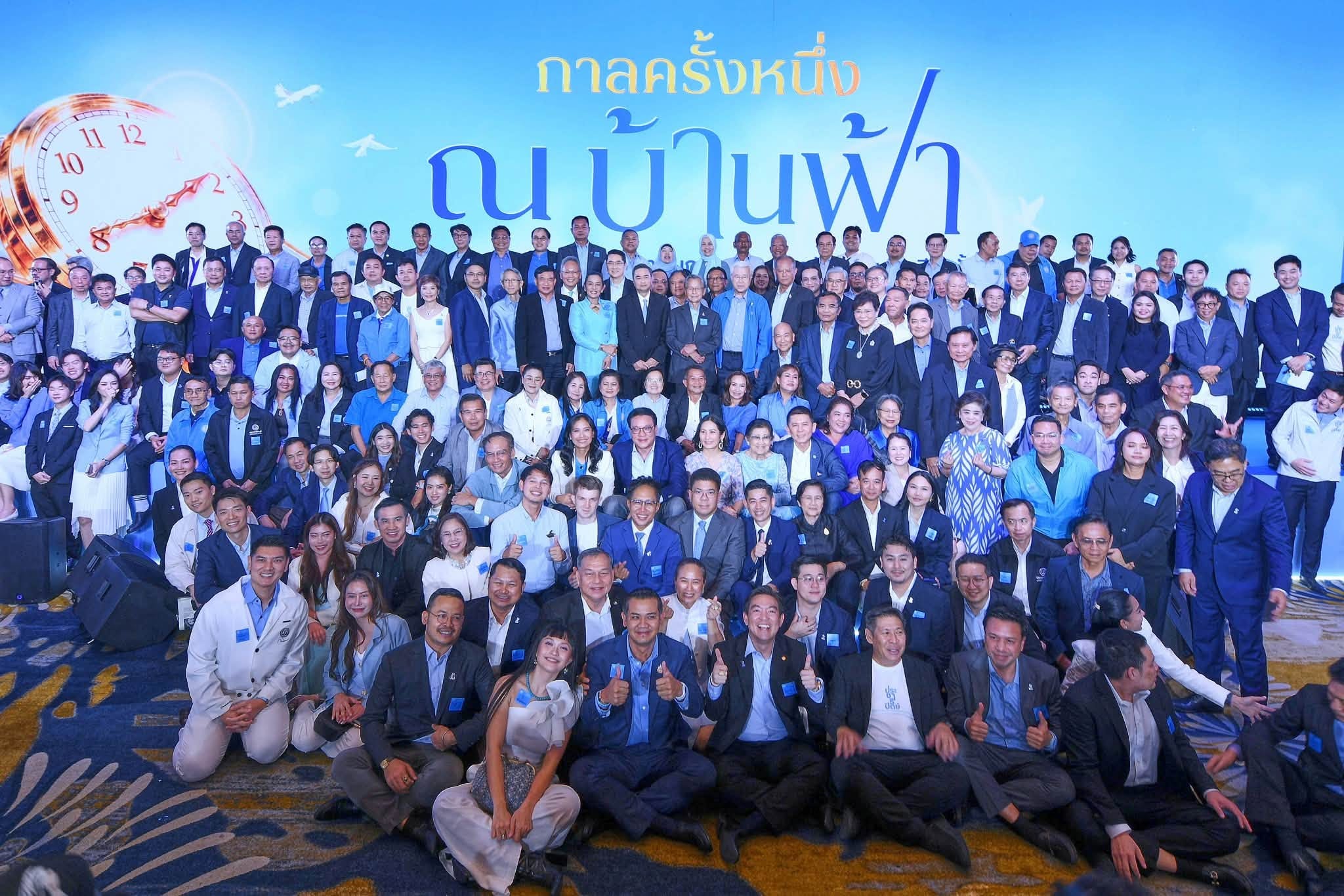
Back in February, I wrote up an overview of the Democrat Party since Abhisit Vejjajiva’s return as party leader, including a recap of its performance in the general election. I argued that while the party successfully escaped extinction (which was not a completely unthinkable scenario pre-Abhisit) and recovered its party-list support almost to 2019 levels, the Democrats still face multiple major challenges: stuck in a centrist no man’s land and running the risk of overpersonalization. Since then, the party appears to be in a holding state: it has become a strident critic of the Bhumjaithai government, but is too small in parliament to take a leadership role within the opposition.
The Democrats did hold a very interesting event this past week. As part of the party’s celebrations of the 80th anniversary of its founding this year, the Democrat leadership invited all of its former officeholders to attend a reunion, with the invitation open to those who had already left for other political parties as well. The list of attendees sparked a lot of interest. Among them was Suthep Thaugsuban, the former Democrat secretary-general (and PDRC protest leader) who publicly fell out with Abhisit after leaving the party. Some prominent politicians who had not been a Democrat member for decades, such as former speaker Wan Muhammad Noor Matha and Pheu Thai MP Chaturon Chaisang, also attended. Others included former frontline members of the party, such as Trairong Suwankhiri, Tarrin Nimmanhaeminda, and Kalaya Sophonpanich.
Most of these attendees are probably not planning on an imminent return to the party simply with their presence, but who knows — perhaps some were indeed signaling their openness to coming back to a party they once called home. Those absent are also interesting; only one Bhumjaithai MP came, and he was forced to deny to the media that there was an order from Bhumjaithai’s leadership prohibiting attendance at this event. (That will only spark more speculation that the gulf between the two parties has become ever wider). All in all, the event was a good opportunity for the Democrats to remind a national audience of their previous glory and relevance, and a way to underline the unique nature of their status as Thailand’s only institutionalized party. (One would be hard-pressed to think of another party would be in a position to host a similar event).
At the same time, however, the reunion is also a reminder that for all of its storied past, the Democrats still face an uncertain future. Its support as tracked by the NIDA poll remains essentially stagnant, and the party has found it virtually impossible to bring support from young people. Figures like Abhisit and Chuan Leekpai have had immense staying power — but for the Democrats to rejuvenate they will need to find new ways to reinvent the party.