

With the dissolution of parliament last week, Thailand has now shifted into full election mode. My plan is to post a little more frequently during the campaign to highlight notable news as the campaign progresses. If you’d like to read my election analysis during the election season, a subscription to The Coffee Parliament is currently completely free.
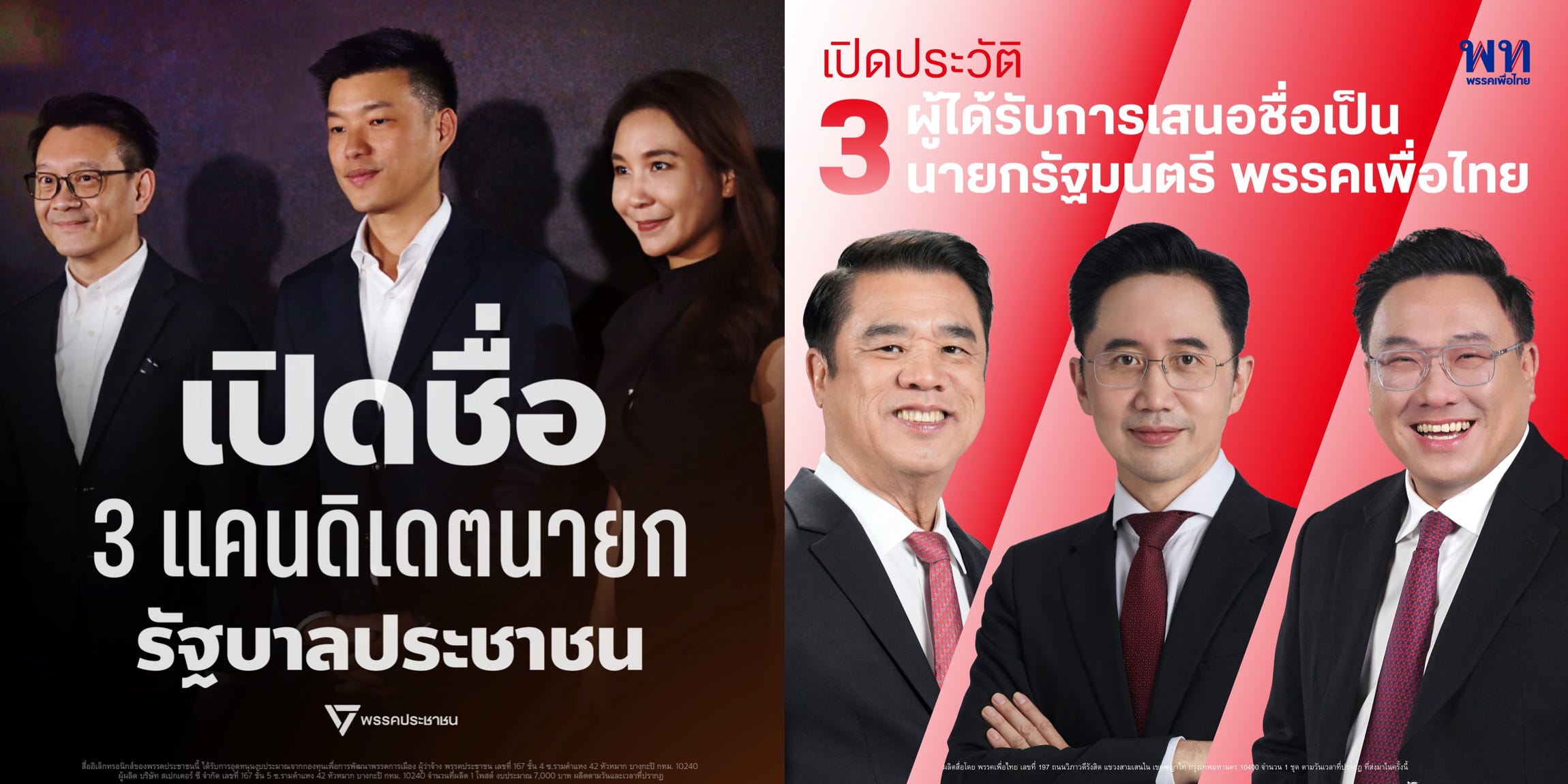
Of Thailand’s 32 prime ministers, around a third has held prominent ranks in the military. Many were former bureaucrats. Some had legal training. A few had successful business careers before entering politics. The People’s Party and Pheu Thai’s prime ministerial nominees for the 2026 general election, however, are a shift away from the norm: both come from STEM backgrounds.
Due to the quirks of the 2017 Constitution, each political party is able to nominate up to three candidates for prime minister. Given the tumultuous circumstances of the past parliamentary term which led to the elimination of two Pheu Thai prime ministers, few parties will now take the political risk of nominating only one candidate. We expect to see a full slate from all the parties, including Bhumjaithai and the Democrats. Every party, however, is likely to indicate which candidate is their “number one choice” — the first in line to be nominated for prime minister should their party win the election.
The People’s Party nominated three candidates: the party leader Natthaphong Rueangpanyawut, along with two deputy leaders Sirikanya Tansakul and Veerayooth Kanchoochat. Of these three, Natthaphong obviously holds precedence as the party leader. His background is certainly different from the other two candidates. Take Sirikanya, a former think-tanker who specializes in economic policy. She was actually the subject of more speculation to become party leader after the dissolution of the Move Forward Party, and has headed the party’s economic team.
Natthaphong, on the other hand, is most well known as a data whiz who founded a cloud computing company and formed “Kao Geek” (a Discord community of, well, progressive digital geeks). He is known for his interest in pushing open data in government and digitizing budgetary materials. His LinkedIn bio states: “Now, I’m still finding an answer for my country: Why Thailand still has no its own WORLD-CLASS tech firm despite there are abundant requiring resources in this country to do this?” The party has billed Natthaphong as “the programmer” who will “write Thailand’s new future.”
Perhaps, however, the PP’s candidate ordering may not be as stable as one might think. Both Natthaphong and Sirikanya may be ruled ineligible to serve as MP following an ethics probe related to their past support for amending Section 112. In that case Veerayooth (who currently has no legal obstacles) could very well become the party’s sole candidate for prime minister, and if elected he would become Thailand’s first academic economist to run the country. Previously a professor in Japan who studied under the famous economist Ha Joon-Chang, Veerayooth researched economic development, the middle income trap, and industrial policy. The PP calls him “a developmental strategist who will plan Thailand’s economic strategy on the world stage.”
Interestingly, this puts Veerayooth head-to-head with another academic who has been nominated for prime minister: Yodchanan Wongsawat, who Pheu Thai has indicated will be first in line to lead the country if elected. Yodchanan, like many previous Pheu Thai nominees, has plenty of family pedigree: he is the son of former prime minister Somchai Wongsawat and the nephew of Thaksin Shinawatra. (At the party’s announcement, Somchai and former prime minister Paetongtarn Shinawatra flanked Yodchanan, reinforcing the message of family continuity). But in its messaging, Pheu Thai has emphasized less his family background and more his past experience as a scientist.
Yodchanan was a biomedical engineering professor at Mahidol University, where he also served as a deputy dean in the engineering department. He has scant political experience, winning an election as an MP candidate in the nullified 2014 election. Pheu Thai has played up Yodchanan’s scientific background, emphasizing his aim to “lay the foundations for Thailand to become a high-income country…Yodchanan believes that upgrading requires increasing productivity through using science and technology to develop every industry in every form.” It is worth noting how Pheu Thai has listed all of his major academic awards and patents in their party graphics, demonstrating his scientific chops.
It also seems that Pheu Thai has given particular thought to how their candidates for prime minister form a coherent whole. The party also nominated Suriya Juangroongrueangkit, most recently acting prime minister for two days but who has served in a variety of cabinet positions. Suriya emphasized his focus on infrastructure, relying on his previous experience as transport minister. Finally, Pheu Thai selected its current leader Julapun Amornvivat, a former deputy finance minister who focused on economics and proposed a new debt forgiveness policy.
We thus have a curious situation where a programmer who leads the People’s Party is set to do battle with a scientist who will be Pheu Thai’s next prime minister if elected. It is a situation which comes with risks for both parties. Natthaphong has more political experience, having been leader of the opposition for over a year, but the party has not been polling well under his leadership and he appears to underperform his own party’s favorability. For the data geek to match Pita Limjaroenrat’s rock-star status in 2023 was always a big ask. But given all the unfavorable headwinds — swirling questions about whether it was wise for the party to back Bhumjaithai for government, and the heightened nationalist atmosphere amidst the border tensions with Cambodia — one wonders whether Natthaphong’s more low-key style will be enough to allow the PP to match its 2023 performance.
Yodchanan, on the other hand, has very little political experience and we still have virtually no idea of how he will run this campaign. Emphasis on his scientific background is a deviation from Pheu Thai’s usual electoral playbook; the party and its previous incarnations has usually gone for big, eye-catching policies (think of universal healthcare or the 10,000 baht giveaway). Yodchanan, on the other hand, talked mostly about economic restructuring and infusing industries with technology. (It’s likely that the more “populist” schemes will be left to Julapun and Suriya to handle). But how will a professor who has probably spoken at more academic conferences than political rallies handle his first campaign for prime minister? With Pheu Thai polling at the poorest level it ever has throughout its existence, Yodchanan will need to run an above-average campaign to claw back the party’s lost support.
In the end, the fact that Thailand could have its first-ever programmer prime minister or scientist premier probably has less to do with how much their respective parties value science and technology, and more to do with their recent political problems. The PP has appeared to struggle with finding charismatic leaders after the MFP’s dissolution. Reports have speculated that he became party leader because of his ties to Thanathorn Juangroongrueangkit and a personality that made him acceptable to all in the party. And the first reports suggested that after Paetongtarn’s ouster, Pheu Thai was eyeing Natthaphong Kunakornwong, husband to Thaksin’s daughter Pintongta Shinawatra, as a potential candidate. How Pheu Thai ended up choosing Yodchanan is unknown, but we can assume that the party wanted to keep the top candidate “in the family.” Two of Thailand’s major parties appeared to have stumble into a STEM-flavored election not by design but by circumstance.
Addendum: I was reminded after this piece was published that Prime Minister Anutin Charnvirakul also studied engineering, although I don’t think it merits the same level of discussion here as he isn’t emphasizing his engineering credentials when running for prime minister.
> Yodchanan, on the other hand, has very little political experience and we still have virtually no idea of how he will run this campaign.
The same way Sretta did. He didn't run the campaign, he was just chaperoned around by babysitters and told what to do.