

Our thoughts today are with the people affected by the Lad Phrao fire, which at the time of writing has already killed 27.
Good morning from The Coffee Parliament. Last week was exceptionally busy in Thai politics and so I felt that a Morning Coffee Briefing is in order.
In today’s newsletter:
Parliament passes a bill granting amnesty to people facing cases stemming from political conflict over the past two decades
The Constitutional Court rules that the government’s emergency degree is legitimate
Prime Minister Anutin Charnvirakul visits Malaysia, while the Shinawatra premiers visit Indonesia
1. Parliament passes Amnesty Bill
Over a decade ago, the Yingluck Shinawatra government attempted to pass an amnesty bill for those with legal cases stemming from the color-coded political conflicts of the 2000s. It proved so controversial that the bill (which failed to pass) became the main trigger for mass protests against the Pheu Thai Party. This past week, a new amnesty bill (now called the Peaceful Society Promotion Bill) sailed through parliament with relatively little fanfare.
The Peaceful Society Promotion Bill will provide amnesty for Thai citizens who were or are being prosecuted for legal cases stemming from the yellow shirt protests, red shirt protests, People’s Democratic Reform Committee (PDRC) protests, anti-coup protests, and the 2020-21 youth protests. This covers around 6,000 people. There are some major omissions, however. For one, it does not cover civil lawsuits (and as the Bangkok Post points out, yellow shirt leaders billed for their airport closure in 2008 will not become exempt from paying compensation). It does not cover those convicted of corruption.1 And finally, it does not provide amnesty for lèse-majesté cases.
This third point has proved to be a major point of controversy, with the People’s Party coming out against the bill because of is omission of lèse-majesté convicts. Pheu Thai MP Thongthai Wechayachai argued that “this draft is the furthest step that Thai society today can collectively accept.” The Democrat Party, on the other hand, pointed out that the Senate added a clause allowing amnesty to be extended to those convicted of wrongdoing regarding the Senate elections. All in all, the bill passed by a vote of 306 to 141 with a number of MPs who would be direct beneficiaries of amnesty declining to vote.
2. Constitutional Court rules that loan decree is legal
In May, the Cabinet green-lighted borrowing 400 billion baht “to ease impacts on people’s living costs caused by the energy crisis and to support the restructuring of Thailand’s energy sector.” Thai law requires that an emergency borrowing decree can only be made when there is “an emergency of necessity and urgency which is unavoidable,” and the opposition parties quickly petitioned the Constitutional Court to rule on whether or not there is an emergency of sufficient magnitude to warrant using this mechanism.
On July 9, the Constitutional Court delivered its ruling. In a unanimous ruling, the Court said that using the loan funds to alleviate cost pressures for the people is lawful. In a 7 to 2 ruling, the Court also found that using the funds to facilitate Thailand’s transition to renewable energy is also lawful. Given that this ruling was the biggest legal question hanging over the Bhumjaithai government, ministers will be relieved to have the Constitutional Court clear one of their biggest economic initiatives to date.
The ruling does leave long-term implications, however. Thammasat University professor Supreeya Kaewla-iad pointed out, for example, that this ruling may pave the way for future fiscal indiscipline, as interpretations of what is meant by “preserving the economic security of the country” may become so wide as to decrease in meaning. It may also encourage future governments to use the emergency decree mechanism to avoid legislative oversight on borrowing.
3. Prime Minister(s) visit maritime Southeast Asia
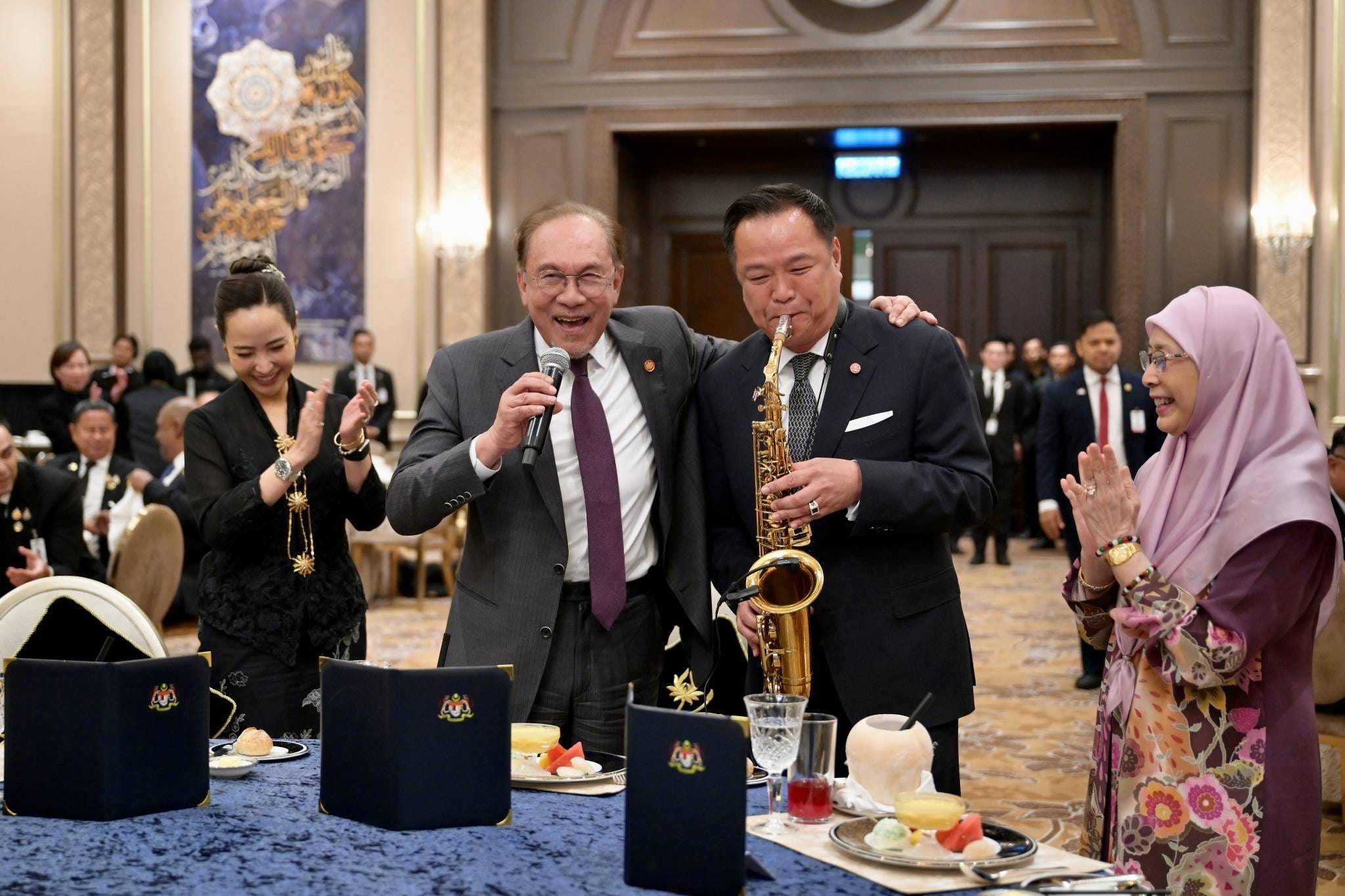
Prime Minister Anutin Charnvirakul visited Malaysia from 9 to 10 July to resolve a seafood spat. As Channel News Asia summarizes, “Thailand restricted the import of Malaysian-caught sea bass due to concerns over chemical residues, prompting Kuala Lumpur to temporarily ban some varieties of Thai shrimp over food safety controls last month.” Anutin and Malaysian Prime Minister Anwar Ibrahim also opened a new border crossing in Songkhla province. Most memorably, Anutin and Anwar had an episode of musical bonhomie.
At the same time, Indonesian President Prabowo Subianto met with not one but three former Thai prime ministers: Thaksin Shinawatra, Yingluck Shinawatra, and Paetongtarn Shinawatra. Thaksin is an advisor to Danantara, an Indonesian sovereign wealth fund. This is one of Thaksin’s most visible public engagements since he was released from prison in early May.
In a strange coincidence, Anutin’s Facebook account shared a post from a Pheu Thai fanclub page on rumors that Thaksin had helped Agricultural Minister Suriya Juangroongrueangkit resolve the shrimp issue with Malaysia. Anutin later posted: “Sorry, I accidentally pressed ‘share.’ That was unintentional. Thank you to the reporter who called me and let me know.” Make of that what you will…
This omission, unlike the 2013 Amnesty Bill, is what makes it far less controversial.