

My Ph.D. has kept me very busy over the past few weeks, so I’ve been missing out on a lot of important updates in Thai politics. Hopefully I’ll have time to catch up soon! Since the Bangkok local elections are happening in only ten days, I thought that I’d give the race priority. So today, I’ll be diving into some polling data of interest in the governor election and examining where we stand with the Bangkok Metropolitan Council elections.
The Race for Governor
At the start of this month, I wrote that Chadchart Sittipunt is likely to be a lock to win re-election as governor. The “Agong Regime” allegations have not hurt his polling numbers, as far as we can tell, and if that did not hurt, new scrutiny over the governor’s tenure like the Democrat Party’s examination of “suspicious” public procurement practices in the Bangkok Metropolitan Administration is unlikely to have much of a cut-through effect. All the data we have points to a Chadchart landslide, whether it be polling data or social media engagement statistics (Chadchart’s engagement statistics simply dwarfs all other candidates).
What I want to highlight today is Suan Dusit Poll’s interesting polling data where they asked respondents who they voted for in 2022 and who they intend to vote for this time. I’ve illustrated the data below. Worth noting that I don’t know the raw numbers of 2022 voters, only the percentages, so the diagram below is a little misleading in the sense that it presents all five 2022 candidates as having equal support. But for the purposes of illustrating voter flows, I think that it is useful enough:
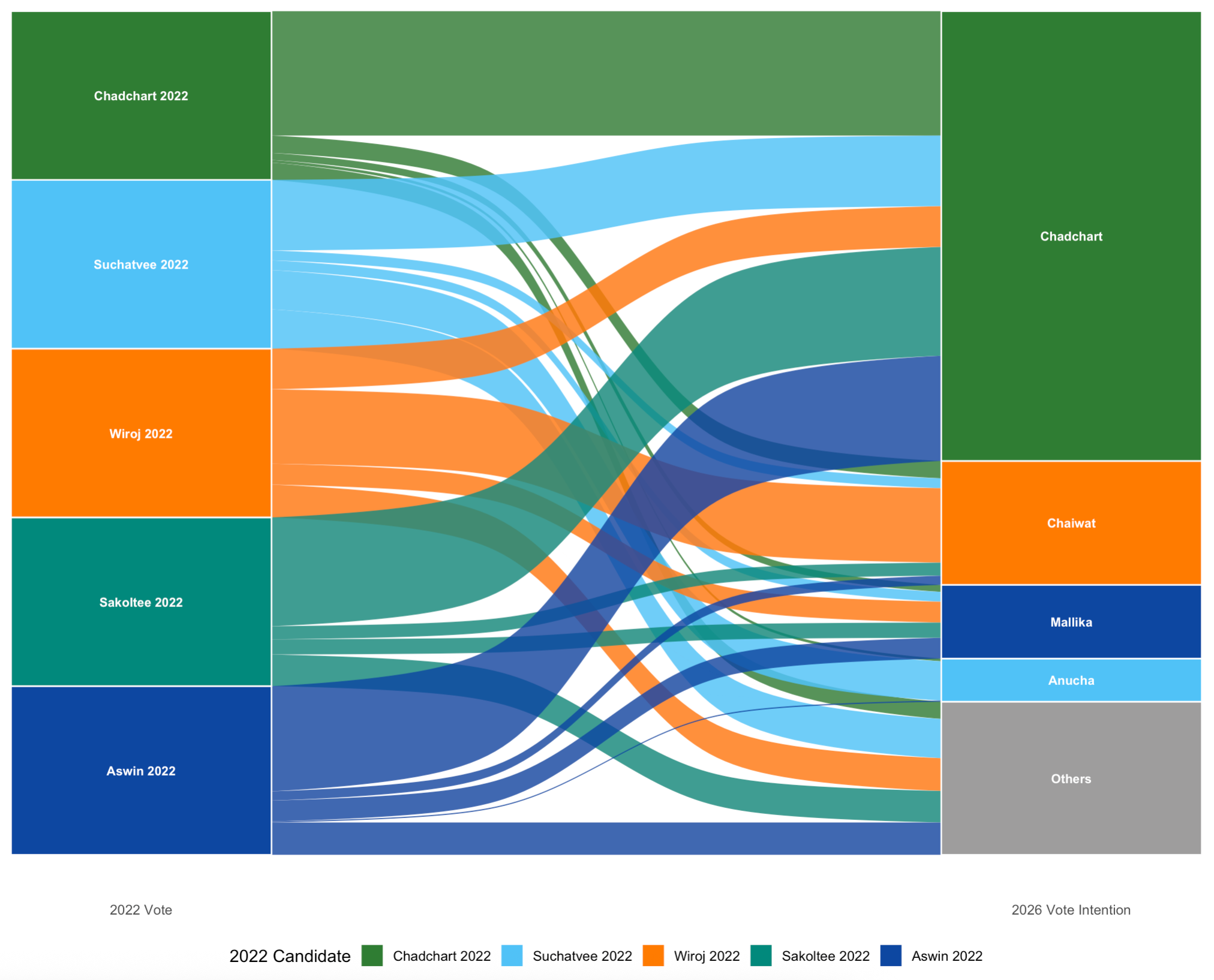
Chadchart, who sits at 60 percent support in this poll, is retaining the majority of his 2022 voters (around 74 percent) with some minor outflows to other candidates. He is also receiving a big chunk of voters who previously cast their support for his 2022 opponents. Interestingly, 64 percent of Sakoltee voters, perhaps the most popular choice among ideological conservatives in 2022, told Suan Dusit that they plan to vote for Chadchart this time around. I imagine that this is very much an effect of seeing the People’s Party sweep Bangkok in the general election earlier this year and, fearing a repeat, choosing Chadchart as a “lesser evil.”
The People’s Party’s Chaiwat Sathawornwichit (sitting at 13 percent) retains around 44 percent of Wiroj Lakkhanaadisorn’s voters. That…is not a great result for the PP, and a sign that the party has simply been unable to generate any sort of enthusiasm in the capital. While the PP probably never truly expected Chaiwat to win, the lack of enthusiasm for its gubernatorial candidate could have negative downstream effects for its Bangkok Metropolitan Council candidates.
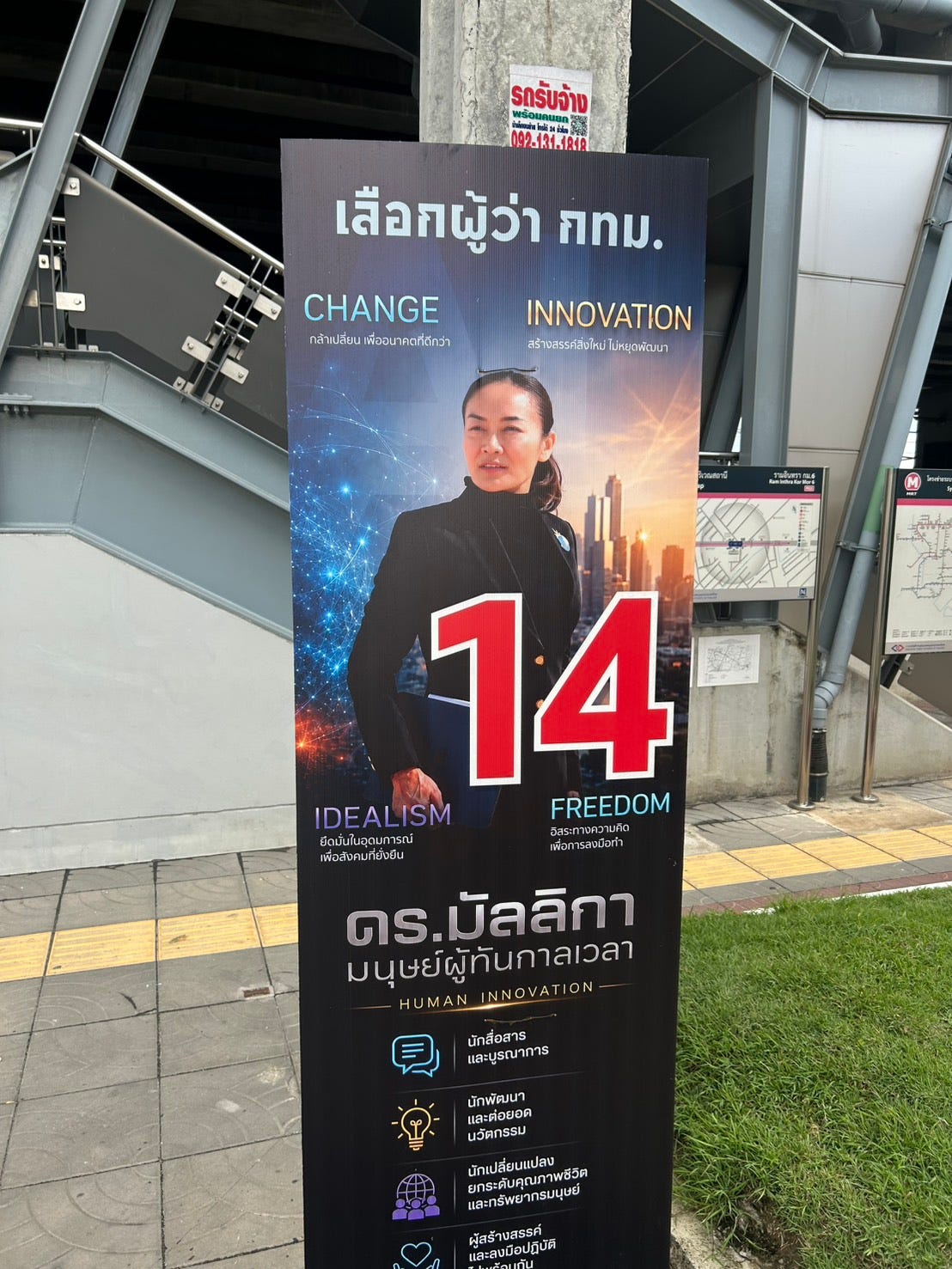
As far as I can tell from various polls and anecdotal data, aside from backing Chadchart, the conservative vote is “coalescing” around the independent candidate Mallika Boonmeetrakul Mahasuk (7 percent). For context: Mallika has long been a popular conservative media figure. There is certainly more online buzz that I can see around Mallika in conservative circles than Anucha; I imagine that most Bhumjaithai voters will back her given that there is no Bhumjaithai candidate. (If nothing else, Mallika certainly has an interesting election poster — one gets to ponder the need for change, innovation, idealism, and freedom in Bangkok).
The Democrat Party’s Anucha Burapachaisri (with around 4 percent support) is capturing only around 23 percent of voters who previously voted for the 2022 Democrat candidate, Suchatvee Suwansawat. If accurate, that is a devastating result for the Democrats, who didn’t do that well in Bangkok in the general election earlier this year but should still be capturing a lot more than 4 percent of the vote. My unscientific, anecdotal data is that even my politically-engaged friends do not recognize his name.
This is a lot of words to say that my assessment of the race has not changed since the start of the month, and all the other candidates are probably out of time to catch up unless there are some truly earth-shattering negative revelations about Chadchart.
The Bangkok Metropolitan Council Elections
I’m disinclined to look too closely at Suan Dusit’s BMC election because the data is a little questionable (they include Bhumjaithai as an option even though the party is not running any candidates). The polling we do have does suggest that independent candidates (from various groups, but most would be pro-Chadchart) are favored to win the most seats. Yet polling here is only useful to some extent — support for BMC candidates are distributed unevenly across districts.
I did find NIDA Poll director Suvicha Pouaree’s observations on this election interesting: “BMC candidates with organized votes are advantaged.” Because the PP and the Democrats have found it so difficult to generate enthusiasm amongst their voters in this election, he notes, they are unlikely to turn out their supporters. This favors independent candidates with their own local popularity, particularly in the pro-Chadchart “Working People” (khon tum ngarn) group.
How much does this matter, you may ask — is the BMC truly that powerful. ThaiPBS calls them the “hidden shaper of Bangkok’s future.” I would argue that for Chadchart, assuming he is re-elected, whether or not he has a friendly BMC could be a critical factor determining the level of success he experiences in his second term. Chadchart did not run with any BMC candidates in 2022 and has acknowledged that this has created “limitations” for him. Given the renewed attention that other parties have now placed on scrutinizing corruption within the Bangkok city government, a BMC that is dominated by unfriendly councilors could make life quite difficult for the governor.
With only ten days to go, we’ll find out very soon what the next four years of Bangkok’s administration will look like.