

This is the third of retrospective analyses of the 2026 general election. I previously wrote about the election results in Bangkok and the regional impact of nationalism.
Split-ballot voting in Thailand
Thailand has a parallel electoral system, composed of a constituency system (where voters choose a local candidate) and a proportional “party-list” system (where voters pick the party they like best). In this system, ballot-splitting — when a voter picks one constituency candidate from one party and then selects another party on the party-list — is quite common. But ballot-splitting is a bit of a puzzling phenomenon.
A glance at the scholarly literature on vote behavior would actually tell us that ballot splitting should actually be quite unlikely to happen. This may perhaps sound silly to many who are enthusiastic about politics (of course Thais can, as the saying goes, choose a candidate they like and a party they love, both of which need not be of the same affiliation). But as scholars like Arthur Lupia (1994) have shown, voters who — quite rationally — do not want to spend all of their valuable time consuming political information depend on “heuristics” (shortcuts), such as endorsements, to make voting decisions. The existence of large-scale ballot splitting in Thailand would indicate that voters are, in fact, not depending on a single source of heuristics: they are using different rationales to make different decisions on the two ballots.
What are those rationales? To make sense of split ballot results, we have generally treated constituency results as reflective of local attitudes (“this MP has performed exemplary service in my locality and deserves to be re-elected”), while party-list results are seen as a proxy for genuine ideological attachments or national sentiments (“I agree with this party’s policy platform and want their candidate for prime minister”). This often leads to contradictory voting decisions, where a voter might pick the People’s Party on the party-list ballot but vote Bhumjaithai on the constituency ballot — even though they do not see eye to eye on many fundamental issues and would have been unlikely to form a government together. This was certainly the case in 2023, when Move Forward was the most popular option on the party-list in 70 constituencies won by the major conservative parties (United Thai Nation, Palang Pracharath, and Bhumjaithai).
In 2026, we still see a lot of split ballot voting decisions. The People’s Party won the most party-list votes in most of the central and northeast, but won only a handful of constituency seats. Pheu Thai was still dominant in the northeast party-list vote but saw major inroads made by Bhumjaithai and Kla Tha, in the constituency ballot. The Democrats swept the south on the party-list, but a plea by the party for voters to give the party more than “half their love” failed. The map of the constituency vs party list results below illustrates this clearly:
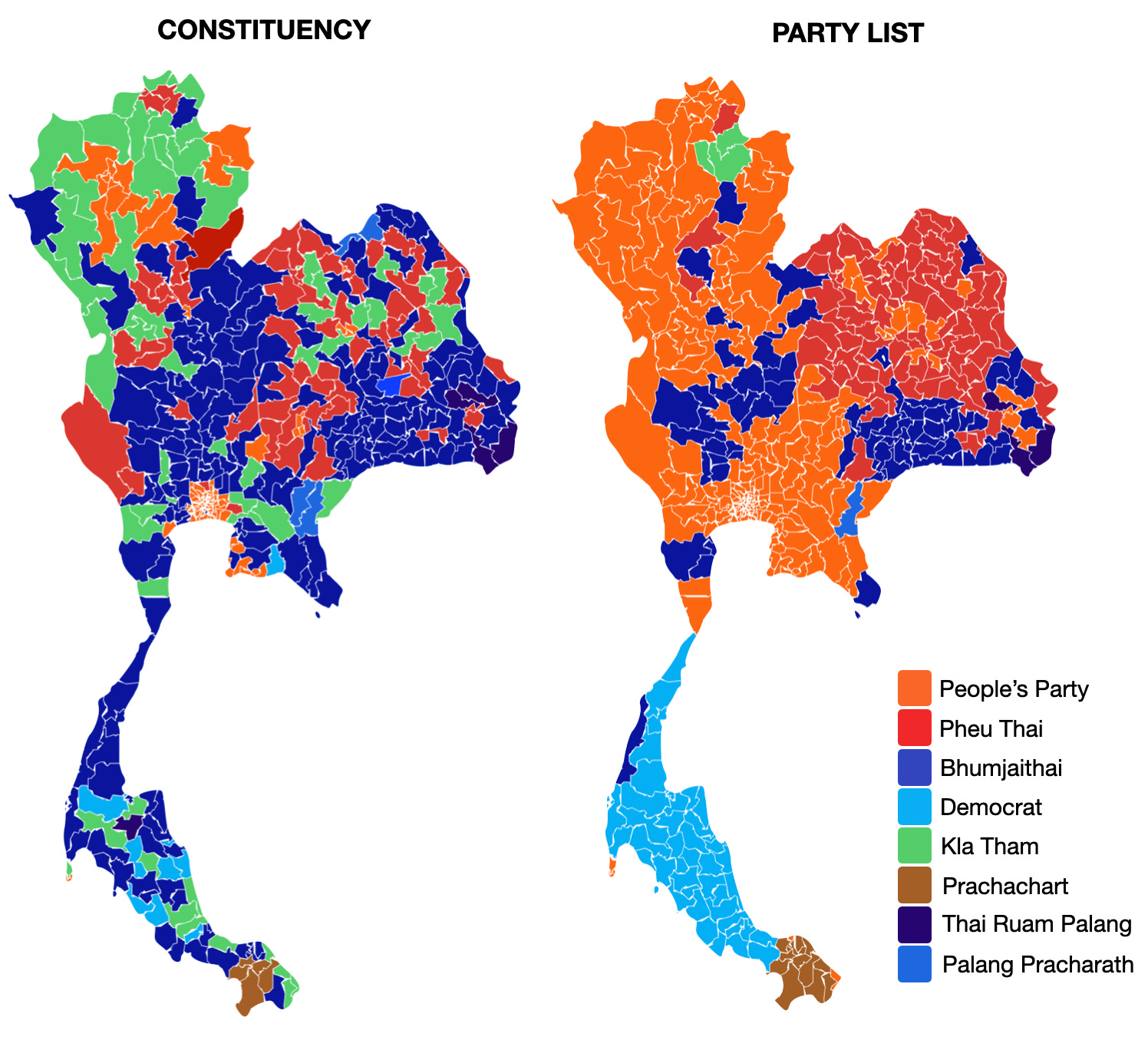
Straight ticket voting in the 2026 general election
At the same time, the 2026 general election complicates our understanding of the party-list ballot with an increased number of straight-ballot results. Some were to be expected: many more provinces that previously voted for Bhumjaithai on the constituency ballot now also returned more votes for the party in the party-list than ever. This aligns with our theoretical expectations: the party became genuinely more popular nationally and had emerged as an ideological choice for a large segment of voters. But there were other instances where parties with little national krasae1 were topping the vote in the proportional system as well.
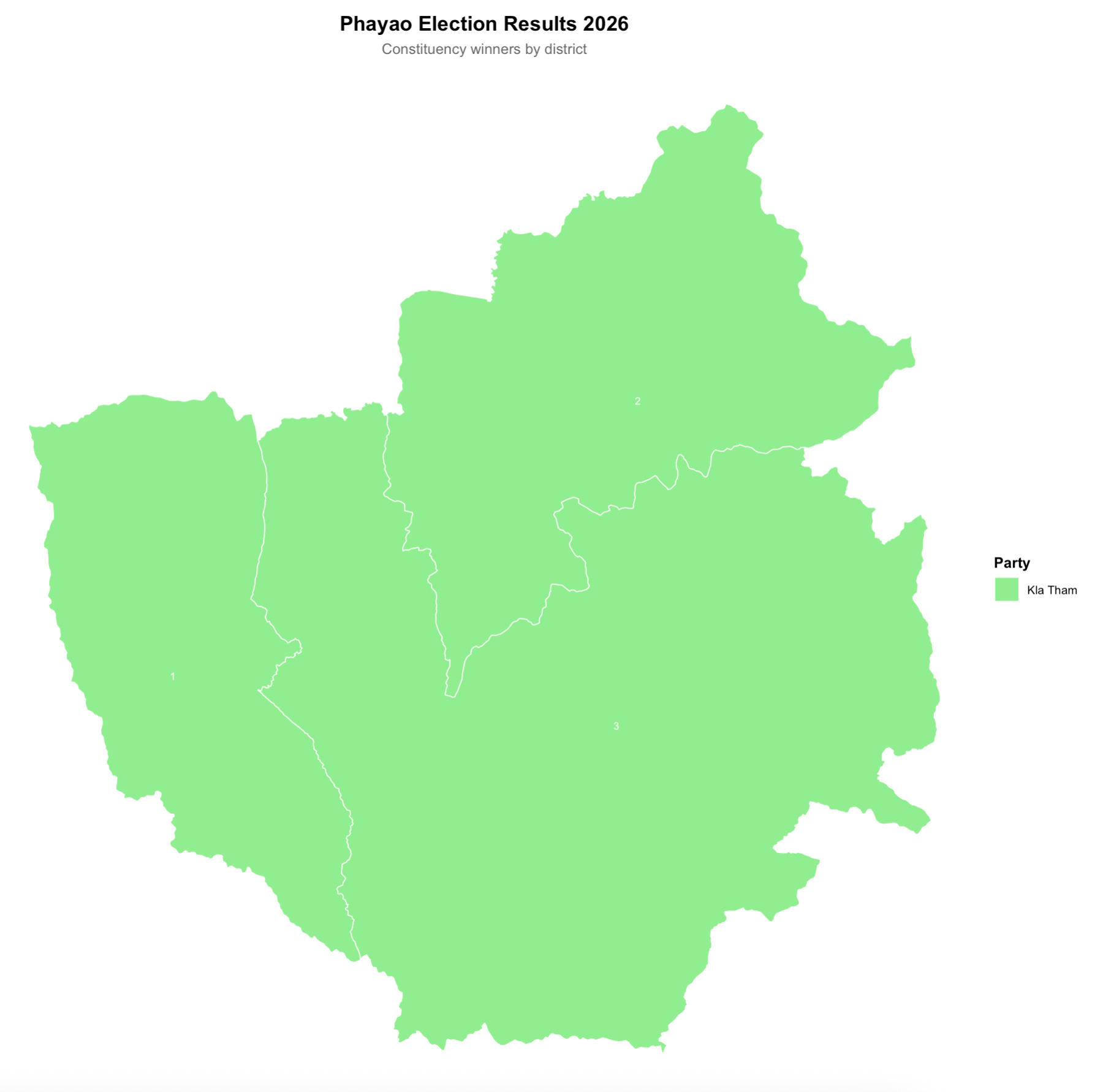
Consider Phayao province. Phayao has long been the homebase of Kla Tham’s prime minister candidate, Thammanat Promphao. In 2023, when Thammanat was still a member of the Palang Pracharath Party, Phayao voted in PPRP MPs in all of its three constituencies, while on the party-list two constituencies favored Pheu Thai and one constituency voted for Move Forward. As we noted earlier, this was a typical result in 2023, and an analyst extrapolating to 2026 would have predicted that Kla Tham would now sweep the province on the constituency ballot but the party-list result would likely return either Pheu Thai or the People’s Party. These expectations would prove completely wrong. Kla Tham swept in both systems, winning all three constituencies and coming in first in the party-list by a wide margin. (Kla Tham won 121,746 votes on the party-list province-wide, while the PP came in a rather distant second place at 71,108 votes).
Phayao is not the only province where this happened. In Ubon Ratchatani, the Thai Ruam Palang Party came first in the party-list vote in a number of constituencies. Meanwhile, Palang Pracharath won the most party-list votes in the constituency seat of its leader, Trinuch Thienthong. Overall, where four parties came in first on the party-list vote in any constituency in 2023, eight parties accomplished this feat in 2026.
Something similar happened in 2011 when Chart Thai Pattana won the party-list vote in three out of five provinces in Suphanburi. The deep south has also favored Prachachart on the party-list two elections in a row. This means that straight-ticket voting for regional parties is not necessarily a new phenomenon. However, both Chart Thai Pattana and Prachachart are somewhat exceptional cases; the former has built a legendary base of support in Suphanburi over decades and even this loosened up in 2023, when Move Forward won the most party-list seats in the province. Meanwhile, Prachachart is popular in the deep south for identity-related reasons that go beyond just local patronage. So the fact that we have the local baan yai2 winning considerable numbers of party-list votes is a rather fascinating result.
What this means
Perhaps we shouldn’t make too much out of the fact that three provinces decided to vote a little differently on the party-list vote compared to the rest of the country. But it does force us to update some of our priors on how voters and parties approach the parallel voting system, which can be important to analyzing future elections.
For one, it was perhaps premature in 2023 to forecast that the baan yai were at risk of being displaced by nationally popular parties. Move Forward winning big on the party-list even in the strongholds of the baan yai was perhaps a sign of the party’s exceptional popularity in 2023 but not to the vulnerability of the local clans themselves: the moment that the progressive forces began declining in popularity, the baan yai were ready to mount a renewed challenge. Urban-local convergence remains a complicated story in Thailand.
Secondly, even locally-driven parties may care more about the party-list than we originally expected. It actually doesn’t make much sense for parties with strong local capacity to spend a lot of resources canvassing for the party-list vote; there are only a hundred party-list MPs, so you would need about one percent of the vote nationally to get even one MP. It’s much more efficient to spend resources on winning constituency seats if a party has the capability. Differing ballot numbers also means that it is quite confusing for parties to give two different numbers for voters to memorize. But perhaps some parties do want at least a modest number of party-list votes, because most party leaders run on the party-list rather than the constituency. Hence a party like Kla Tham may wish to make a big party-list push in its strongest province to make sure that its two core leaders, Thammanat and Narumon Pinyosinwat, would be able to enter parliament.
Third, we still need a better understanding of the circumstances in which a voter would go straight-ticket for a local party. Even though they are outliers, the existence of constituencies where Kla Tham, Palang Pracharath, and Thai Ruam Palang won the party-list vote demonstrates that the generally accepted hypothesis of “constituency races for local matters and party-list for national matters” does not always apply. Is this due to a deep enthusiasm for a local candidate that overrides national concerns? A genuine belief that these parties are also ideological matches? We can guess, but without more data we don’t know for sure.
Two parallel election systems is, to a political scientist with an enthusiasm for electoral politics, a bit like giving Charlie (of Chocolate Factory fame) two Wonka bars instead of one. We get to study basically two elections happening at once! But they do make things more complicated to study, and leave us with a lot more food for thought.
Thai term for the national sentiment, usually contrasted with krasoon (resources to be used in local races).
Thai term for local clans.
An excellent writeup that helped me better understand the relationship between candidate and party-list voting. Your analysis is very interesting.